Thursday, May 13, 2021

Edmund Ingalls Death by Bridge: 52 Ancestors 2021 Bridge

Possibly the First Wrongful Death Claim Against the Government

Edmund Ingalls: 1598-1648

Although I have previously written a blog post about the life of my ninth-great-grandfather Edmund Ingalls back in 2019, the post only briefly mentioned his dramatic death and the events that followed. Edmund was the only person in my tree who died as a result of a defective bridge.

Edmund Ingalls lived in and was one of the original settlers of Lynn, Massachusetts. In early March 1648, Edmund was returning home to Lynn from Boston, and was crossing the Saugus River on a bridge near Lynn. The bridge collapsed beneath Edmund and his horse and both plunged into the river.

1600s map of Lynn, Massachusetts area

I originally assumed Edmund drowned in the river, but apparently he was pulled out, seriously injured. He was able to write his will before dying from his injuries a few days after the accident. Although his birth date has not been verified, he was only around age fifty at the time of his death, and still had minor children at home. This death must have been a shocking blow to his family economically as well as emotionally.

The book The History of Lynn by Lewis and Newhall included a summary of events that occurred in the year 1648, which stated that “on the 23d of March, the Court allowed the town twenty pounds toward repairing the ‘great bridge’ over Saugus river. On the 18th of October thirty shillings were granted annually for the same purpose.” The repairs were obviously necessitated by the collapse that threw Edmund into the river.

Lynn, Massachusetts, 1800s, by John Bachelder

At some point after Edmund’s death, his eldest son Robert Ingalls, then age 27, filed a legal petition with the local courts on behalf of the family seeking compensation for Edmund’s death.

The History of Lynn by Lewis and Newhall includes a transcription of the petition, which reads as follows:

“The humble petition of Robert Ingalls with the rest of his brethren and sisters, being eight in number, humbly sheweth, that whereas your poor petitioners father hath been deprived of life by the insufficiency of Lynne Bridge, so called, to the great impoverishinge of your poore petitioners mother and themselves, and there being a Court order that any person soe dyeing through such insufficiency of any bridge in the countrye, that there should be an hundred pounds forfeit to the next heire, may it therefore please this honorable Court to take your poore petitioners case into consideration.” (page 112)

Further in the history, the outcome of the petition is reported:

“This was granted. It was in conformity with an old British law, established by Howell the Good, King of Wales, by which the value of each person’s life was nominally fixed, and so much money paid, in case of his being killed.” (page 223)

This petition may be the earliest example of a wrongful death suit in colonial America.

Note that the cost of repairing the bridge was one fifth the amount paid to the Ingalls family for his death. This helps to show what a large sum one hundred pounds really was in 1648. Edmund’s tragic and untimely death shows that infrastructure maintenance was as critical in colonial America as it is today, and that governments were just as reluctant then to pay for this maintenance as now.

Sources:

History of Lynn, Essex County, Massachusetts: including Lynnfield, Saugus, Swampscott, and Nahant

by Lewis, Alonzo, 1794-1861; Newhall, James R. (James Robinson), 1809-1893, pgs. 110 and 223,

https://archive.org/details/historyoflynness01lewi/page/110/mode/2up


Incredible summary of sources for life of Edmund Ingalls

https://www.wikitree.com/wiki/Ingalls-52#_note-Burleigh

Burleigh, Charles: The Genealogy and History of the Ingalls Family in America Giving the descendants of Edmund Ingalls who settled in Lynn, Mass, in 1629, Published by Geo. E. Dunbar, Malden, Mass., 1903. https://archive.org/details/genealogyhistory01burl/page/16/mode/2up?view=theater

Some English Material Pertaining to Edmund and Francis Ingalls of Lynn, Mass by John Brooks Threlfall, published in Volume 52 (1976), pages 241-3 of The American Genealogist. New Haven, CT: D. L. Jacobus, 1937-.

https://www.americanancestors.org/databases/american-genealogist-the/image/?volumeId=12344&pageName=241&rId=24157683

Additional English Data on Ingalls by Rosalyn Davenport Gibbs, published in Volume 56 (1979), pages 109-110 of The American Genealogist. New Haven, CT: D. L. Jacobus, 1937-. (Online database. AmericanAncestors.org. New England Historic Genealogical Society, 2009 - .)

https://www.americanancestors.org/databases/american-genealogist-the/image/?volumeId=12605&pageName=110&rId=24379154

Lynn, Mass [art original] : west view from near High Rock Subject: Highs Rock Cottage and High Rock are depicted in a circular vignette beneath the image. John Bachelder, painter. Out of copyright.

Bachelder, John B. (John Badger), 1825-1894Endicott & Co. (New York, N.Y.)

Wednesday, May 5, 2021

At Home in Hanska: 52 Ancestors 2021 Prompt “Cousin Bait”

 Learning About Ancestors from My Hometown’s Facebook Group


            About a year and half ago, an old high school classmate from my hometown invited me to join a Facebook Group called “At Home in Hanska”. I joined out of curiosity, and I am so happy I did.

            Hanska is my hometown. It is a small Norwegian community located in Brown County, Minnesota. The current population is around 400—it has always been home to only a few hundred people, with a large number of additional families scattered on farms that surround the town.

            I’m not sure who set up the Facebook group in the first place. Here is the “About” description of the group:

“Welcome to "At Home in Hanska"! A group created for anyone who grew up in; lives in; has lived in; or wants to live in HANSKA! If none of these apply, you're still welcome here! Please invite anyone who might be interested in joining this group. The more the merrier! Anything goes: memories, announcements, questions, photos, etc.”


            In practice, a lot of members have taken to posting 19th and early 20th century photos of their ancestors from the community. They seek to share them with any cousins who might be members would appreciate seeing them. Sometimes they ask for help identifying the people and location in the photos.


An example of a typical post--but one without people to protect others' privacy...

            I have learned so much from the comments the photos generate—people generously share information about family relationships, areas of Norway that families immigrated from, original homesteads that those families settled on when they arrived in Minnesota, and more. I have shared a few photos myself, and got appreciative comments from several cousins who are also members.

            One of my most exciting recent discoveries was a photo of my dad’s oldest sister, Anna Peterson, who died before he was even born. This church confirmation photo from 1910 was the earliest photo of her I’d ever seen—all other photos show her at age 16, just a year before her death.


            So this wonderful little Facebook Group has truly served as “cousin bait”—it lured me in, and connected me with family members I haven’t seen in person for years, and helped me identify more distant cousins and understand how we are related. I really enjoy visiting the page to see what new treasures have been posted.

Wednesday, April 7, 2021

Lubberland Creek Preserve and the World of Joseph Chesley: 52 Ancestors 2021 Prompt “Preservation”


Lubberland Creek Preserve: A Nature Conservancy Property That Gives a Glimpse into the World of Joseph Chesley

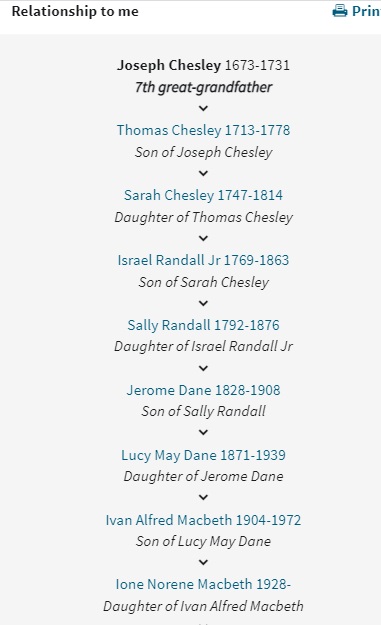
Joseph Chesley: 1673-1731

            My seventh great-grandfather Joseph Chesley had extensive land holdings in New Hampshire in the early 18th century. These holdings included some marshlands along the Great Bay, and two small islands known as Chesley’s Islands. Today, the Nature Conservancy apparently owns some of that land. The property is called the Lubberland Creek Preserve and is near the New Hampshire city of Newmarket.


            The land my ancestor owned, including the islands, were originally owned by Richard York, who conveyed it to his son John York in 1676. The tract was described as follows:

“all that tract or point of land lying and being in Lubberland, bounded by the Great Bay on the Southeast side, by the lands of Nicholas Doe on the North West side, by the lands of the said John York on the North east side, and by the creek called Goddards Creek on the South west side…with a parcel of marsh on the South side and two little Islands containing by estimation six acres be it more or less.”

            John York sold the property to Roger Rose in 1680. Rose sold it to John Rawlins of Newbury, and Rawlins sold it to Joseph Chesley’s brother-in-law, John Smith, in July 1705. Improvements had been made to the property by this point, which was now described as “a tract of land and salt marsh, houses, fields and orchards scituate, lying and being in Lubberland.”


The land then went to a neighbor, Nicholas Doe, and his son Sampson sold the land and islands to Joseph Chesley on March 27, 1707. According to the History of the Town of Durham cited below, Joseph Chesley “is said to have had a garrison house here and the islands were called Chesley’s Islands.”

A list of Piscataqua area historic place names prepared by the Piscataqua Pioneers (cited below) provides additional information about the locations of Lubberland, Goddard’s Creek, and Chesley’s Islands. The descriptions below come from the Piscataqua Pioneers’ list:

Lubberland: District on upper shore of Great Bay. Except for Goddard’s neck (in Newmarket) the area was early part of Oyster River District of Dover. Since 1870 mostly in Newmarket.

Chesley’s Islands. Two small islands in Great Bay off Lubberland Shore of Newmarket. Joseph Chesley Garrison was near here. Later known as Channel’s Islands.

Goddard’s Creek (Lubberland Creek). John Goddard, one of Mason’s carpenters of 1634 settled on theneck between the Creek and the mouth of Lamprey River. Goddard’s Creek until 1870 was a boundbetween Newmarket and Durham, the neck being part of Newmarket. In 1870 a large adjacent slice ofLubberland (Smith lands) was annexed to Newmarket.

            So what has happened to Joseph Chesley’s land? Amazingly, we can still visit this property, which has been lovingly preserved and restored by the Nature Conservancy and is known as the Lubberland Creek Preserve. So how do we know this is Chesley’s former property? First, the preserve is located along Lubberland Creek, which, as we learned above, used to be called Goddard’s Creek, which was the border of Chesley’s property.


            Secondly, the Preserve’s brochure notes that the “Davis-Smith Garrison, which was built somewhere on the present-day preserve, is remembered by a nearby stone marker on Bay Road.” This may be the garrison mentioned in the Durham History property description, which was called Chesley’s Garrison while he owned the property. If not, the Chesley garrison was near Davis-Smith’s, as both were mentioned in the same passage of the Durham History.


            Lastly, the Preserve brochure states that “Robert Channell purchased this land around 1817 and passed it down through generations of the Channell family.” Chesley’s Islands were renamed Channell’s Islands, presumably when the property changed hands. We can assume the Channell family question was the Robert Channell family.

            The preserve is described as a “mosaic of estuarine, grassland, forest, and freshwater wetland habitats, as well as relics of its agricultural past.” There are miles of hiking paths through the various habitats. The restored marshes and estuaries are close to the way the land would have appeared in Joseph Chesley’s time. Someday I hope to visit the Preserve and look out over the same landscape that my seventh-great-grandfather would have gazed upon.  


Sources:

http://www.piscataquapioneers.org/pdf/piscataqua-area-place-names-and-history.pdf

 Stackpole, Everett Schermerhorn,. History of the town of Durham, New Hampshire (Oyster River Plantation) : with genealogical notes. Durham, N.H.: Published by vote of the town, 1913. Pg. 33-34. Accessed through Ancestry.  https://www.ancestry.com/imageviewer/collections/24139/images/dvm_LocHist009223-00025-0?pId=40

 https://www.nature.org/content/dam/tnc/nature/en/documents/lubberland-creek-brochureweb.pdf

 List of garrisons. http://www.ancestoryarchives.com/2013/09/1713-treaty-of-portsmouth.html

Sunday, February 28, 2021

Chipping Away at a Brick Wall: 52 Ancestors 2021 Prompt “Brick Wall”

Catharine Bolinger Funk: 1837-1871

Discovering a Tragic Early Marriage Helps to Chip Away at a Brick Wall


            For many years, my maternal second great-grandmother Catharine Funk was a brick wall in my family tree. I had few records for either Catherine or her husband, Charles Funk, and few clues to help me find out where these two people had come from. I had no birth record for Catharine, and no death record. She just mysteriously disappeared from the records after 1870, along with her three oldest children. I found no burial records for any of them. So who was Catharine? And what happened to her?

            My first real clue came from a research trip to the Blue Earth County Historical Society—the last records for Catharine found her living on a farm outside Mankato, Minnesota, the county seat of Blue Earth County. While searching old newspaper records at the Historical Society for any Funk family members, I found the obituary for Catharine’s second son, Charles Funk. The obituary gave me two critical pieces of information:

1.         The obituary stated, “His mother died when he was six years old.” Since Charles was born on February 6, 1865, that meant his mother likely died in 1871.

2.         The obituary stated that he was survived by one sister, Mrs. William Hoffman of Mankato (my great-grandmother) “and one half-sister, Mrs. Mary Gaffney of Redwood Falls.” This was the first hint that my second great-grandfather, Charles Funk, was not the father of all six of Catharine’s children. On census records, the three oldest children were just listed by first name, so were assumed by census transcribers to share the Funk surname. Perhaps Mary and her older siblings William and Sophia went by a different surname, which would explain why I had been unable to find any trace of them after 1870.


So my first job was to find out Mary Gaffney’s maiden name, which would tell me what Catharine’s previous husband’s name had been. I quickly found her marriage record: George Gaffney married Mary L. Grentz on January 14, 1879.

        I immediately sought marriage records for a Catharine Grentz and anyone with a surname of Funk, in Iowa, since Mary Grentz Gaffney was born in Iowa. Bingo! The Iowa Select Marriages Index listed a C. N. Funk marrying Catharine Grentz on November 21, 1863 in Mahaska County, Iowa.

I also found an 1860 census record that included Catharine and her two oldest children, William and Sophia, along with her husband Louis Grentz. Louis was listed as a brewer, and the family was living in the city of Oskaloosa, located in Mahaska County, Iowa. Louis was born in Darmstadt, Germany, and Catharine was born in Ohio.

I could find no records of Louis and Catharine’s marriage in Iowa, so I tried Ohio. I found a Lewis Grantz marrying Catharine Bollinger in Delaware County, Ohio on May 11, 1856. At long last I had a maiden name for Catharine! She was a Bollinger!

Marriage record for Lewis Grantz and Catharine Bollinger


I found Catharine’s parents and siblings on the 1850 federal census, living in the town of Delaware in Delaware County, Ohio. Jacob and Catharine Bolinger (with only one “L”) had five children at the time, Catharine being the oldest daughter. The couple went on to have three more children, so Catharine was the second oldest of their eight children. Two of Catherine’s children were named for her siblings William Bolinger and Mary Bolinger Ryan.

Many of the bricks in my Catherine Funk brick wall had been removed: I had a tentative death date and I had found her parents. But there was still a mystery: what happened to Catharine’s first husband, Lewis/Louis Grentz/Grantz? He was living with the family in 1860, but by 1863, Catharine was free to marry Charles Funk. What happened in those three intervening years?

A search of Newspapers.com provided the tragic answer. According to the Oskaloosa Herald, Lewis Grentz was in business with a friend, running a brewery in Oskaloosa called Blatner and Grantz.  (Note: the newspaper spelled both surnames incorrectly. Grantz should be Grentz, and Blatner should be Blattner.) He apparently suffered from mental illness and committed suicide on November 2, 1861, “first gashing himself in the stomach with a butcher knife and then drowning himself in the Muchikinock.” The Muchikinock was a creek that ran through Oskaloosa. Now it is more marsh than creek; drowning would be nearly impossible. However, in late fall of 1861, the Muchikinock was probably a much larger, faster- moving body of water.


The article went on to note that Lewis “had been unwell for a week, some of the time deranged, but it was not known that he contemplated suicide.” In those days, there really wasn’t any appropriate treatment for mental illness other than committing the patient to an asylum. Poor Catharine! She must have been so desperate when her husband suffered some sort of mental breakdown. She would have had few options for helping him.

And then to be left a widow in her twenties with three small children, which would be difficult enough without the added shame that accompanied suicide in the nineteenth century.  Hopefully Lewis’ partner, C. Blattner, helped her with money. The brewery survived for several more years with a new partner, David Newbrand, so must have been a successful business.


Lewis Grentz' partner, Blattner, made a success of the brewery with a new partner. 1870s.


Charles Nicolas Funk was living in Oskaloosa when Lewis Grentz died, working as a cabinetmaker. He was considerably older than Catherine—possibly by sixteen to twenty years (his birth year on census records was usually 1821 or 1822, but his headstone lists a birthdate of May 12, 1817). However, with three children coupled with the shame of Lewis’ suicide, Catharine probably had few other suitors. She needed stability and security; I hope she found love as well.

1860 Federal Census for Oskaloosa IA showing Charles Nicolas Funk 


Shortly after their marriage, Charles and Catharine relocated to a farm near Mankato, Minnesota, and Charles became a farmer, eventually abandoning his cabinetmaking business. The couple had three children together, including my great-grandmother Lena Funk, Amelia Funk and Charles Funk.

It took me a couple years to chip away at the Catharine Funk “brick wall”, but thanks to two newspaper obituary items—Catherine’s son Charles Funk’s, and her first husband Lewis Grentz’s--I was able to discover Catharine’s parentage and her fate. I also discovered how difficult and tragic her life had been as a young mother in the 1860s. I hope that further research will give me insight into the lives of her parents, her siblings, and the fate of her two oldest children.

Sources:

Marriage and census records from Ancestry.com.

Newspaper articles from Newspaper.com

Tuesday, February 16, 2021

Frank and Jessie Thisse and Silver Mining in Death Valley: 52 Ancestors 2021 Prompt “Fortune”

Digging for a Fortune: Silver Mining in the Early Twentieth Century Death Valley Region

Frank George Thisse: 1856-1950
Jessie Day Thisse: 1866-1929


            Several of my ancestors have sought their fortunes by mining for precious metals. My second cousin three times removed, Jessie Day Thisse, and her husband Frank George Thisse probably came closest to making a fortune, searching for veins of silver ore in the Death Valley region of California. While they aren’t closely related to me, I wanted to write about their experiences as they illuminate an interesting period of American and California history.

            Jessie Day was born in Ogdenburg New York on March 25, 1866. Following her mother’s death in 1892, she moved west to California, joining her brother, Eugene Day. Eugene was already involved in mining by that time, living in the Tuolumne area of California.

            Frank Thisse was born in Springfield, Illinois on March 26, 1856, and moved west in the 1880s. He first worked as a chef for the railroads, initially in Sacramento, and then at Humboldt House, a rest stop on the Central Pacific Railroad about thirty miles north of Lovelock, Nevada. He reported that he was told to give the passengers “45 or 50 cents’ worth of grub for their dollar”. Many of those passengers were probably prospectors hoping to hit it rich, and at some point, Thisse decided to follow them to the gold and silver fields.

He headed west to Tuolumne County, California, where he must have become acquainted with Eugene and Jessie Day. I have been unable to find Frank and Jessie’s marriage record, but they appear to have been married a year or so prior to 1900. The couple invested in mining property with Eugene Day, including the John Royal Quartz Mine near Columbia, California. Thisse also owned a placer mining property in Experimental Gulch near Columbia, selling it in August of 1906.  


Frank and Jessie sold more property in June 1906, including the Los Angeleno quartz mine, the Baxter claim, the Marble and Monday Morning quartz claims, and their share of Eugene’s ranch. They seem to have decided to abandon the search for gold and move further south where silver ore was being uncovered near Death Valley.

            Death Valley had always been at the fringe of the mining industry’s boom and bust fevers in California. The harsh desert conditions and lack of roads made mining financially impractical for all but the most mineral-rich ore. But around the turn of the twentieth century, as gold and silver prices rose, there was renewed interest in exploring the area. Big silver finds around Skidoo and Rhyolite led to the growth of boom towns and a flood of men searching for a find that would make their fortune.

            Frank and Jessie settled in Skidoo, becoming valuable members of the community. By 1908, Frank was Judge Thisse--he was not a lawyer or a regular court judge. He was serving as a Justice of the Peace. However, in remote areas like Skidoo, justices basically performed the duties of actual judges, as an article that discusses a 1908 murder case in Skidoo demonstrates. Frank was out prospecting, and had to be recalled to town to preside over the murder trial, and also examine the body since he also served as the county coroner for Inyo County.


            Later that year, while traveling through the desert near Wild Rose in the Panamint Mountains, Frank apparently came across a vein of silver ore in the Nemo Canyon area of what is now Death Valley National Park. 


Nemo Canyon floor--shows how rugged area was when Frank was prospecting there...


            The National Park Service compiled a history of mining in Death Valley National Park, and they had a section on Thisse and the Nemo Mine:

 “Mining activity in the Nemo Canyon area was contemporary with mineral development at Skidoo and Harrisburg. The only claims in this area of which specific mention was found are the Eureka Nos. 1, 2, and 3, located 10 April 1908 by Judge Frank G. Thisse of Skidoo and situated in Nemo Canyon about 1,500 feet east of the Skidoo pipeline. [78] Judge Thisse returned to Skidoo in April 1908 to have samples of his ore assayed; the results were so encouraging that a small rush ensued to the discovery site. James Arnold, general manager of the Skidoo Trading Company, was in partnership with Thisse, and proceeded with a wagonload of supplies to the area with intentions of setting up a camp. Because of its proximity to the pipeline and its location within one-half mile of the wagon road, it was assumed that the mine would be easy and cheap to work and profitable to develop. With visions of the birth of a new bonanza camp, many people descended on the area within a short time from Harrisburg and other surrounding communities. The extent of development activity at other mines in the canyon is unknown, although there were notices of more strikes in the ensuing months. [79]

Frank Thisse's original find evidently later became known as the Nemo Mine and was referred to in August 1908 as a profitable gold- and silver-producing venture whose silver samples were assaying over 2,000 ozs. of silver and 1 oz. of gold per ton. Although still owned by Thisse and associates of Skidoo, the property was under lease to S.E. Ball and partners (later connected with the Tucki Mine) who were extracting and shipping ore averaging around $300 per ton. [80] Another large strike was reported in Nemo Canyon during the winter of 1908, with assays yielding over $200 in gold and 86 ozs. of silver per ton. The area was at this time evidently judged to have some promising production potential, because word was soon being spread by none other than Shorty Harris that a ten-stamp mill was to be erected. [81]”


Shaft at Nemo Mine 1 with Pinyon Pine logs--National Park Service photo by William Tweed


            It is unclear how long Frank and Jessie continued to prospect and buy and sell mining claims. In the 1910 census, Frank lists his occupation as “prospector”. The mines were still producing valuable ore in February of 1911, as a news article reports the Thisse and Forg ore “sampled at $450 per ton” and Mason & Thisse also sold some ore at $3.50 a pound.

At some point, Frank and Jessie sold off their Nemo Canyon mines, including the Christmas Gift mine property pictured below. 


Ruin of cabin at Christmas Tree mine once owned by Frank Thisse


Open stope at Christmas Gift mine--photo by William Tweed, NPS


By 1920, the couple had relocated to Lovelock, Nevada, where Frank was working as a salesman for a local store. He had other business interests, as he and Jessie would occasionally travel to San Francisco to handle. By the 1930 census, he was widowed and was working as a manager for a honey company in Lovelock. He died in 1950 at age 93, and is buried in Lovelock with Jessie.


While the Nemo Canyon mines paid off for Frank and Jessie, it is unlikely that they managed to amass a fortune. After all, by 1930 Frank was in his seventies and yet still held a full time job—hardly the choice of a wealthy man. The Thisses probably discovered, like so many Gold Rush prospectors had discovered decades earlier, that only a rare few prospectors ever truly struck it rich.


Sources:

https://zh.mindat.org/loc-258716.html

Nemo Mine (Eureka Nos. 1; 2 & 3 claims), Wildrose District (Wild Rose District), Panamint Mts (Panamint Range), Inyo Co., California, USA

https://www.nps.gov/parkhistory/online_books/deva/section3b2e.htm

Death Valley Historic Resource Study: A History of Mining. Inventory of Historical Resources the West Side, Wild Rose Mining District, Christmas Gift Mine. Photos of Christmas Gift mine shaft stope by William Tweed, 1975.

http://dvexplore.blogspot.com/2014/06/nemo-canyon-and-christmas-gift-mine.html

https://www.newspapers.com/clip/70966601/los-angeles-herald/

https://www.newspapers.com/clip/71210702/thisse-ore-gets-high-prices-feb-5-1911/

https://www.deathvalley.com/index.php/stories/death-valley-gold/93-by-david-wright?showall=&start=6

https://archive.org/stream/Desert-Magazine-1958-04/Desert-Magazine-1958-04_djvu.txt

Evalyn Gist, "Skidoo — Ghost Camp in the Lonely Panamints, April 1958 edition of Desert Magazine

Roster: California State, County, City and Township Officials, State Officials of the United States,

Secretary of State., 1913 – California, pg. 38, Inyo County

Sunday, February 14, 2021

Ursulas and Chapples: 52 Ancestors 2021 Prompt “Name’s the Same”

Five Ursulas and the Chapel’s Chapple: The Name’s the Same

Ursula Chapple: 1720-1798
Ursula How: 1761-1836
Ursula Herniman: 1796-1797
Ursula Herniman: 1801-1879
Ursula Herniman Berryman: 1828-1889
Jonathan Chapple: 1690-?


            Names from centuries ago occasionally intrigue me, often because they have fallen out of favor and I am surprised at how popular they used to be. Ursula is one of those names that always catches my eye, especially after it was used as the villainess’ name in The Little Mermaid. Now when I see the name Ursula, I immediately associate it with a large purple octopus/woman. So discovering four generations of Ursulas in my family tree amused me, as did my discovery regarding Ursula Chapple’s father.


            Ursula Chapple, my fifth great-grandmother, was born in West Bagborough, Somerset, England in 1720. Her parents were Jonathan and Ann Chapple. I have found no record of her actual birth date, but her baptism took place on October 12, 1720. This record, below, shown below, reads: “Ursula, ye daughter of Jonathan Chapple, minister, and Ann his wife, was baptized October 12 1720.”


            I was interested in the word “minister” following my sixth-great-grandfather Chapple’s name. I reviewed the other baptism records on the page, and no other father had such a notation after his name. In present times, minister is a title for a church leader—a pastor. Was it used in the same way in 1720? According to a glossary of religious terms used in the Anglican Church in the 17th century, a minister was a “person having responsibility for leading or co-ordinating preaching, public worship and pastoral care; often used as a general term for a clergyman such as a rector, vicar or curate.” (source below) So it appears that Jonathan Chapple was aptly named: he held some sort of religious job in his local parish—a Chapple in the chapel!

            To return to the Ursulas, Ursula Chapple married William How in Taunton, Somerset, on November 9, 1746. They had several children, including a daughter named Ursula How. She was born January 25, 1761. On November 21, 1786, Ursula How married Robert Herniman in the neighboring town of Lydeard St. Lawrence, Somerset. They settled in Crowcombe, and had several children, including my ancestor James How Herniman.


They also had two daughters named Ursula. The first Ursula Herniman was born in 1796, and died a year later. Her burial record is below. 


Between two and four years later, the Hernimans had another daughter they named Ursula in honor of her mother, grandmother and lost sister. This Ursula was baptized along with her sister Ann on December 20, 1801. One might assume the girls were twins but for the rector’s note that “Ursula private baptize Nov. 16. 99”. This would indicate that Ursula was born in the fall of 1799, was baptized at home, and was publicly re-baptized with her new sister Ann two years later in 1801.


Ursula Herniman married Henry Butland on June 3, 1822. The young couple moved to Clerenwell in Middlesex, England and had several children. One of their daughters, Matilda, had the middle name Ursula, but that was the last generation of Ursulas in the family line. Ursula Herniman Butland died in 1879 at the age of eighty.


Ursula Herniman’s sister Sarah named one of her daughters Ursula, thus continuing the tradition for a fourth generation. Ursula Herniman Berryman was born to John Berryman and Sarah Herniman Berryman in 1828. She married William Coniber or Conibeare, and they had several children, but no other Ursulas. Ursula Berryman Conibeare died in 1879.


So for over a century, my family tree had a succession of women named Ursula. Perhaps by the mid-nineteenth century, the name had fallen out of fashion. Whatever the reason, after those four generations of Ursulas, the name never re-appears among my ancestors.


Sources:

https://www.nottingham.ac.uk/manuscriptsandspecialcollections/collectionsindepth/archdeaconry/glossary.aspx


Friday, February 5, 2021

Multiple Sisters Marry Same Man: 52 Ancestors 2021 Prompt "Multiple"

 Multiple Sisters, Multiple Marriages:

Charles Foster Slayton: 1854-1919

Mary Douglass 1859-1881

Clarissa "Clara" Douglass 1847-1919

Jennie Douglass 1869-1942

I am not directly related to Charles Foster Slayton, but he serially married three of my distant cousins, all sisters. Multiple sisters, multiple wives, multiple disasters. The mind boggles.

Charles Foster Slayton was born in 1854 to Edson Slayton in the Stowe, Vermont area. When he was 20 years old, he married 15-year-old Mary Douglass, my second cousin three times removed. The poor hapless Mary had three children before she turned 21 in 1881. A year later she was dead, leaving Charles a 27 year old widower with two children under six years of age--one child had died of spinal meningitis.


He turned to his sister-in-law for help and comfort. Mary had a sister who was twelve years her senior named Clarissa or Clara Douglass. She’d moved away when Mary was very young, first working as a servant and then marrying an older farmer named Othniel Darling. It’s unclear if Mr. Darling had died in the earlier 1880s, or if Clara had divorced him, but by 1883, she had married Charles Slayton, despite being seven years older than him.


Clara Douglass Slayton


The marriage didn’t last, however. By 1899, the 52-year-old Clara had divorced Charles and married a 57-year-old farmer named Jackson Sargent. This, her third marriage, lasted for the remainder of her life. She had no children with any of her husbands.


Charles played a little fast-and-loose on the 1900 census. He told the census taker he was married, and had been for 24 years (the length of time since the date of his first marriage, but hardly a continuous period of marriage). The census also showed that he had another sister-in-law, the divorced or widowed Jennie Douglass Bundy, living in his home with her three children, acting as his housekeeper. Apparently they got a little closer than employer/employee, for within a year, they were married.  Jennie was even younger than Mary. On August 10, 1901, the date of their marriage, she was 33, and Charles was 47.


Charles and Jennie had one child together, Charles Stanley Slayton, born in 1907. However, the marriage unraveled shortly afterward. By the 1910 census, the divorced Jennie was working as a housekeeper in Stowe. Charles and 3-year-old Stanley were living on his farm. He told the census-taker that he was a widower, even though he had his 20-year-old stepdaughter Julia, his ex-wife’s child by her previous husband, Mr. Bundy, working as his housekeeper, along with her much older husband John Frank Burnham, and their infant daughter Hazel.


Jennie Douglass Slayton


Something serious must have happened in the next few years to shatter this family. Julia apparently either divorced John F. Burnham or he died, for by 1914 she had married a farm laborer named Carroll G. Brown. By 1920, young C. Stanley Slayton was living with his mother, boarding where she worked as a housekeeper.

Charles Foster Slayton had a worse fate. According to his death certificate, he died at age 65 on June 24, 1919 at the Vermont State Hospital. The certificate notes he had been committed to the mental institution on April 15, 1912. The cause of death was acute peritonitis brought about by a fight three days earlier with another patient/inmate that left him with abdominal injuries. The secondary cause of death was his mental illness, listed as paranoia.


Death Certificate for Charles Slayton


The mental illness may explain his inability to keep a wife. Perhaps Jennie and Clara divorced him when they couldn’t deal with his mental state anymore. The bigger question is why did they marry him in the first place? Surely the sisters talked to each other. Living in the same area, they must have witnessed his “paranoia”, or at least heard gossip from family and friends. There can only be one explanation: he must have been incredibly charming when he was lucid, and possibly very attractive as well.