Saturday, October 16, 2021

Triplets Birth Day Turns from Joy to Tragedy: 52 Ancestors 2021 Prompt “Birthdays”

An Amazing Birth Day Ends in Grief

Elaine Trosdahl: April 11, 1929-April 11, 1929
Orrin Reeves Trosdahl: April 11, 1929-April 11, 1929
Mary Trosdahl: April 11, 1929-April 11, 1929


My preliminary research on my first cousin once removed, Nels Alford Trosdahl, and his wife Lola Conway turned up five children, all daughters, born between 1906 and 1917. I assumed the couple had no other children; later census records listed only the five daughters. However, while searching for Nels’ obituary on Newspapers.com, I turned up an amazing article that revealed Nels and Lola had, for one brief day, three more children, including their only son. This discovery is an example of how birthdays can sometimes be days of sorrow rather than celebration.

Minneapolis Star Tribune, April 13, 1929

Nels Trosdahl was the child of my greataunt Marit Peterson Joramo and her husband Johan Trosdahl. Nels was the fourth of their eleven children, and the oldest of their four sons. Nels was born February 10, 1883, in Lake Hanska Township in Brown County, Minnesota. At some point after Nels’ seventeenth birthday in 1900, the entire family moved from Lake Hanska in southern Minnesota to Otter Tail County, 200 miles to the northwest.  

Nels met a young girl from the area, Lola Conway, and on December 29, 1905, the couple married. Nels was 22 years old. Lola was a child of 14, already several months pregnant with their first child. Myrtle was born May 7, 1906, three months after Lola’s fifteenth birthday. Four more daughters followed, every two or three years, until daughter Doris’ birth in 1917.

In general, women from this time period have about a twenty year period of fertility at most. However, twenty-four years after giving birth to her first child, Lola delivered fraternal triplets, two daughters and a son. The triplets’ youngest sibling was twelve; their oldest was grown up and married.

The newspaper article noted that the triplets were the first ever born in Battle Creek. This was a time before fertility drugs, so triplets were quite rare. Of course, this was also before the advent of neonatologists and NICUs. The triplets were probably very small and possibly premature. It is doubtful a rural Minnesota hospital even had incubators for infants in 1929. The triplets really didn’t have any chance of survival.

The babies’ birth day was the sole day of their lives. A day of joy and anticipation for the parents turned into a day of mourning. Fortunately, Lola survived the birth despite the high maternal mortality rates of the era.

Little Mary, Orrin Reeves and Elaine Trosdahl were buried together at Nidaros Lutheran Cemetery, their grave marked by a single stone.


The loss of the triplets seems to have placed a strain on Nels and Lola’s marriage. Their youngest child, Doris, married young like her mother, and was only 16 when she moved out in November, 1932. Lola and Nels separated at some point following Doris’ marriage. By 1938, Lola was living on her own in Moorhead, Minnesota.

By the time of the 1940 census, Lola and Nels had lost another child—their daughter Doris. Following Doris’ early marriage to Selmer Baldwin, the couple had two children, David Sylvester, born April 15, 1936 when Doris was 19, and daughter Alphilde Marie, born September 28, 1937 when Doris was 21. Yet just two years later, Doris was dead at age 23. It is unclear if she died giving birth to a third child, or if she contracted an illness that proved fatal.


Whatever the cause of Doris’ death, Lola Trosdahl stepped up to care for her little grandchildren. She ended up moving in with Doris’ inlaws who had custody of the two motherless toddlers. The 1940 census finds her living as a “lodger” with John and Mae Baldwin, Selmer’s parents, and several of their children, as well as David and Alphilde. Lola’s occupation is listed as “caretaker” of “grandchildren”, with her job categorized as “unpaid family worker”.  Selmer is not living with the family; he appears on a WWII draft registration in Grand Forks, North Dakota, where he was living alone, unemployed.

Meanwhile, Nels Trosdahl appears on an April 1942 draft card, living in Detroit Lakes on the property of a Mrs. Clara Hawkins, who he lists as his employer. I was unable to find him on the 1940 census. I have found no further records on his occupation or residence thereafter.

Lola died March 25, 1947 in Fergus Falls, Minnesota at age 55, far too young. Nels died June 12, 1958 in Mahnomen, Minnesota. He was 75.

Without my discovery of the tiny five-line story about the triplets in the Minneapolis Star Tribune, I would never have known about Mary, Orrin Reeves or Elaine and their April 11 birthday in 1929. The usual searches under their parents’ names on Ancestry and Family Search did not pull up their birth and death records. Like so many babies who died shortly after birth, their brief lives were quickly forgotten, as was the joy and sorrow their parents experienced. These lost babies’ birthdays are so much more than the day of their birth—they mark the entirety of their brief lives.

Saturday, September 25, 2021

Shock to See Cousins Still in Touch: 52 Ancestors 2021 Prompt “Shock”

Paul Peterson’s Children Still in Touch with Marit Peterson Trosdahl’s Children in the 1960s: How Did My Generation Lose Touch?

Joseph M Trosdahl: 1886-1968
Minnie Paulson Trosdahl: 1891-1961
Randy Peterson: 1899-1965
Thelma Peterson Hansen: 1915-1965


Most of my generation of Paul Peterson’s descendants aren’t even aware that Paul had two sisters, both of whom had large families. Marit Peterson Joramo Trosdahl and her family moved to northern Minnesota some time before 1910. Julia Peterson Joramo Severson moved to South Dakota with her husband and children a good decade earlier. Both families mostly fell out of touch with Paul’s side, until their very existence was no longer part of the oral family history. Many of my cousins think that Paul had only one sibling, a brother, Jacob Joramo.

After I discovered the existence of Marit and her descendants a couple years ago, I had assumed that Marit and Paul’s families had lost touch soon after Marit and her husband Johan Trosdahl moved to Nidaros Township in Otter Tail County. Paul Peterson and brother Jacob Joramo had stayed in southern Minnesota, farming in Lake Hanska Township in Brown County about 200 miles from the Trosdahls. However, this assumption was shattered when I ran across an obituary from 1961.


Marit and Johan Trosdahl had ten children. The sixth of their children was son Joseph Mangnus Trosdahl, born October 4, 1886 in Linden Township, just a couple miles from Paul Peterson’s farm. Joseph was in his teens when the family relocated to northern Minnesota. He took up farming, and married a local girl named Minnie Paulson.

Minnie died December 31, 1960, and her funeral was held at the Nidaros Lutheran Church on January 5, 1961. The Fergus Fall Daily Journal had a nice funeral write up, with more detail than typical. It included a list of family and friends who had traveled a long distance to the funeral. Among this list were two very familiar names, Randy Peterson and Mrs. Leo Hanson of Minneapolis. Randine and Thelma were my dad’s older sisters. They had driven 172 miles in the middle of a harsh Minnesota winter to attend the funeral of their first cousin’s wife—an extraordinary effort in that time considering the quality of cars and the condition of the roads. They must have felt close to Joseph and his siblings, people my dad didn’t even remember (probably because they moved away about 15 years before he was born).

Nidaros Lutheran Church

Sadly, Thelma and Randine both died just four years later in 1965, and Joseph Trosdahl died in 1968. Trosdahls still live in Nidaros Township, as can be seen on the plat map below--they are likely cousins.


While it was a shock to realize that the two families maintained communication and connection for many years longer than I had originally assumed, it was also very comforting. I’m glad family ties survived the miles through at least one generation. Perhaps a new generation can re-establish the connection. 

Tuesday, September 7, 2021

Family Vintage Toys: 52 Ancestors 2021 Prompt “Fun and Games”

 Toys That Survived Two Generations of Play


When my brother and I were youngsters in the 1960s, we had some favorite toys that had belonged to our parents when they were children in the 1920s and 1930s. Some of these toys were at the farmhouse where my dad was raised, and others were kept at my grandparents’ house near Eagle Lake, Minnesota. Our family often drove there on Sunday to visit my grandparents, and my brother and I would drag out a box of toys kept on the ledge along the basement stairs to amuse ourselves, or we would head upstairs to my uncle Dwight’s old bedroom where a set of shelves held a few more toys and games plus a collection of Big Little Books, whose fat, chunky shape—about four inches square—pleased me in some odd way.

Here are a few of my favorites from the vintage toys we played with:

The Brownie Kick-In Top game:

My brother and I never quite figured out how to play this old game of my dad’s. We knew it involved marbles, which would fit neatly into the numbered holes. But I don’t know if we ever realized that the lovely, red wooden top we would set spinning on the hardwood floors of our house was part of the game, and was meant to collide with the marbles and send them into the holes. I still own the metal game board and random vintage cats-eye marbles, but I am missing the spinning top and the original wooden marbles that were part of the set.


Hard Rubber Farm Animals:

My grandparents had a set of farm animals made out of a heavy substance that I once thought was Bakelite, but now realize was a hard rubber. The animals had their legs planted on platforms so they stood up very well, unlike the 1960s plastic farm animals we had at home, whose legs would end up splayed or broken, and the animals would stand drunkenly if at all. I remember my grandparents’ rubber cows were mostly painted black and white, with one or two all-brown ones. 


There were some rather moth-eaten looking sheep—the white paint was rubbing off. There were two black lambs as well, and several pigs. We would line these creatures up on grandma’s rag rugs, which we imagined were fields and pastures. There was also an old metal tractor and a few other odd bits—I seem to remember wooden milk cans painted a watery silver. The photo below shows similar hard rubber animals but the Macbeth ones were painted differently.

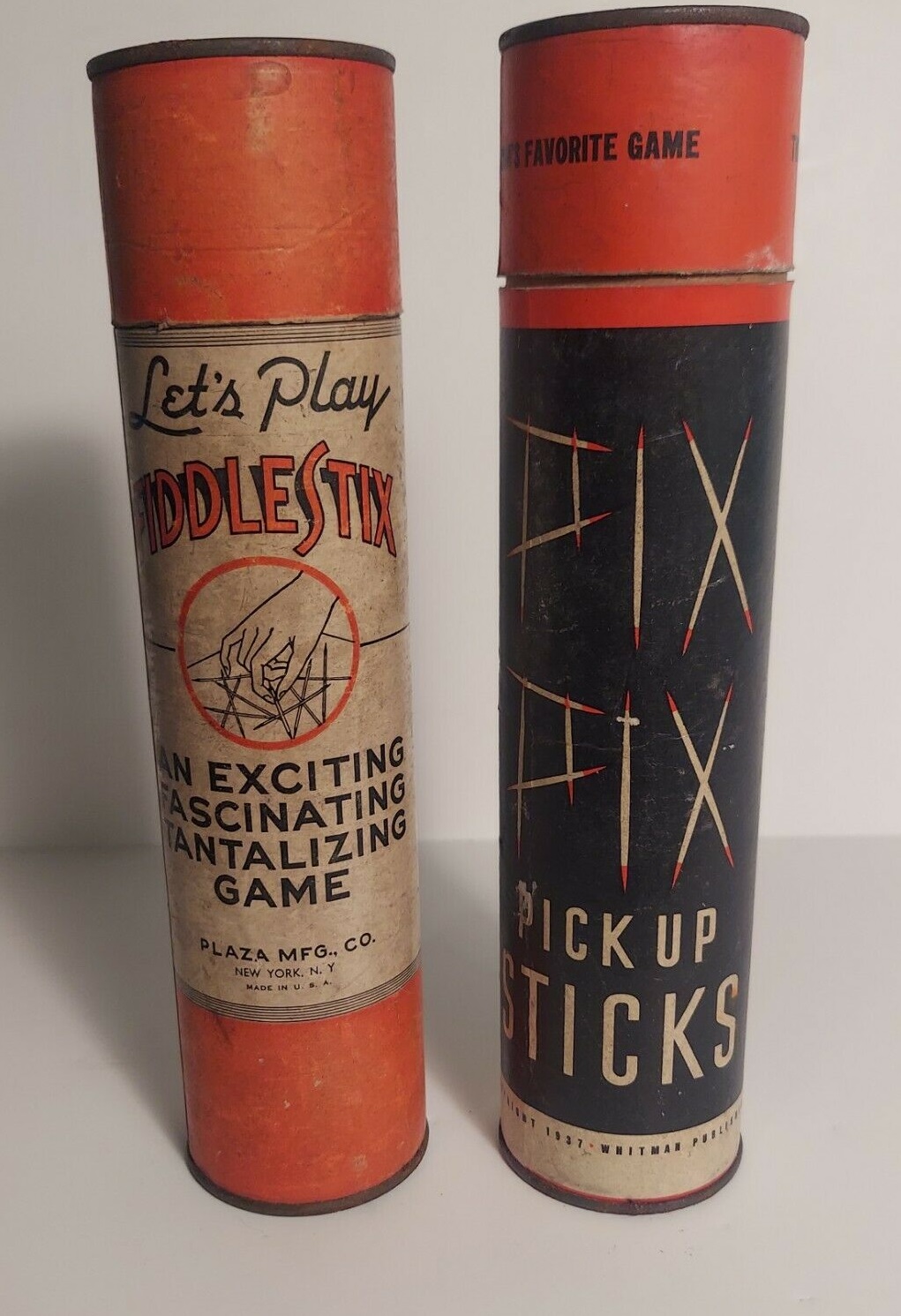
Pix Pix Pick Up Sticks:

This lovely old game feature thin wooden skewers painted in a variety of primary colors. The game involved holding the skewers upright, then letting them splay outward on a hard surface. The object of the game was to try to extract as many of your color skewer without moving any other skewers. We especially enjoyed flicking one stick into the air with the point of another.


Big Little Books

While not toys per se, these fat little books brought hours of fun. I can no longer remember the titles—I believe there were a couple that featured cartoon characters like Goofy or Donald Duck, and a Little Orphan Annie one. Most were nearly an inch thick, and had thick, coarse pages that felt a little like cheap, thin construction paper. The paper was prone to growing brittle as years passed, so most of the books had pages with little triangles of corners missing, broken off as we turned the pages. The books were just the perfect size for small hands, and fat like adult books, so we felt a little more grown-up reading them.

All the toys and books at my grandparents’ house were sold or thrown away when her property was auctioned off in the early 1980s. She could no longer live alone at the farm, so moved in with my Uncle Dwight and his wife Rosie. The farm and house were sold. My family kept a few things, but now that my brother and I are older and more aware of what is valuable—both monetarily and emotionally—we wish that we had kept more things back from the auction, especially some of the toys that held such sentimental value for us. What I wouldn’t give for a chunky, rubber cow or sheep to set on a shelf, or to hear the soft clatter of a shower of pick-up sticks!


Saturday, August 21, 2021

The Appropriately Named Hatevil Nutter: 52 Ancestors 2021 Prompt “Favorite Name”


A Truly Appropriate Name for a Hate-Filled Hypocritical Puritan Zealot


Hatevil Nutter: Approx. 1603-1675


When I first ran across my tenth-great-grandfather Hatevil Nutter, I was so fixated on his delightfully amusing surname, Nutter, that I totally failed to recognize that his first name was a portmanteau—a single word composed of two words. I first mistakenly pronounced it Hat’-eh-val—it took me a while to realize that due to the erratic spelling used in the early 17th century, his parents had dropped the now-standard silent “e” from the word “hate” when they combined the words “hate” and “evil” into a bizarre Puritan given name.

The combination of Hate Evil and Nutter is ridiculously funny to a 21st century person like me. Sadly, my ancestor may truly have been a “nutter”, for rather than fighting evil, he seems to have delighted in stirring it up. Hatred for Quakers consumed him and led to persecution and violence against those peaceful people, including attacks on female Quakers. In seventeenth century New Hampshire, Hatevil was considered a godly man doing the Lord’s work. His actions were accepted and even lauded by his fellow Puritan colonists, while those same actions, viewed through the lens of the 21st century, appear evil, sick and bigoted.

Hatevil Nutter was born in England sometime between 1598 and 1603. His parents may have been Edmund Nutter and his wife Jane Fulford, but that information is based solely on public trees that provide no evidence or documentation, and I have been unable to verify his origins.

 Hatevil married Ann Ayers in England sometime prior to 1630. She is said to have been born around 1608. The couple arrived in the colonies between 1633 and 1637, possibly with their oldest son Antony who seems to have been born in England around 1630. According to Mary Hanaford in her book cited below,

“Hatevil Nutter, an elder and preacher, was born in 1603; he was one of a company induced to leave England with Captain Wiggin in 1635, and to help found on Dover Neck, N. H., a "compact town' which never went farther than High Street, & Dirty Lane; he received lots of land, in different localities.”

Mouth of Piscatqua River in NH modern day

Nutter was one of a group of Puritans who founded the town of Dover—then Dover Neck—New Hampshire. The group was described in one account as a "Company of persons of good estate and of some account for religion".   Hatevil was very active in the Puritan church, attaining the title of “Elder”, which meant he may have helped at church services and occasionally preached.

Dover Neck NH 1623-1723

He was also a successful businessman with a variety of business pursuits. He appears in records in the 1640s, giving a deposition at one point that detailed his land acquisition from a John Wiggins, which included the following parcel:  "Butting on ye Fore River, east; and on ye west by High Street; on ye north by ye Lott of Samewell Haynes; and on ye south by Lott of William Story."

John Scales described Hatevil and his business affairs as follows in his book Piscataqua Pioneers:

“He was among the noted men of the town, both in business and in church affairs. He was one of the first Elders of the First Church, and held the office for life. Though not given to much office holding, he received various valuable grants for saw mills and trees for supplying his mills for sawing into lumber. He had a ship yard on Fore River, and was largely engaged in ship building; his ships sailed all along the coast and to the West Indies, with which islands Dover had much trade.”

The shipping interests were probably the main source of his wealth. The map below shows the various Dover area properties owned by Hatevil.

Map of Dover Neck area including Nutter house adn shipyard

Hatevil and his wife had at least five children. In addition to Antony, the family included John, Elizabeth, Abigail, and my ancestor, Mary.

The Puritans, despite coming to America to pursue religious freedom, did not welcome or accept people of other faiths who also sought the freedom to worship as they chose. When Quakers began visiting colonial villages, attempting to gain converts, Puritan leaders reacted with anger and cruelty. Hatevil was a prime example of this Puritanical hatred. In 1662, three Quaker women, Ann Coleman, Mary Tompkins, and Alice Ambrose, arrived in Dover and began preaching to the inhabitants. They openly argued with the minister of the Puritan church, Rev. John Reynor.

This infuriated Hatevil. He organized a petition that was sent to the colonial crown magistrate, "humbly craving relief against the spreading & the wicked errors of the Quakers among them". The magistrate issued the following order:

 "To the constables of Dover, Hampton, Salisbury, Newbury, Rowley, Ipswich, Wenham, Linn, Boston, Roxbury, Dedham, and until these vagabond Quakers are carried out of this jurisdiction, you, and every one of you are required in the name of the King's Majesty's name, to take these vagabond Quakers, Ann Coleman, Mary Tompkins, and Alice Ambrose, and make them fast to the cart's tail, and driving the cart through your several towns, to whip their naked backs, not exceeding ten stripes apiece on each of them, in each town; and so to convey them from constable to constable, till they are out of this jurisdiction".

This was the middle of winter, and the towns in question covered eighty miles. The women were expected to walk in the snow, dragged along behind a cart, while bleeding. Not a very Christian action, but par for the course in the Puritan colonies. Quakers were frequently executed or beaten to death, so the plan to whip the women and drag them for miles through the snow raised no immediate objections among the populace.

Engraving of Puritans whipping Quaker men at cart tail--1660s

When the magistrate’s order came down, Hatevil roused his son-in-aw, John Roberts (married to daughter Abigail), who was one of the town’s constables, and had him capture the women, strip them to the waist, tie them to a cart and whip them.

George Bishop described the events as follows:

"Deputy Waldron caused these women to be stripped naked from the middle upwards, and tied to a cart, and after awhile cruelly whipped them, whilst the priest stood and looked and laughed at it."

It sounds as if the men of Dover delighted in ogling the half-naked women. Even the supposedly pious Rev. Reynor was laughing at the horrific sight.

The Quaker historian William Sewell blamed Hatevil for the abuse.

"All this whipping of the Quaker women, by the Constables (in front of the meeting-house), was in the presence of one Hate-Evil Nutwell (Nutter), a Ruling Elder, who stirred up the Constables (John and Thomas Roberts) to this wicked action, as so proved that he bore a wrong name (Hate Evil)."

Fortunately for the three women, they were only tortured and whipped in Dover and Hampton. When they were dragged into the town of Salisbury, the local constable along with Major Robert Pike, the leading military officer of the region, refused to enact the order. The women were freed, received medical attention from a Dr. Barefoot, one of Nutter’s neighbors, who had accompanied the cart from Dover. Pike sent the women to Maine to recuperate, as Maine was not under Puritan control.

All of Hatevil’s efforts to stamp out Quakerism in Dover were for naught. Within a matter of a few years, the Quakers returned to Dover, converted over one third of the inhabitants, and built a Quaker meeting house, probably within view of at least one of Hatevil’s many properties.

Nutter property in orange. Blue shows site of whipping and Puritan meeting house, with Dr. Barefoot's house at bottom, and Quaker meeting house at top. 

Hatevil died in 1675; he was about 71 years of age. Two of his five children (John and Elizabeth) had preceded him in death, so his substantial estate was divided amongst his wife Ann and the remaining three children, including my ancestor Mary Nutter Wingate.

The given name “Hatevil” was passed down to at least two of Hatevil’s grandsons: Hatevil Nutter, son of Antony Nutter, and Hatevil Roberts, son of John and Abigail Nutter Roberts. Hopefully, those young men had hearts that were open to love as well as hatred, and that they exhibited tolerance to those of other faiths. 

Hatevil Nutter and his bigotry live on in a poem by John Greenleaf Whittier called “How the Women Went from Dover”. It begins as follows:

The tossing spray of Cocheco's fall

Hardened to ice on its rocky wall,

As through Dover town in the chill, gray dawn,

Three women passed, at the cart-tail drawn!


Bared to the waist, for the north wind's grip

And keener sting of the constable's whip,

The blood that followed each hissing blow

Froze as it sprinkled the winter snow.


Priest and ruler, boy and maid

Followed the dismal cavalcade;

And from door and window, open thrown,

Looked and wondered gaffer and crone.


"God is our witness," the victims cried,

"We suffer for Him who for all men died;

The wrong ye do has been done before,

We bear the stripes that the Master bore!


Further on, Hatevil is immortalized in this verse:


"Smite, Goodman Hate - Evil!-harder still!"

The magistrate cried, "lay on with a will!

Drive out of their bodies the Father of Lies,

Who through them preaches and prophesies!"


This act of cruelty was a sad legacy to leave. Perhaps Hatevil’s name should be unpacked from its portmanteau form into the original two words, but separated by periods: Hate. Evil. Nutter. For after all, he seems to have been a nut job filled with hate and evil.

Dover Neck area today--satellite view

Sources:

Hatevil Nutter of Dover, New Hampshire and his descendants, by Boyle, Frederick. Publication date 1997. Publisher Portsmouth, NH : Peter E. Randall Publisher. Pages 3-7.

https://www.newenglandhistoricalsociety.com/1662-robert-pike-halts-quaker-persecution-massachusetts/

Family Records of Branches of the Hanaford, Thompson, Huckins, Prescott, Smith, Neal, Haley, Lock, Swift, Plumer, Leavitt, Wilson, Green and Allied Families by Mary Elizabeth Neal Hanaford. Books on Demand, 1915. Pgs.277-279.

https://www.dover.nh.gov/government/city-operations/library/history/the-whipping-of-the-quaker-women.html

Piscataqua Pioneers : Register of members and ancestors, 1623-1775. John Scales. (Dover, NH: Piscataqua Pioneers, 1919). “Hatevil Nutter”, pg. 139-140.

http://www.jeaniesgenealogy.com/2019/05/dover-new-hampshire-hatevil-nutter-and.html

“How the Women Went from Dover”, by John Greenleaf Whittier.    http://www.hampton.lib.nh.us/hampton/poetry/dover.htm

Sunday, June 27, 2021

Warren Dane and His Intriguing Cause of Death: 52 Ancestors 2021 Prompt “Health”

 Intriguing Cause of Death: Tabes Dorsalis

Warren J Dane: 1839-1907


            Warren J. Dane, also called J. Warren Dane, is my first cousin four times removed. While the relationship is distant, when I discover something of historical interest in distant ancestors’ lives, I like to record and share it so that we can better understand the time period in which they lived. Warren Dane is illustrative: his cause of death is one that is rarely seen any more, for good reason.

            Warren was born in 1839 in Derby, Orleans County, Vermont, to parents Joseph Dane and Jane Wheeler Dane. Joseph Dane was the sibling of my fourth great-grandfather David Dane. Warren, like his father and at least one brother, became a carpenter.

            Warren enlisted in the cavalry during the Civil War; he was 22 years old. He served as a private in the Vermont First Regiment Cavalry, Company I. The volunteer regiment fought in 76 engagements during the war, including the Shenandoah Valley Campaign, Gettysburg, and the Wilderness Campaign. According to his war record, Warren was captured by Confederate troops on October 24, 1862. He was a prisoner of war for slightly less than a week; he was paroled by the Confederates on October 30, 1862. This was a period when the regiment was protecting Washington, D.C. from attack.

            Warren returned to duty after his release, and served two more years in the cavalry, mustering out on December 31, 1864. He then returned to his home area, living in Newport, Vermont, also in Orleans County. There is very little information about the remainder of his life.

            Warren died June 20, 1907 at age 68, after being hospitalized in the Vermont Soldiers Home. His cause of death was unusual and required research: tabes dorsalis.


        According to Medlineplus.com,

 “Tabes dorsalis is a form of neurosyphilis, which is a complication of late stage syphilis infection. Syphilis is a bacterial infection that is spread sexually.

When syphilis is untreated, the bacteria damages the spinal cord and peripheral nervous tissue. This leads to the symptoms of tabes dorsalis.

Tabes dorsalis is now very rare because syphilis is usually treated early in the disease.”

An online medical dictionary provided the grim symptoms:

“A late form of syphilis resulting in a hardening of the dorsal columns of the spinal cord and marked by shooting pains, emaciation, loss of muscular coordination, and disturbances of sensation and digestion.”


            Damage to the optic nerve, leading to blindness, is another symptom. Apparently it takes at least twenty years for syphilis to progress to such a state, so Warren had been infected many years earlier.

            Warren never married, although obviously he had a relationship with at least one woman in his life. Did he frequent prostitutes? Did he contract the disease as far back as during his Civil War service? Did he choose not to marry because he knew he was infected and didn’t want to infect a spouse? We will never know.


            The cure for syphilis was found in 1910, just three years after Warren’s death. His death is a reminder of how dangerous sexually transmitted diseases were in the 19th century. Thank goodness this terrible condition is rarely seen in the 21st century.

Sources:

https://medlineplus.gov/ency/article/000729.htm

https://www.medicinenet.com/tabes_dorsalis/definition.htm

https://www.yourdictionary.com/tabes-dorsalis

https://en.wikipedia.org/wiki/1st_Vermont_Cavalry_Regiment

Thomas Chesley and the Oyster River Indian Conflict: 52 Ancestors 2021 Prompt “Conflict”

Oyster River, New Hampshire: Conflict Between Native Americans and English Settlers in the 1690s

Thomas Chesley: 1644-1697


Thomas Chesley, my eighth-great-grandfather, was born in Oyster River/Dover, New Hampshire in 1644 to parents Philip Chesley and Elizabeth Leighton Chesley. Thomas married Elizabeth Thomas in Dover on August 22, 1663. He was nineteen, and Elizabeth was still in her teens. They had several children, possibly seven or eight depending on what records are examined. One of the sons was my seventh great-grandfather Joseph Chesley, born in 1673.

Thomas was a well-respected member of the Oyster River/Durham community in New Hampshire, serving as selectman in 1688 and again in 1695.

Colonial era map of Oyster River Settlement

It is easy to imagine his life as a small-town version of our own lives—living in a community, attending church, patronizing businesses and craftsmen, working his farmland and raising his children. It sounds idyllic. But life in 1690s New Hampshire was far from idyllic. Thomas’ community was at the very edge of the area settled by white settlers. The Oyster River settlement abutted lands used by Native Americans for hunting and farming. The colonists’ lands were acquired through deception, broken treaties and outright theft, which created ill will between the two cultures. This ill will occasionally boiled over into violence.

Map of entire Pescataway region, approx. 1670

The settlement at Oyster River, which included what eventually became the towns of Dover and Durham, New Hampshire, had been the target of native anger for some time, culminating in a raid in 1694 that destroyed between one third and one half of the settlement. Wikipedia sums up the so-called Oyster River Massacre as follows:

“The English settlement of Oyster River was attacked by Villieu with about 250 Abenaki Indians, composed of two main groups from the Penobscot and Norridgewock under command of their sagamore Bomazeen (or Bomoseen). A number of Maliseet from Medoctec took part in the attack. The Indian force was divided into two groups to attack the settlement, which was laid out on both sides of the Oyster River. Villieu led the Pentagoet and the Meductic/Nashwaaks. The attack commenced at daybreak, with the small forts quickly falling to the attackers. In all, 104 inhabitants were killed and 27 taken captive, with half the dwellings, including the garrisons, pillaged and burned to the ground. Crops were destroyed and livestock killed, causing famine and destitution for survivors.”


It is believed the settlement only had three hundred residents at the time, so one third of the population was killed, with many others traumatized. While some Chesley family members may have died in the original raid, Thomas and his family survived. Despite the dangers, they chose to stay.

But conflicts with the natives continued, and in 1697, Thomas and a friend were attacked and Thomas was killed. Rev. John Pike wrote in his journal:

“Nov. 15, 97. Tho: Chesley, sen., slain by ye Indians not far from Johnsons Creek. Will Jackson taken' at the same time, & at same time made his escape.”

Johnson’s Creek is a tributary of the Oyster River and was very near the settlement. Chesley and Jackson were probably out collecting firewood or hunting, normal daily activities in an area they probably assumed was safe.

Johnson's Creek area today on Google Maps with Oyster River at bottom

Thomas’ estate was probated in January of the following year, with his widow Elizabeth dividing the money from the estate, about 195 pounds, amongst his seven surviving children: Thomas, George (spelled Jorge in the probate files), Joseph, Elizabeth (spelled Elesebeth), Susannah (spelled Sewsanne), Sarah and Mary. The land was divided as follows: (note: the spelling and unusual capitalization directly copies the written text record. There were wide variations in spelling, with even names spelled differently just lines apart. Also note that the women signed with a mark only—they may not have been able to read and write.)

“know all men by thes present Riting that I Eleseath Chesly Administretres to my Husbands Asteast Have A greed with my children in devideng what Estete He Left when deseast which is in maner as folloeth:

To my Soon Thomas chesly all the Land Seastated Liying and being betwixt Stephen Jonses and philep Cheslys land AJoyneng to the salt River

To my Soon gorg chesly all the Land and Houseng and orchet that was my Husbands at the place comamly called new towen and Half the march that was my Husbands Laying by belemans Banck Rever and the branches ther of

To my Soon Joseph chesley fort ackers of Land and A houce situated Lieang and being on the wast side of oister River frechet and the other Half of Said mairch that Lise by belemans banck River and the branches ther of

Resarving only the thards ther of for my yous to Long as I shall Leve

Elesabeth Chesle”

Oyster River present day

The conflict with the Native Americans continued for another decade or so. Several of Thomas’ nephews were killed between 1704 and 1708. However, Thomas Chesley’s descendants continued to live in the Oyster River area for several additional generations. My seventh great-grandfather Joseph Chesley and sixth-great-grandfather Thomas Chesley were born and died in the Durham/Oyster River area. The Chesley’s persistence, along with the growing numbers of new settlers pushing into the region, helped the colonists prevail in their conflict with the Native tribes.


Sources:

Rev. John Pike, Journal of the Rev. John Pike, of Dover, N.H., ed. Rev. A.H. Quint (Cambridge: Press of John Wilson and Son, 1876

https://en.wikipedia.org/wiki/Raid_on_Oyster_River

Gillette and allied families : genealogical and biographical / prepared and privately printed for Mrs. Lewis Singer Gillette.    Publication date 1930  Topics Bent family, Brown family, Clark family, Gillette family, Hoskins family, Perkins family, Raymond family.  Publisher New York, N.Y. : The American Historical Society, Inc., 1930.

The Wentworth Genealogy: English and American, Volume 1, John Wentworth, Little, Brown & Company, 1878, pgs. 221-222. Accessed on Google Books 26 Jun 2021. https://books.google.com/books?id=KR8aAAAAIAAJ&printsec=frontcover&source=gbs_ge_summary_r&cad=0#v=onepage&q=chesley&f=false

Sunday, May 16, 2021

Qualifying for DAR Membership: 52 Ancestors 2021 Prompt “Groups”

 Surprise Discovery: I Qualify to Join the DAR Five Times Over


When I was a senior in high school, I was surprised to receive a modest scholarship from the New Ulm Chapter of the Daughters of the American Revolution, the DAR. I believe that the award was for $200, a nice amount for a work-study student. I didn’t understand why they had chosen me, the daughter of Norwegian and German immigrants who arrived in America long after the American Revolution. I won a National Merit Scholarship that year, which had received coverage in the local newspaper, so assumed they chose me to honor a local student’s achievement. I felt a little sorry that they weren’t able to find any real descendants of Revolutionary War soldiers to honor instead.

It turns out the joke is on me, for once I began to research my ancestry, I discovered that I qualify to become a member of the DAR several times over. While it is true that the majority of my ancestors came from Germany and Scandanavia in the 1800s, my grandfather Ivan Macbeth’s ancestors arrived in America far earlier, just a few years after the Pilgrims. Thus far, I have identified five direct ancestors who served in the Revolutionary War. They are as follows:

1.      Joseph Burtt 1726-1820. 5th Great-Grandfather

Served as a private in Capt. Joshua Holt’s 4th Andover Company.

2.      Nathaniel Mills Jr. 1743-1814. 5th Great-Grandfather.

Served in Lt. Paine Converse’ Company of the Connecticut 11th Regiment.

3.      Israel Randall 1743-1829. 5th Great-Grandfather.

Served as a Lieutenant under Col. Reynolds’ company of militia from Nottingham, NH Aug. 1776.


4.      John Dane Jr. 1716-1801. 5th Great Grandfather

Served in Capt. Joshua Holts’ 4th Andover company as support—too old at 58 to bear arms.

5.      Francis Dane. 1750-1832. 4th Great-Grandfather—John Dane’s son

Served in Capt. Joshua Holt’s Andover company of foot soldiers. 1775. With Capt, John Abbott, 1775, and in Col. Gage’s Andover regiment in 1777.


At some point I will have to decide which of these ancestors has the best paper trail so that I can prove both that I am their descendant, and that they served in the Revolution. Then I can begin the process of applying for membership with my local Daughters of the American Revolution chapter. In the meantime, I will continue to research other colonial ancestors to see if I have additional veterans of the Revolution in my family tree.