Osgoods: Good and Plenty—Plenty Confusing, That Is
Christopher Osgood: 1606-1660 (Tenth-great-grandfather
maternal side)
Mary Osgood Lovejoy: 1633-1675 (Ninth-great-grandmother
maternal side)
John Osgood: 1595-1651 (9th Great-Grandfather,
maternal side)
Mary Osgood Ingalls: 1633-1686 (8th
Great-Grandmother, maternal side)
A notification from FamilySearch about an ancestor that wasn’t
on my Ancestry tree sent me into research mode. I ended up adding some new
eighth and ninth great-grandparents to the maternal side of my tree. However, these
new discoveries were also quite confusing. Some of the surnames were awfully
familiar—Ingalls and Osgood, surnames already in my tree. I thought I had
discovered new ancestors—was I wrong? Were they already in my tree? Or were
they somehow related to people already in my tree? I suspected my family tree
might have some crossed branches back in mid-1600s Massachusetts. It was time
to get organized and tease out who these people were, and how they might be
related to one another.
I realized I had some real problems when I tried to attach a
record to my new eighth-great-grandmother Mary Osgood, verifying her marriage
to Henry Ingalls, and discovered that the Mary Osgood I’d attached it to
already had a husband named Lovejoy. While this other Mary Osgood had the same
birth year as Mary Osgood Ingalls, Mary Osgood Lovejoy had a different death
date—and different parents. I had barely begun researching my new branch, and I
was already attaching documents to the wrong people.
So who were these two Mary Osgoods? And who were their
parents? And how am I related to them?
The first Mary Osgood in my tree was the daughter of
Christopher Osgood and his first wife Mary Everatt. Christopher was born April
10, 1606 in Wilshire England. His parents are believed to have been Thomas
Osgood and Margaret Skeat.
Christopher married Mary Everatt in Marlborough on April 21,
1632. He was 26, and his bride was only 17. About a year later on March 17,
1633, their daughter Mary was born. Sadly, Mary Everatt Osgood appears to have
never recovered from childbirth, or perhaps contracted an illness shortly after
the birth. Whatever the cause, she died on her first wedding anniversary, April
21, 1633, leaving a motherless one-month-old baby.
Christopher remarried just three months after Mary’s death; he probably needed someone to help care for baby Mary. He chose another 18-year-old girl, Margaret Fowler. Around the same time, he decided to move to the American colonies, booking passage for his young family on the ship “Mary and John”. They travelled with Margaret’s parents, Philip and Mary Fowler, so at least Margaret had help to care for her little stepdaughter.
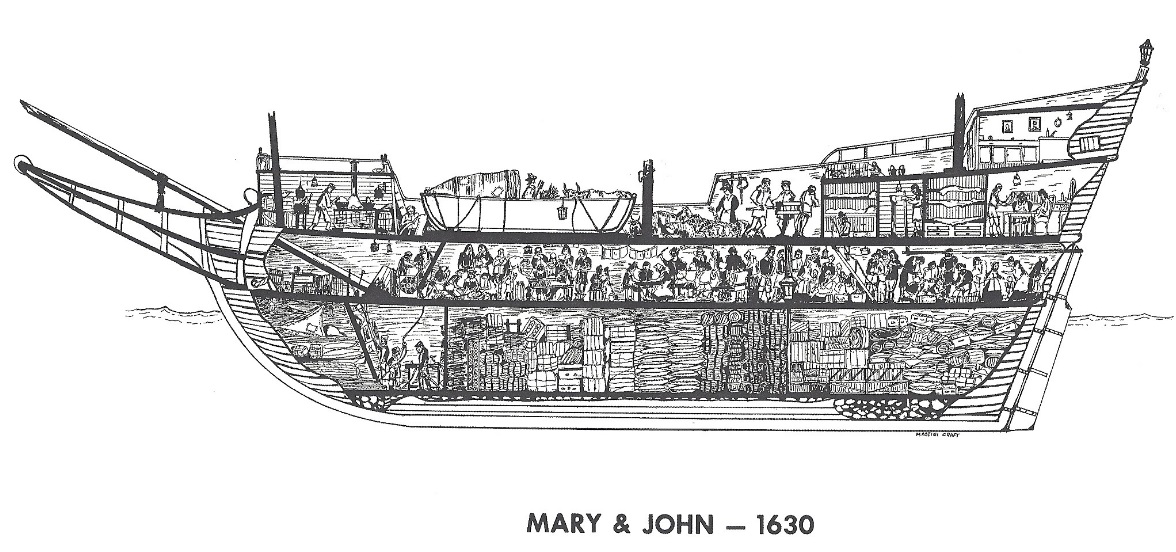
The Mary and John
travelled back and forth from England to both Maine and Massachusetts in the
1620s and 1630s, carrying colonists and supplies. This illustration of the
ship’s interior shows how cramped the conditions must have been on the vessel.
It is amazing baby Mary survived. The Osgoods must have travelled with a wet
nurse.
The family arrived in Massachusetts in spring of 1634, and
settled in Ipswich. Several researchers have compiled all the colonial records
for Christopher Osgood that can be located, showing that he took the Freeman’s
Oath in 1635, received several grants of land in the Ipswich area, and worked
as a bricklayer. Over the years, he also served several terms on the Ipswich
Jury of Trials, so must have been a respected member of the community.
 |
| Map of Ipswich, Massachusetts 1640 |
Christopher Osgood died sometime between 1650 and 1651. He
remembered Mary in his will, which read, “First, I do give unto my oldest
daughter Mary Osgood, ten pounds, to be paid her or her assigns at her day of
marriage.” He left five pounds each for her three half-sisters by his second
wife, with his lands and property left to his wife and oldest son (which left
the youngest son, born after his death, totally without property). Sadly, his
wife Margery returned to the court a few months after his death to ask for an
“abatement of the portions” (cutting of the bequests) to be paid to Mary and
her siblings as the “property not proving sufficient.”
 |
| Close-up of map, with Osgood spelled "Ausgood" |
Despite Mary’s lack of an inheritance, she was able to find
a husband shortly after her father’s death. According to S. L. Bailey’s
Historical Sketches of Andover, “third in the list of the first ten marriages
in Andover is Jan. 1, 1651, John Lovejoy and Mary Osgood.” They were married in
Ipswich by the Rev. Mr. Simons. The Lovejoys had travelled to Massachusetts on
the same ship as the Osgoods, so the families were long acquainted. Mary was 18
years old, while John Lovejoy was 28.
The couple was quite prolific. Mary gave birth to twelve
children over the space of 22 years. She died July 15, 1675 at the young age of
42—she probably died of exhaustion, having borne a baby every two years! Mary
and John Lovejoy’s fifth child, Anne Lovejoy, was my eighth great-grandmother.
She was born December 21, 1659, and married Johnathan Blanchard May 20, 1685.
The familial line down to my great-grandmother Lucy Dane is shown below.

The second Mary Osgood is part of the newly-discovered
branch of my family tree. She was born March 17, 1633 in Wherwell in the Test
Valley of Hampshire, England. Her parents were John Osgood and Sarah Ann Booth.
John Osgood, my ninth-great-grandfather, was born in the
Wherwell area in 1595. There is some debate about his parentage. Most
researchers agree that his parents were Robert Osgood of Wherwell, and his wife
Joan, who owned a farm called Cottonworth. John seems to have been the oldest
son, and took over the farm when Robert died in 1630. I wrote about this farm’s
house in my previous blog entry.
John Osgood married Sarah Ann Booth, sometime around 1627 in
Wherwell. The couple likely had four children by the time they decided to
emigrate to the colonies in 1638. The children included my eighth
great-grandmother Mary Osgood, who was probably their third child, born March
17, 1633.
The Osgoods’ decision to emigrate was influenced by
religious intolerance in their area, increasing tax burdens, and a crop failure
in 1637. John seems to have been desperate to leave, as shown by a letter sent
by the headmaster of the school at Winchester, a town ten miles from Wherwell, on
John Osgood’s behalf. The letter was sent to Sir Edward Nicholas, Secretary of
State to King Charles I, begging that he grant approval to Osgood’s planned
move to the colonies.

John set sail with his wife and children, including
5-year-old Mary, on the ship Confidence
in 1638. The passenger list includes “Sarah Osgood, spinster of Herrell, and
four children”. Herrell is the phonetic spelling of Wherwell. Oddly, John
Osgood is not listed on the passenger manifest. Instead Sarah—who was
definitely not a spinster-- is accompanied by a William Osgood, age 11. There
were several versions of the passenger list, compiled at separate times, and
one of the others lists Sarah’s children as “Sarah Osgood 9, John Osgood 7,
Mary Osgood 5, Elizabeth Osgood 3.” Her destination was listed as Newbury,
Massachusetts.
There are varying explanations for the relationship between
11-year-old William Osgood and John Osgood. Most researchers suggest they were
either brothers or that William was John’s nephew.
The Confidence
probably set sail from Southampton on either April 11 or 24, 1638. The date of
the ship’s arrival in Boston is unknown.
Christopher Osgood and family were living in Ipswich in
1638. Researchers have suggested that John and Christopher were related somehow—possibly
cousins—and that Christopher provided shelter for John Osgood and his family
for a few weeks after their arrival until John was able to acquire land of his
own in nearby Newbury.
 |
| Colonial era Newbury Mass. map |
From the colonial records, John seems to have been a decent,
respected member of his community. He made his Freeman’s application on May 22,
1639. He spent some years living in Newbury before becoming one of the founders
of Andover, Massachusetts. In 1645, he was one of ten founding members of the
church in Andover. In 1650, he sold a house he still owned in Newbury to a man
named George Little. In 1651, Andover residents appointed John to be their
first representative to the General Court.
Sadly, John Osgood did not live to complete his term in
office. He attended the May session, but by the fall session he was ill. He died on October 24, 1651; he was 56 years
old.
His will, reproduced in the Eben
book listed below, provided 25 pounds each for daughters Mary, Elizabeth, and
Hannah payable when they turned 18, and 25 pounds for son Stephen at age 21.
John also left 20 shillings for Sarah Clements, his eldest and now-married daughter,
with an additional 20 shillings for Sarah’s daughter Bekah. Presumably Sarah
received less in the will because she had already received a dowry upon her
marriage. His oldest son, also named John, inherited his lands and house, with
a life interest to the widow Sarah.
 |
| Part of John Osgood's will |
Mary Osgood had her 18th
birthday a few months before her father’s death, so came into her inheritance
quickly. She married Henry Ingalls two years later, on July 5, 1853. Mary was
20 years old, and Henry was 26.
As I alluded to at the beginning of
the blog, I already had a man named Henry Ingalls in my family tree—he was the
brother of my eighth-great-grandmother Elizabeth Ingalls, who married Rev.
Francis Dane. This was the same man, so Henry Ingalls is both my eighth-great-granduncle,
and my eighth-great-grandfather. Henry and Elizabeth’s parents, Edmund Ingalls
and Ann Telbe, are my ninth-great-grandparents twice over.
Mary Osgood and Henry Ingalls had
a huge family. Mary gave birth to ten children between 1654 and 1679—she was 45
years old when her last daughter, Sarah Ingalls, was born. Mary died seven
years later on December 16, 1686 at age 53. I am descended from their daughter
Mary Ingalls, born January 28, 1659, who went on to marry John Stevens. The
relationship is spelled out below.

In order to understand how all
these Osgood and Ingalls family members were related to one another and to me,
I had to organize my records and do a lot of research into genealogies and
family histories prepared by other researchers. I now have a clearer picture of
these families. Best of all, I can finally tell the two Mary Osgoods apart.
Perhaps someday I will be able to definitively determine whether the two Mary
Osgoods and their Osgood fathers were related to one another, and if so, how. A
project for a later date!
Sources:
Ancestry.com. The Fowler family : a genealogical memoir of
the descendants of Philip and Mary Fowler, of Ipswich, Mass. [database
on-line]. Provo, UT: Ancestry.com Operations Inc, 2005. Original data:
Stickney, Matthew Adams,. The Fowler family : a genealogical memoir of the
descendants of Philip and Mary Fowler, of Ipswich, Mass., ten generations,
1590-1882. Salem, Mass.: Printed for the author by Salem Press, 1883. https://www.ancestry.com/discoveryui-content/view/191:15733?tid=46986934&pid=322178585653&hid=1037386144396&_phsrc=Jng14245&_phstart=default
Great Migration 1634-1635, M-P. (Online
database. AmericanAncestors.org. New England Historic
Genealogical Society, 2010.) Originally published as: The Great
Migration, Immigrants to New England, 1634-1635, Volume V, M-P, by
Robert Charles Anderson. Boston: New England Historic Genealogical Society,
2007.
https://www.americanancestors.org/DB401/i/12155/318/235141190
https://www.laddfamily.com/Files/Mary%20&%20John/Mary%20and%20John.htm
Tepper, Michael, Passengers to America, Genealogical
Publishing Co., Inc.: Baltimore, MD, 1977. Passenger list for the Mary and
John’s 1633-34 voyage that Christopher Osgood and family were aboard.
"New Light on the English Background of the Osgoods of
Essex County, Massachusetts", published in The American Genealogist,
Jan/Apr 2008.
A Genealogy of the
Descendants of John, Christopher and William Osgood, Who Came from England and
Settled in New England Early in the Seventeenth Century, Osgood, Ira,
1799-1877; Putnam, Eben. https://archive.org/details/genealogyofdesce00osgo/page/n23/mode/2up


