Wednesday, December 15, 2021

Crossed Family Lines: 52 Ancestors 2021 Prompt “Lines”

Three Family Lines Criss-Cross in Eighteenth Century Andover

Susannah Burt: 1758-?

Abiah Burt: 1759-1798

Lois Burt: 1763-1814

Lucy Burt: 1785-1842


One set of my fifth-great-grandparents had daughters who married into two other of my ancestral lines. The resulting mix of family relationships is confusing at the best. Apparently the town of Andover, Massachusetts was so small that there were a limited number of families available for marriage. These four women’s children have varying relationships to me depending on the familial connections of the Burt women’s husbands.

My fifth-great-grandparents Joseph Burtt (1726-1810) and Abiah Mooar Burtt (1741-1828) married March 23, 1758 in Andover. Joseph was 32 years old, while Abiah was half his age—just 16 years old. They had a total of eight children, including six daughters. Four of those daughters—all my fourth-great-grandaunts-- chose husbands from two other of my ancestral lines.

Abiah Mooar Burt

Joseph Burt

Susanna Burt was Joseph and Abiah’s eldest child. According to a transcript of Andover’s birth records, Susanna was born June 25, 1758. This means her mother was nearly six months pregnant at the time of her marriage. Susanna married at age 22. Her husband was William Dane, born October 17, 1753 to parents William Dane and Mary Osgood. William the senior was the son of my sixth-great-grandfather John Dane and his wife Sarah Chandler, making him my fifth-great-granduncle, and his son, Susanna’s husband, my first-cousin-six-times-removed. William and Susanna had an amazing ten children, who were my first cousins five-times-removed.

Joseph Burt's will mentioning daughters Susanna, Abiah and Elizabeth

Abiah Burt was Joseph and Abiah’s second daughter, born December 13, 1759. She married my fourth-great-grandfather Francis Dane on May 1, 1781. Francis Dane was born on February 18, 1750 to John Dane and wife Elizabeth Chandler Dane. This complicates my relationship to Abiah Burt Dane—she is both my fourth-great-grandaunt and my fourth great-grandmother.  

Lucy Burt was born June 5, 1785, 27 years after the birth of her oldest sister, Susanna. At the time of her father’s death, she was named in his will, but as an unmarried minor. On May 10, 1805, at age 19, she married another member of the Dane family, Peter Osgood Dane. Peter is my second cousin five times removed, the son of Joseph Dane, who was the son of Joseph Dane, who was the son of my 6th Great-Grandfather John Dane.

Lucy and Peter O. Dane had one daughter named Lucy after her mother, and three sons, Peter Osgood Dane, Albert Kimball Dane and Joseph Mooar Dane. These children are my first cousins five times removed.  

Lucy Burt and Peter Osgood Dane graves

So how are these three Dane husbands related to one another? Francis and William Dane were the sons of brothers, so were first cousins. Peter Osgood Dane was one additional generation along on the family tree, so his father Joseph was another of Francis and William’s first cousins, while Peter Osgood Dane was their second cousin.

Clear as mud, isn’t it? Talk about crossed familial lines!

Lois Burt, along with sisters Elizabeth and Sarah, found non-Dane husbands. Elizabeth married a man with the surname Clark and Sarah married John Foster. Fortunately, neither of those families appears in my tree. However, Lois is a different story.

Lois was born June 16, 1763. She married Thomas Blanchard on March 12, 1782. She was 18 and he was 19 years old. Thomas Blanchard is my third cousin seven-times-removed—a very distant relationship, but a relationship all the same. Thomas was born November 11, 1762 to Aaron Blanchard and Eleanor Holt. Aaron was the son of yet another Thomas Blanchard, my first-cousin nine-times-removed. His father, also named Thomas, was the half-brother of my eighth great-grandfather Johnathan Blanchard, 1664-1742.

Lois Burt Blanchard grave

Ancestry’s cousin-calculating algorithm ignores this complex relationship, and lists Lois and Thomas Blanchard’s children as my first-cousins five-times-removed.

Running across familiar names as I traced the Burt family tree led me down quite a rabbit hole. I ended up delving into the collateral Dane and Blanchard lines to confirm my initial suspicion that those four husbands of the Burt sisters were already connected to my endlessly growing, sprawling family tree. I wonder how many other twisted, crossed familial lines I will find as I continue my research. Small towns foster intermarriage, and many of my early American ancestors were born and died in small colonial towns. I look forward to making even more complicated connections.

Tuesday, December 14, 2021

Grandpa’s Woodshop: 52 Ancestors 2021 Prompt “Homemade”

Folding Bookshelf Grandpa Built

Ivan Macbeth: 1904-1972


I have fond memories of puttering around in what my grandparents called “the shop”, my Grandfather’s woodworking shop. When I was really young, the shop was a chicken coop—a long, low building with windows on the side that faced the house. Sometime in the mid-1960s, Grandma gave up her chickens and Grandpa converted the building into a storage and work area for himself—a man-cave outside the house.

Ivan Macbeth in his early teens

Ivan Macbeth was my maternal grandfather, and lived on his parents’ farm outside Eagle Lake, Minnesota. I liked to go to the shop with him because he’d let me hammer nails into scraps of wood. He never criticized me or laughed at my efforts—he was always kind and encouraging. I don’t know if I ever managed to put together anything useful, but I had fun.

I’m not sure how many things Grandpa built over the years. I only really noticed two. First, he made a custom frame for a huge paint-by-number painting my mother did of the Last Supper. She worked on it while she was pregnant with me, so it had a lot of sentimental value for her. Grandpa’s frame was about three inches wide with a lot of detail.

Detail on bookshelf

The second of Grandpa’s wood pieces was a four-shelf bookshelf. My mom inherited it after Grandpa had died and Grandma Nora moved in with my uncle and aunt. The interesting thing about the shelf design was that it could be folded up when it needed to be moved—the legs and shelves would fold down to make the piece only a few inches thick.


My mom had the shelves in her bedroom in her assisted living apartment. When she had to move into a nursing home, there was no room for the shelves anymore, and they ended up in a storage unit, where I took theses photos. I didn’t really have a place for the shelves in my house; nor did my brother. They were probably donated. However, at least I have the photos of the shelves and the memories of my Grandpa happily absorbed with the tools in his woodshop.

Sunday, November 28, 2021

Hefting Haybales: 52 Ancestors 2021 Prompt “Strength”

 Weightlifting the Farm Way: Haybaling in the 1960s and 1970s

Juhl Peterson: 1917-2001


“Strength” made me think of muscles and weightlifters, but I didn’t have any gymrats or Mr. Americas in the family tree. However, I did have generations of farmers—men who toted, stacked and even tossed fifty to seventy pound haybales with ease. They didn’t need dumbbells to build their muscles. They built them through the hard work of farm chores, including baling hay.

Threshing on the Peterson farm in the 1940s--more hard work that produced straw

My father had a couple fields of alfalfa when I was a child in the ‘60s and ‘70s. Alfalfa was good fodder for his herd of beef cattle. A couple times a year, the alfalfa was mowed with a big tractor-driven mower, and then raked into long windrows. My father would nervously watch the weather, praying the rain stayed away until the alfalfa was dry enough to be baled. He would also mow the grass in the road ditches that lined his fields; the grasses and weeds weren’t as nutritious as alfalfa, but were still an important source of cattle fodder.


When it was time to bale, he would hitch up our red baler behind the tractor, and would hitch a hay rack behind the baler. The hay racks were pretty long, and the baler had a chute at the rear where the rectangular bales would chug along leading up to the rack. The total length of the equipment was pretty impressive.

Similar rig to my dad's

I liked to ride along on the hay racks during baling. The alfalfa smelled so sweet and fresh, and from my elevated perch I could spot small animals as they darted away from the tractor wheels—the rabbits, mice, voles, gophers and snakes kept me interested.

Dad used a twine baler, which bundled the hay into rectangles that were probably about 40x20x20 inches, and were held together by two pieces of twine which the baler wrapped around the hay bundles, and then tied and cut off somewhere deep inside its mysterious, clanking innards. Baling required at least two people, one to drive the tractor and one to stack the bales on the hayrack. My dad would often recruit his brother or nephew to drive the tractor (Oscar and Roger lived just across the road maybe a quarter of a mile away), and dad would take care of the stacking. When my brother got old enough to drive the tractor, he was dad’s partner.


It was hot, miserable work; baling season occurred during the height of summer in southern Minnesota. Temps were often in the 80s and the humidity was high. Dad would bring a huge orange cooler jug of water to drink. The hay was dusty, and his skin and clothes were quickly covered with dusty leaf fragments and dirt. He had to wear leather gloves to protect his hands from the bite of the thin twine. The twine was made of sharp fibers that could give you splinters, and the stalks of alfalfa were sharp and pointed. His arms would get sliced up as the hours went by.

Depending on which hayrack he was using, he would stack the bales four to six bales high (some of the racks could handle more weight than others). My brother and I would climb up atop the stack and would rock along as the equipment rumbled over the rough surface of the field. I was a fanciful kid, and imagined I was riding atop an elephant or in a litter carried by men like I’d seen in movies about Cleopatra and other historical figures.

The work didn’t end once the hay rack was full. The rack would be unhitched from the baler and driven back to the farm with a second tractor. The bales would then be hauled into the haymow of our huge barn, or stacked outdoors in big square stacks that would reach the height of a second story window.

I loved watching the bales get loaded into the hayloft. First the big hayloft door was opened—it was gigantic and folded down the face of the barn on huge hinges. A pulley system ran the length of the haymow right along the topmost beams of the barn roof. The pulley was used to both open and close the loft door, but also attached to a hayhook contraption that could sink six huge metal claws into 6 haybales, and then the pulley would pull the bales up off the wagon, up to the level of the hayloft, and would send the bales sliding along the pulley into the center of the loft area. At that point, someone down on the ground would give a yank to a rope attached to the hayhook, and it would suddenly release, sending the bales tumbling down into the hayloft. I remember that the hayhook contraption was painted red and yellow, and I can still remember my dad and Uncle Oscar stomping on the hooks with their heavy-soled boots to make sure the hooks took hold—sometimes a bale would fall off as the pulley swung upwards, crashing down on the hay rack. The men had to watch closely to avoid get hit with a 60 pound block of hay.

Similar pulley and trolley rig to the one in dad's barn

The noise of this whole process was deafening. The pulley system was run with a tractor engine. The big bale spike had to be stomped and pounded down into the bales before the pulley was activated, and as the bales rose, their twine groaned and squeaked, the pulley ropes groaned, and the falling bales made huge thuds as they hit the floor of the loft, followed by a whoosh of dust and debris. The men had to shout to one another to be heard over the noise, even though they were standing within a couple feet of one another.

Dad often had to climb up into the loft to shove the bales around once they’d been dropped. Now that I’m an adult, I’m amazed at the strength of that old barn, pummeled repeatedly by hundreds of pounds of hay bales, and then holding up some 200 or so bales once the process was complete. It’s quite amazing to think about. I wonder what the animals in the pens below the loft thought as the bales thudded down and the haymow floor shook.

Dad, Juhl Peterson, on the right

I am amazed at the strength and endurance my dad and other farm relatives exhibited. Haybaling was one of the most strenuous jobs they dealt with, but every day featured work that was nearly as backbreaking. They were truly men of strength—not just physically, but mentally and emotionally as well.

Saturday, November 27, 2021

Three Times Thankful: 52 Ancestors 2021 Prompt “Thankful”

Triply Thankful: Three Generations of Women Named Thankful

Thankful Holmes:1690-Unknown
Thankful Mascraft: 1721-1805
Thankful Skinner: 1751-1814


One of my sets of seventh-great-grandparents chose a very Puritan name for their second daughter, my sixth great-grandaunt: Thankful Holmes. The name Thankful graced two more generations, passed down from mother to daughter.

Thankful Holmes was born on September 11, 1690 to parents James Holmes and Jane Stephens Holmes. The family lived in Woodstock, Massachusetts Colony, in what is now Connecticut. Thankful had several siblings; I list eight on my tree, while other trees include up to ten.

18th century drawing of Woodstock CT

Thankful did not marry until fairly late in life for the time period; she was 28 when she married Samuel Mascraft on March 28, 1719. Perhaps Thankful had been needed at home to help raise her siblings, or perhaps there simply weren’t any appropriate suitors in Woodstock, which had been founded less than a decade before her birth by a mere thirty families.

Map of Connecticut, 1797, from the Library of Congress

Samuel Mascraft had been born in Roxbury, Massachusetts in 1683, and moved to Woodstock, some seventy miles southwest, at some point in the early 1700s. Histories of the area note that many children of Roxbury families moved to new communities, including Woodstock, that were being carved out of the wilderness, as there wasn’t enough arable land near Roxbury to support more families.

Samuel had been previously married. His first wife, Mehitable, died in early 1719, leaving him at age 36 with five motherless children. He married Thankful shortly after Mehitable’s death. Samuel and Thankful Mascraft had several children of their own, including daughter Thankful Mascraft, born June 23, 1721. Thankful Holmes Mascraft seems to have died in 1729 after giving birth to her last child, Abigail. I have yet to confirm the death date.

Thankful Mascraft, my first cousin 7x removed, married William Skinner of Malden, Massachusetts, on Jamuary 2, 1746. William was 26 years old and Thankful was 25. William was a church deacon as well as a farmer and landowner. The couple had somewhere between ten and twelve children, depending on whose records are to be believed. Their fifth child, daughter Thankful Skinner, was born in 1751, possibly on July 2 according to an unsourced record on Family Search.

Thankful Mascraft Skinner survived well into old age. Her tombstone can be found in Woodstock, and reads: In memory of/ Mrs. Thankful Skinner/wife of/Deacon William Skinner/who died April 6th 1805/In her 84th Year.


Thankful Skinner, my second cousin six times removed, married very late in life. She was 39 years old, nearly past potential child-bearing years, when she wed Enoch Burt, age 47, on January 23, 1790. Enoch was also a church deacon, born and raised in Wilbraham, Massachusetts, some thirty miles from Thankful’s hometown of Woodstock, Connecticut. He had been previously married to a Eunice Stebbins, and had at least three children with her before he was widowed.

Wilbraham, Massachusetts, 1800s

Despite Thankful’s age, she and Enoch had three children together, Calvin, born in 1790, Lathrop, born in 1792, and William Skinner Burt, born in 1794. Enoch died in 1809, and in his will he refers to Thankful as “my beloved wife”, leaving her “one cow, my mare, six sheep also my weaving loom and its furniture together with the house hold furniture she brought here & property comes to her by heirships or legacy to have and use the same for her own and also to enjoy and possess a part in my house to use as her home as long as she remains my widow.” From this will, it appears Thankful had brought substantial assets of her own to the marriage, and it also appears that the couple loved each other and that Enoch had ensured she would be provided for following his death.

Enoch Burt's will

It is interesting to note that Enoch’s will left the three children of his first marriage, Walter, Eunice and Enoch, small sums of cash, $2.50 each, while he gives his three sons by Thankful “all my landed property together with all the privileges of water my livestock and farming utensils with the House and Barn standing on to farm together with the one half of the grist mill and the one half of the tan mill which I own…” Quite different treatment for the two sets of children. It is to be hoped that Enoch had earlier settled property on his older children, perhaps when they reached their majority.

Thankful Skinner Burt died in 1834, having never remarried. She is buried next to her husband in Hampden Cemetery, and her headstone reads, “The Grave of/Thankful/relict of/Dea. Enoch Burt/who died/Jan. 10, 1834/aged 83.”


While I am not closely related to Thankful Holmes and her daughter and granddaughter and despite having limited information about their lives, I am thankful to have discovered them and the charming, old-fashioned name they shared.

Sources:

https://www.findagrave.com/memorial/49700179/enoch-burt

Massachusetts, U.S., Wills and Probate Records, 1635-1991, accessed through Ancestry. https://www.ancestry.com/discoveryui-content/view/567840:9069?ssrc=pt&tid=46986934&pid=322332739052

Library of Congress, Map of Connecticut 1797

Saturday, October 16, 2021

Triplets Birth Day Turns from Joy to Tragedy: 52 Ancestors 2021 Prompt “Birthdays”

An Amazing Birth Day Ends in Grief

Elaine Trosdahl: April 11, 1929-April 11, 1929
Orrin Reeves Trosdahl: April 11, 1929-April 11, 1929
Mary Trosdahl: April 11, 1929-April 11, 1929


My preliminary research on my first cousin once removed, Nels Alford Trosdahl, and his wife Lola Conway turned up five children, all daughters, born between 1906 and 1917. I assumed the couple had no other children; later census records listed only the five daughters. However, while searching for Nels’ obituary on Newspapers.com, I turned up an amazing article that revealed Nels and Lola had, for one brief day, three more children, including their only son. This discovery is an example of how birthdays can sometimes be days of sorrow rather than celebration.

Minneapolis Star Tribune, April 13, 1929

Nels Trosdahl was the child of my greataunt Marit Peterson Joramo and her husband Johan Trosdahl. Nels was the fourth of their eleven children, and the oldest of their four sons. Nels was born February 10, 1883, in Lake Hanska Township in Brown County, Minnesota. At some point after Nels’ seventeenth birthday in 1900, the entire family moved from Lake Hanska in southern Minnesota to Otter Tail County, 200 miles to the northwest.  

Nels met a young girl from the area, Lola Conway, and on December 29, 1905, the couple married. Nels was 22 years old. Lola was a child of 14, already several months pregnant with their first child. Myrtle was born May 7, 1906, three months after Lola’s fifteenth birthday. Four more daughters followed, every two or three years, until daughter Doris’ birth in 1917.

In general, women from this time period have about a twenty year period of fertility at most. However, twenty-four years after giving birth to her first child, Lola delivered fraternal triplets, two daughters and a son. The triplets’ youngest sibling was twelve; their oldest was grown up and married.

The newspaper article noted that the triplets were the first ever born in Battle Creek. This was a time before fertility drugs, so triplets were quite rare. Of course, this was also before the advent of neonatologists and NICUs. The triplets were probably very small and possibly premature. It is doubtful a rural Minnesota hospital even had incubators for infants in 1929. The triplets really didn’t have any chance of survival.

The babies’ birth day was the sole day of their lives. A day of joy and anticipation for the parents turned into a day of mourning. Fortunately, Lola survived the birth despite the high maternal mortality rates of the era.

Little Mary, Orrin Reeves and Elaine Trosdahl were buried together at Nidaros Lutheran Cemetery, their grave marked by a single stone.


The loss of the triplets seems to have placed a strain on Nels and Lola’s marriage. Their youngest child, Doris, married young like her mother, and was only 16 when she moved out in November, 1932. Lola and Nels separated at some point following Doris’ marriage. By 1938, Lola was living on her own in Moorhead, Minnesota.

By the time of the 1940 census, Lola and Nels had lost another child—their daughter Doris. Following Doris’ early marriage to Selmer Baldwin, the couple had two children, David Sylvester, born April 15, 1936 when Doris was 19, and daughter Alphilde Marie, born September 28, 1937 when Doris was 21. Yet just two years later, Doris was dead at age 23. It is unclear if she died giving birth to a third child, or if she contracted an illness that proved fatal.


Whatever the cause of Doris’ death, Lola Trosdahl stepped up to care for her little grandchildren. She ended up moving in with Doris’ inlaws who had custody of the two motherless toddlers. The 1940 census finds her living as a “lodger” with John and Mae Baldwin, Selmer’s parents, and several of their children, as well as David and Alphilde. Lola’s occupation is listed as “caretaker” of “grandchildren”, with her job categorized as “unpaid family worker”.  Selmer is not living with the family; he appears on a WWII draft registration in Grand Forks, North Dakota, where he was living alone, unemployed.

Meanwhile, Nels Trosdahl appears on an April 1942 draft card, living in Detroit Lakes on the property of a Mrs. Clara Hawkins, who he lists as his employer. I was unable to find him on the 1940 census. I have found no further records on his occupation or residence thereafter.

Lola died March 25, 1947 in Fergus Falls, Minnesota at age 55, far too young. Nels died June 12, 1958 in Mahnomen, Minnesota. He was 75.

Without my discovery of the tiny five-line story about the triplets in the Minneapolis Star Tribune, I would never have known about Mary, Orrin Reeves or Elaine and their April 11 birthday in 1929. The usual searches under their parents’ names on Ancestry and Family Search did not pull up their birth and death records. Like so many babies who died shortly after birth, their brief lives were quickly forgotten, as was the joy and sorrow their parents experienced. These lost babies’ birthdays are so much more than the day of their birth—they mark the entirety of their brief lives.

Saturday, September 25, 2021

Shock to See Cousins Still in Touch: 52 Ancestors 2021 Prompt “Shock”

Paul Peterson’s Children Still in Touch with Marit Peterson Trosdahl’s Children in the 1960s: How Did My Generation Lose Touch?

Joseph M Trosdahl: 1886-1968
Minnie Paulson Trosdahl: 1891-1961
Randy Peterson: 1899-1965
Thelma Peterson Hansen: 1915-1965


Most of my generation of Paul Peterson’s descendants aren’t even aware that Paul had two sisters, both of whom had large families. Marit Peterson Joramo Trosdahl and her family moved to northern Minnesota some time before 1910. Julia Peterson Joramo Severson moved to South Dakota with her husband and children a good decade earlier. Both families mostly fell out of touch with Paul’s side, until their very existence was no longer part of the oral family history. Many of my cousins think that Paul had only one sibling, a brother, Jacob Joramo.

After I discovered the existence of Marit and her descendants a couple years ago, I had assumed that Marit and Paul’s families had lost touch soon after Marit and her husband Johan Trosdahl moved to Nidaros Township in Otter Tail County. Paul Peterson and brother Jacob Joramo had stayed in southern Minnesota, farming in Lake Hanska Township in Brown County about 200 miles from the Trosdahls. However, this assumption was shattered when I ran across an obituary from 1961.


Marit and Johan Trosdahl had ten children. The sixth of their children was son Joseph Mangnus Trosdahl, born October 4, 1886 in Linden Township, just a couple miles from Paul Peterson’s farm. Joseph was in his teens when the family relocated to northern Minnesota. He took up farming, and married a local girl named Minnie Paulson.

Minnie died December 31, 1960, and her funeral was held at the Nidaros Lutheran Church on January 5, 1961. The Fergus Fall Daily Journal had a nice funeral write up, with more detail than typical. It included a list of family and friends who had traveled a long distance to the funeral. Among this list were two very familiar names, Randy Peterson and Mrs. Leo Hanson of Minneapolis. Randine and Thelma were my dad’s older sisters. They had driven 172 miles in the middle of a harsh Minnesota winter to attend the funeral of their first cousin’s wife—an extraordinary effort in that time considering the quality of cars and the condition of the roads. They must have felt close to Joseph and his siblings, people my dad didn’t even remember (probably because they moved away about 15 years before he was born).

Nidaros Lutheran Church

Sadly, Thelma and Randine both died just four years later in 1965, and Joseph Trosdahl died in 1968. Trosdahls still live in Nidaros Township, as can be seen on the plat map below--they are likely cousins.


While it was a shock to realize that the two families maintained communication and connection for many years longer than I had originally assumed, it was also very comforting. I’m glad family ties survived the miles through at least one generation. Perhaps a new generation can re-establish the connection. 

Tuesday, September 7, 2021

Family Vintage Toys: 52 Ancestors 2021 Prompt “Fun and Games”

 Toys That Survived Two Generations of Play


When my brother and I were youngsters in the 1960s, we had some favorite toys that had belonged to our parents when they were children in the 1920s and 1930s. Some of these toys were at the farmhouse where my dad was raised, and others were kept at my grandparents’ house near Eagle Lake, Minnesota. Our family often drove there on Sunday to visit my grandparents, and my brother and I would drag out a box of toys kept on the ledge along the basement stairs to amuse ourselves, or we would head upstairs to my uncle Dwight’s old bedroom where a set of shelves held a few more toys and games plus a collection of Big Little Books, whose fat, chunky shape—about four inches square—pleased me in some odd way.

Here are a few of my favorites from the vintage toys we played with:

The Brownie Kick-In Top game:

My brother and I never quite figured out how to play this old game of my dad’s. We knew it involved marbles, which would fit neatly into the numbered holes. But I don’t know if we ever realized that the lovely, red wooden top we would set spinning on the hardwood floors of our house was part of the game, and was meant to collide with the marbles and send them into the holes. I still own the metal game board and random vintage cats-eye marbles, but I am missing the spinning top and the original wooden marbles that were part of the set.


Hard Rubber Farm Animals:

My grandparents had a set of farm animals made out of a heavy substance that I once thought was Bakelite, but now realize was a hard rubber. The animals had their legs planted on platforms so they stood up very well, unlike the 1960s plastic farm animals we had at home, whose legs would end up splayed or broken, and the animals would stand drunkenly if at all. I remember my grandparents’ rubber cows were mostly painted black and white, with one or two all-brown ones. 


There were some rather moth-eaten looking sheep—the white paint was rubbing off. There were two black lambs as well, and several pigs. We would line these creatures up on grandma’s rag rugs, which we imagined were fields and pastures. There was also an old metal tractor and a few other odd bits—I seem to remember wooden milk cans painted a watery silver. The photo below shows similar hard rubber animals but the Macbeth ones were painted differently.

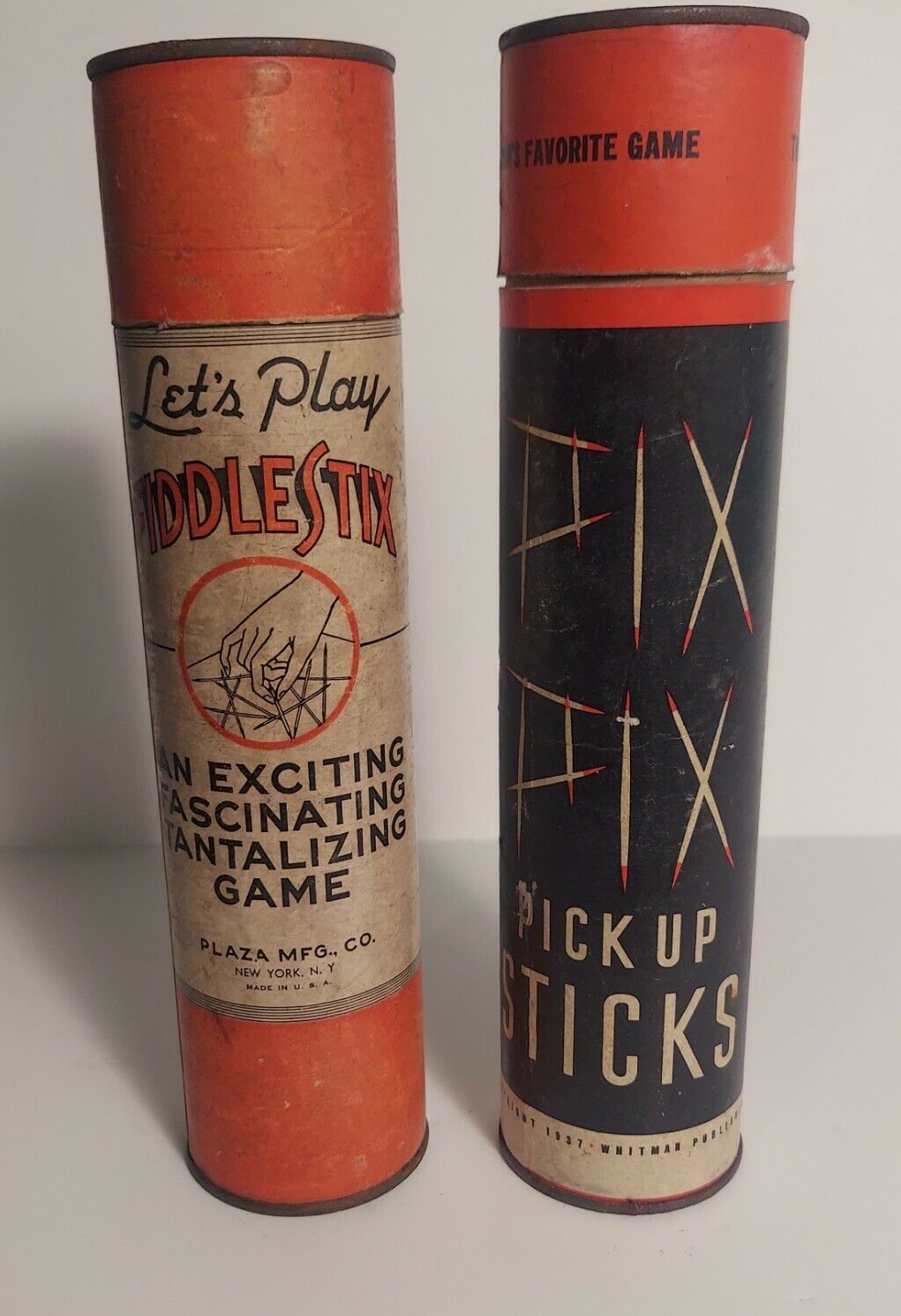
Pix Pix Pick Up Sticks:

This lovely old game feature thin wooden skewers painted in a variety of primary colors. The game involved holding the skewers upright, then letting them splay outward on a hard surface. The object of the game was to try to extract as many of your color skewer without moving any other skewers. We especially enjoyed flicking one stick into the air with the point of another.


Big Little Books

While not toys per se, these fat little books brought hours of fun. I can no longer remember the titles—I believe there were a couple that featured cartoon characters like Goofy or Donald Duck, and a Little Orphan Annie one. Most were nearly an inch thick, and had thick, coarse pages that felt a little like cheap, thin construction paper. The paper was prone to growing brittle as years passed, so most of the books had pages with little triangles of corners missing, broken off as we turned the pages. The books were just the perfect size for small hands, and fat like adult books, so we felt a little more grown-up reading them.

All the toys and books at my grandparents’ house were sold or thrown away when her property was auctioned off in the early 1980s. She could no longer live alone at the farm, so moved in with my Uncle Dwight and his wife Rosie. The farm and house were sold. My family kept a few things, but now that my brother and I are older and more aware of what is valuable—both monetarily and emotionally—we wish that we had kept more things back from the auction, especially some of the toys that held such sentimental value for us. What I wouldn’t give for a chunky, rubber cow or sheep to set on a shelf, or to hear the soft clatter of a shower of pick-up sticks!