Thursday, January 5, 2023

Carried Off to Montreal: 52 Ancestors 2023 Prompt “Out of Place”

Taken Prisoner in Queen Anne’s War: Sarah Randall Cole’s 1703 Travail

Sarah Elizabeth Randall: 1661-1713 (Maternal 8th Great-Grandaunt)
Joseph Cole: 1659-1703
Deborah Marie Madeleine Cole: 1698-1744
Mary Marie Therese Cole: 1701-1761


Sometimes the oldest records I unearth can produce the most surprising and fascinating stories. While working on my maternal lines recently, I identified another of my 8th great-grandfathers, Richard Randall II, born in New Hampshire colony in 1658. I added Richard, his parents, and his siblings to the family tree. The siblings included a sister named Sarah Elizabeth Randall, born just three years after Richard in 1661. Following my usual practice, I looked at the Ancestry hints for Sarah, hoping to pinpoint her birth and death dates, and the name/s of any spouse/s. That’s when I noticed an anomaly in the hints: a 1704 baptismal record for an adult Sarah from a Catholic church in Quecbec! Sarah was born to Protestant English parents in an English colony. Why would she be converting to Catholicism in Canada? Why would she be so out of place?

The answers were quite amazing. 1703 was a pivotal year for Sarah and her family. In 1698 Sarah married a man named Joseph Cole from the area near Fort Saco in Maine. They were rather old for a first marriage—if Sarah’s birth date of March 24, 1661 is correct, she was nearly 38 years old, and Joseph was a year older. The couple started their family quickly. Daughter Deborah was born the year they married, and daughter Mary was born in 1701. Joseph also had a son from his first marriage, probably named John. 

The northernmost English colonial settlements like Saco were under continuous threat from the late 1600s through the early 1700s, as part of a proxy war between England and France. The French manipulated the indigenous tribes in the area, stoking their resentment of the settlers and encouraging and financing raids on English settlers. The year 1703 saw a renewal of this conflict. An article on fortwiki.com explains the situation:

“Queen Anne came to the English throne in 1702 and renewed hostilities with the French. In August 1703 some 500 French & Indians attacked English settlements between Casco and Wells. The assault at Fort Saco resulted in eleven killed and twenty-four taken prisoner. In all, one hundred and thirty people were killed and taken prisoner.”

Fort Saco, 1699 map

It appears from the few records I can find that Joseph Cole and his son were among the settlers killed in the raid, and Sarah was taken prisoner along with her two little daughters. They were taken to Canada by the Wabanaki warriors, where they were apparently ransomed by a French landowner, Pierre Boucher, sieur de Boucherville. Sarah became his servant.

Sarah’s young daughters were given new French names and were baptized into the Catholic faith just months after their capture. Deborah’s baptismal record is below. The translation is as follows:

“The same day 8th of December of 1703 was baptised by me priest Marie Madeleine (also named Deborah) (Coal) Cole English born at (?) in New England on the 7th of October 1698 from the marriage of late Joseph Coal English protestant from Sackow and Sarah Sara Randal kidnapped from said place of Sackow on the 21st of August of this year and brought with her children to Canada.”


As we see in the record, Deborah is now called Marie Madeleine Cole. Little Mary becomes Marie Therese. The baptism records and prisoner lists were compiled and translated in Emma Coleman’s book cited below.

Sarah was pregnant at the time of her capture, and on January 29, 1704 she gave birth to another daughter she named Priscilla. The baby was baptized on the day of her birth. Priscilla did not survive, apparently dying shortly after birth.


Sarah finally agreed to be baptized into the Catholic faith some months later. Her baptism record bears the date April 27, 1704, and notes her maiden name, Randall (although it was misspelled by the priest), her marriage to Joseph Cole, and that she was “inhabitant of Saco in New England, taken the 22 Aug. 1703, living in the service of Mr. Boucher…”

Unlike the records for her daughters, the record notes Sarah “has made abjuration of heresy”, which implies she had to publicly renounce her own faith. The other important thing to note is in regard to the witnesses to the baptism:

“Her Godfather was Monsieur de la Perriere, son of Mr Boucher and officer in the troops…”

I question whether Sarah’s conversion to the Catholic faith was voluntary. The presence of her master’s son, possibly in his military uniform, implies the threat of force. She was totally at the mercy of the Boucher family, forced to work for them after they “ransomed” her—basically she was purchased by them and was seen as little more than property.

Pierre Boucher


The Coleman book notes that Sarah and her two daughters were listed on the French government’s “Roll of 1710/11” as prisoners in Canada, so they were still being held by the Boucher family seven years after their baptisms.

The colonial governments continued to negotiate with the Quebec government, trying to broker returns of prisoners. At some point following the 1710 Roll, Sarah was offered the chance to return to the English-held colonies. The records claim her daughters “chose” to remain in Canada, but I question how much choice was involved. Both girls were minors, who had spent most of their childhood with the Boucher family, speaking French. They likely had no memory of their lives back in Maine. They no longer even had their birth names. They had basically been absorbed into French society.

Accounts by other female prisoners who returned to the New England colonies after captivity in Canada reported they were told that while they could return to their homeland, their children could not. They had two choices: give up their rights to their own children and return to the English colonies alone, or to remain in Canada if they wanted to stay with their children. This was a cruel, brutal choice. Sarah’s life in the Boucher household must have been absolutely miserable to have induced her to abandon her children.

But abandon them she did. Her husband dead and their Saco home probably burned by the Wabanaki, Sarah did not return to Maine. Instead she moved to Beverly, Massachusetts early in 1710, which is where her sister Priscilla had settled with her husband William Preston or Presbury. Sarah quickly entered into a marriage contract with a Beverly widower, Captain Thomas West, on March 29 1710. Two months later, on May 25, 1710, the pair were married by a Robert Hale, Esq. These records appear in the Massachusetts, U.S., Town and Vital Records, 1620-1988 database cited below.

Sarah was widowed again when Captain West died in 1723. Sarah and her sister Priscilla Presbury transferred land still owned by their father in 1727. The Genealogical Dictionary cited below states,

“In 1727 Sarah West and Priscilla Presbury of Bev., widows, ch. And only heirs of Richard Randall late of Cape Porpus, deeded a Cape P. town gr. Of 1681-2 to Edward and Stephen Presbury of Newbury, shipwrights.”

Cape Porpus (or Cape Porpoise) was in Maine near Saco, where Sarah lived with first husband Joseph Cole until the Wabanaki attack in 1703. Edward and Stephen Presbury were two of Priscilla’s several sons, so Sarah’s nephews.

This land transfer was the last record I was able to find for Sarah Randall Cole West. It is believed she died the same year as the land transfer, but I have been unable to confirm this.

As for the daughters Sarah was forced to leave behind in Canada, both were made French citizens just months after Sarah returned to New England. The girls were only 12 and 10 years of age, so hardly able to make such a decision for themselves.

Boucherville in 1724

Quebec notarial records cited below show they both married Frenchmen from the Boucherville area. Marie Therese, born Mary Cole, married Pierre Rougeau, son of Jean Batiste Rougeau (also Berger) on January 16, 1716. She was 16 years old and Pierre was 21. Marie Madeleine, formerly Deborah Cole, married Simon Seguin dit Laderoute on November 10, 1715. She was only 17, while her husband was 31. Once again, I wonder whether she had any say about her fate. The Boucherville records include the baptism records of Mary and Deborah’s children; each woman had several offspring. I wonder if Sarah’s daughters were ever able to communicate with their mother after she returned to New England, or if even letters were forbidden between the warring colonies.

I am so grateful that I happened to notice a record that seemed out of place, prompting me to research the tragic life of Sarah Elizabeth Randall more thoroughly. Sarah and her daughters must have always felt “out of place”—the trauma of 1703 must have haunted their lives, both in Canada and back in New England.


Sources:

http://www.fortwiki.com/Fort_Saco

Ancestry.com. Genealogical Dictionary of Maine and New Hampshire [database on-line]. Provo, UT, USA: Ancestry.com Operations Inc, 2007.
Original data:Libby, Charles Thornton. Genealogical Dictionary of Maine and New Hampshire. Portland, ME, USA: The Southward Press, 1928.

https://en.wikipedia.org/wiki/Queen_Anne%27s_War

New England Captives Carried to Canada Between 1677 and 1760 During the French and Indian Wars, Emma Lewis Coleman. Southworth Press, Portand, Maine. 1928. Accessed via google.com/books.

Ancestry.com. Massachusetts, U.S., Town and Vital Records, 1620-1988 [database on-line]. Provo, UT, USA: Ancestry.com Operations, Inc., 2011.
Original data:Town and City Clerks of Massachusetts. Massachusetts Vital and Town Records. Provo, UT: Holbrook Research Institute (Jay and Delene Holbrook).

Quebec Notarial Records: Bibliothèque Et Archives Nationales Du Québec; Montréal, Quebec, Canada; Collection: Fonds Cour Supérieure. District Judiciaire De Montréal. Cote Cn601. Greffes De Notaires, 1648-1967.; District: Montreal; Title: Labeaume, Marien Tailhandier (1699-1730)

Sunday, January 1, 2023

Family Photo Identified at Last: 52 Ancestors 2023 Prompt “Favorite Photo”


Norway Wedding Photo Now Proudly Hangs in Minnesota

Ove Syverson: 1841-1882 (Paternal Great-grandfather)
Ragnhild Olsdatter Ve: 1848-1933 (Paternal Great-grandmother)


My brother has rescued many family photos from the attic of the farmhouse that has been in the family for three generations now. He has painstakingly and beautifully refinished and restored the often elaborate frames, and has hung the largest and oldest in the stairwell of the home. I was fascinated by one photo in particular, but hadn’t been sure of the identity of the young couple depicted. Over Thanksgiving this year, my brother refreshed my memory: the photo depicts our great-grandparents, Ove and Ragnhild Syverson.


This photo is such a treasure! Ove died just a few years after the couple and their children had immigrated to the Linden Lake/Lake Hanska area of Minnesota. He was killed in a farming accident at the young age of 41 when my grandmother, Regina Syverson, was only ten years old. During their early years as homesteaders, the Syversons had no money to pay for a sitting with a photographer, so this photo is the only image of Ove I have ever seen, and was probably the only image his young children had to remember him by.

Ove's death record--1882 Brown County Minnesota

In addition, this is the only photo I have ever seen of my great-grandmother Ragnhild as a young woman. In her old age, she looked quite different. She styled her hair severely and had a rounder, fuller face. In addition her lower jaw looked smaller—I think she may have lost most of her teeth, causing the jawline to compress. 

Ragnhild in her old age


But in this photo I can see the resemblance to her daughter, my grandmother Regina Syverson Peterson, and to her grandchildren, including my father. She is quite beautiful.


My dad, Juhl Peterson, and his mother Regina and grandmother Ragnhild above.

This photo was probably taken on the occasion of Ove and Ragnhild’s wedding. They were married around 1866, when Ragnhild was 18 and Ove 25. The only potential wedding record I have found thus far was from Opland rather than Fjordane and the birthdates and parents’ names don’t match. So as yet I have no marriage record to help me definitively date the photo.

The photo emphasizes Ove and Ragnhild‘s amazingly light blue eyes—even in the sepia-tone photo, those pale irises are arresting. I see where my dad’s wintry blue eye color came from. It appears Ove and Ragnhild were each photographed separately and their images joined in a single photo by the photographer. Not only does my brother have a separate photo with just Ove’s identical image to support this theory, but you can see that Ragnhild’s image is slightly larger than Ove’s, making the photo look slightly off-balance.

Both young people posed stiffly, and probably wore their most formal clothes. They obviously took this event seriously. I love the silk tie Ove wore with his black suit. Ragnhild’s dress appears so perfect except for the white ruffle along the neck that is hiked up higher on the right side.

The Syverson family obviously treasured the photo, placing it in a beautiful oval wood frame—the wood grain, restored by my brother, is lovely. We are fortunate that the oval bubble glass survived all these years—replacing it now costs a fortune.


My brother and his family continue to treasure and preserve this photo of our great-grandparents, an image that has survived nearly 160 years.

Saturday, December 31, 2022

The Path Ahead: 52 Ancestors in 52 Weeks Prompt “Looking Ahead”

 2022 into 2023


Before I can really look ahead, I need to take a quick look back at 2022. I finished 56 blog posts—more than one a week! I also completed blog posts for each and every one of Amy Johnson Crow’s 52 prompts—the first time ever that I fulfilled that goal!

So what was the breakdown between the two sets of family trees among those 56 posts?

I completed thirty posts about my Peterson/Macbeth ancestors, on topics ranging from family photos and photos of horse teams to a lawsuit over an estate. I had some exciting “brick wall” breakthroughs. First, I confirmed my third great-grandfather Charles Macbeth’s parentage, and found his siblings. Second, I made huge strides in expanding my great-grandmother Ragnhild Olsdatter Syverson’s family tree, discovering that several Hanska area families descended from her nephews.

I completed twenty-six posts on the Aird/Jandy family tree blog. I made so many fascinating discoveries. I found a cemetery in Kentucky where all 43 graves are people on the family tree. I discovered an ancestor who is reputed to haunt a local Orange County canyon. I also learned how much information could be gleaned from death notices and death certificates, discovering the tragic toll of tuberculosis on one branch of the Smith family, and a mysterious murder on another branch.

I am eager to begin a new year of 52 Ancestors in 52 Weeks. I have downloaded Amy Johnson Crow’s 2023 prompts, and I have already compiled a list of fascinating stories that I want to write about.

My only problem is that many of the stories I want to tell don’t match up with this year’s prompts. So what should I do?

I think I will use Amy’s prompts when it suits me, and make up my own when necessary. I don’t want to forget significant discoveries and fascinating tales just because they don’t fit Amy’s prompts. When I make a discovery and have all the documentation right in front of me, I’m going to write it up.

I believe I can do 52 blog posts again, although it may be difficult with a lot of other tasks ahead of me this year. However, I’m going to try. I’m having so much fun writing up my discoveries, so why stop?

Onward to new discoveries and new stories in 2023!

Sunday, December 11, 2022

New Year’s Eve Oysters: 52 Ancestors 2022 Prompt “Tranditions”


Grandma’s New Year’s Eve Prescription: Oyster Stew

Nora Elsie Hoffman Macbeth: 1899-1994


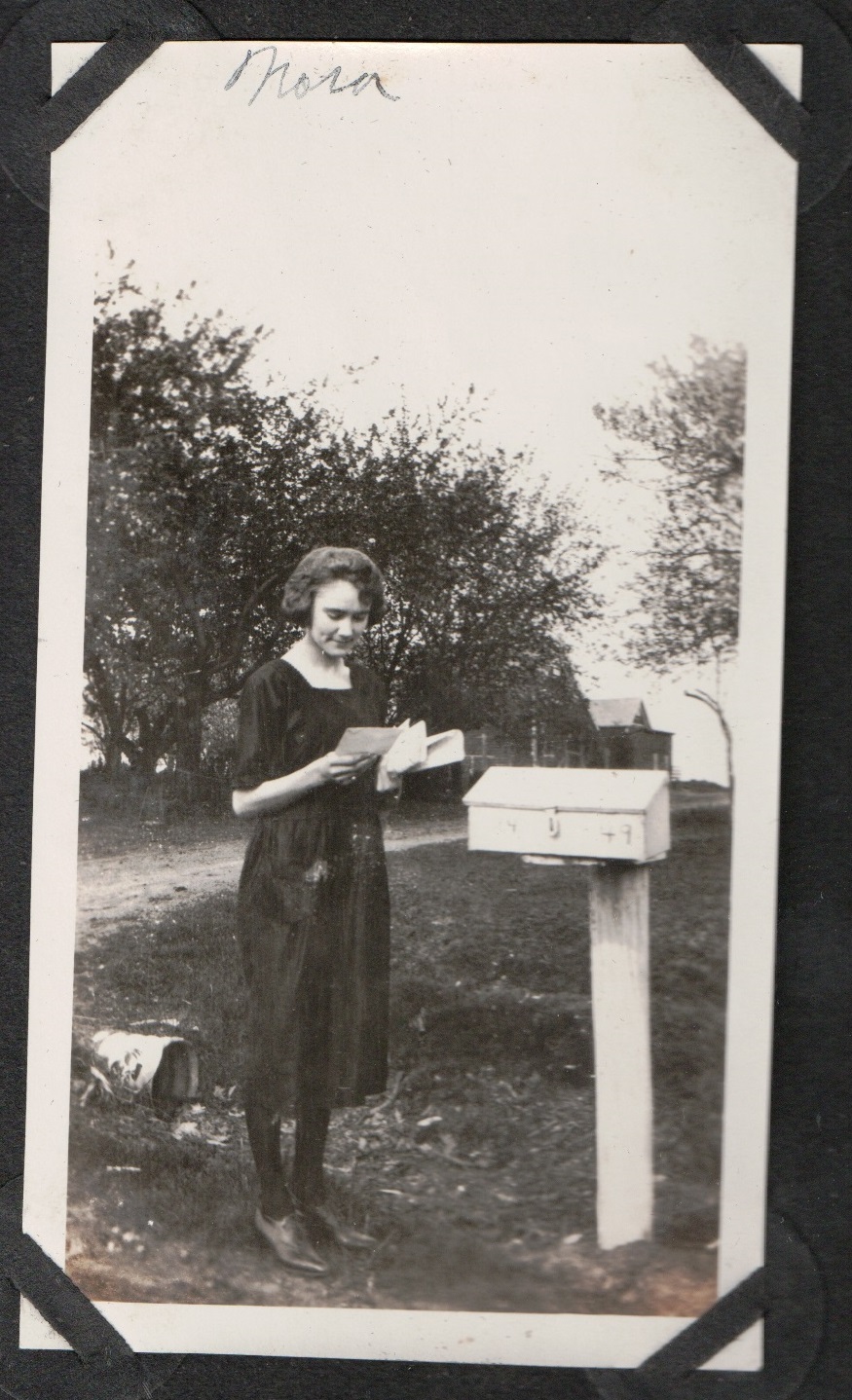
For my Grandma Nora, the New Year couldn’t start properly without a good helping of oyster stew the night before. My mom picked up the tradition, and every year we’d be shopping for canned oysters at the rural Minnesota supermarkets near our home. Amazingly, they were always available, so I suspect that this tradition was fairly common in the area.

Grandma Nora as a young woman


My Grandma Nora’s parents were both of German descent. I believe she acquired the recipe and the tradition from one of them. According to my Google research, oyster stew was only a holiday tradition in the northern areas of Germany, possibly due to the closer proximity to the sea. Lena Funk’s father emigrated from northern Germany, so perhaps the oyster stew was a little piece of the Old Country he brought with him.

Apparently more people serve oyster stew on Christmas Eve rather than New Year’s Eve. However, the tradition makes more sense to me as a propitious way to begin a new year since the oysters are believed to promote libido and fertility. It’s very similar to the southern tradition of eating black-eyed peas for the same reason.


I’m not sure if my grandmother was trying to promote healthy libidos or not. I know that she was rather superstitious, and claimed that consuming oyster stew on New Year’s Eve brought good fortune in the coming year.

Another genealogist who had the same New Year’s Eve tradition found an authentic German recipe for the stew or soup that sounds close to the one my grandmother and mother used (I used Google Translate to convert it into English):

Austernsuppe  (Oyster Soup)

Portionen: 4

Oyster soup ingredients

24 oysters (with juice)

40 grams of butter

3/4 cup(s) whole milk (hot)

Sweet paprika

Salt

Pepper

For oyster soup, cook the shelled oysters in the hot butter with the oyster juice.

As soon as the oyster crusts begin to curl, add hot milk, season with salt and pepper and heat through.

Serve the oyster soup in soup bowls sprinkled with sweet paprika.


My grandmother used more milk than this, and less butter. Fresh oysters were hard to find in Minnesota at the best of times, and in winter during the 1970s was nearly impossible. We used canned oysters. I recall that she added carrots and onions, and occasionally potatoes. Here is a recipe that is more similar to hers:

New Year’s Oyster Stew

4 servings

1/2 cup water

1/2 cup minced onion

1/4 cup diced celery

1/4 cup diced carrot

1/2 teaspoon mild paprika

1/8 to 1/4 teaspoon cayenne

1/4 to 1/2 teaspoon salt

1/8 teaspoon black pepper

8 ounces bottled fresh oysters with liqueur

4 cups nonfat milk

1/2 cup nonfat dry milk powder

1 cup half-and-half

Combine water, onion, celery, carrot, paprika, cayenne, salt and pepper in a small pot. Cover and simmer over low heat until vegetables are tender. If necessary, add more water. Strain oysters and pour the liqueur into the pot with the vegetables. Chop oysters into 1/2-inch pieces and set aside.

In another pot, stir together the liquid milk, dry milk and half-and-half. Heat at medium-low temperature until warm. Stir in the vegetable mixture and increase the temperature slightly. Cook 1 minute and add the oysters. Heat at medium heat until hot. Serve immediately.


My family’s soup was served with saltines, or even more appropriately, oyster crackers. I remember how my brother and I loved the oyster crackers. It was a fairly bland dish, which was probably why I enjoyed it as a child.

Sadly, I didn’t carry on this tradition. I only made the soup once or twice when my own children were young. I’m not the biggest fan of canned oysters, and my children weren’t impressed. Perhaps I should try again with fresh oysters.


Sources:

Recipe courtesy of https://www.ichkoche.at/austernsuppe-rezept-179466

https://www.dglobe.com/news/celebrating-christmas-german-style

https://www.sandiegouniontribune.com/sdut-lz1f31history182839-oyster-stew-holiday-tradition--2008dec31-story.html#:


Wednesday, October 19, 2022

New Parents, New Siblings for Charles Macbeth: 52 Ancestors 2022 Prompt “New Horizons”

Parentage Correction Opens New Horizons in Macbeth Family Research

Charles Macbeth: 1828-1913 (Maternal Second Great-Grandfather)
Colin Macbeth: 1834-1883 (Maternal Second-Great-Granduncle)
Charles Macbeth: 1801-? (Maternal 3rd Great-Grandfather)
Ann Williamson Macbeth: 1807-1838 (Maternal Third Great-Grandmother)


I was always puzzled by the few measly records I’d found for my second-great-grandfather Charles Macbeth. Other Ancestry and Family Search trees listed him without siblings, and said his parents’ names were John and Mathilda. However, the records for John and Mathilda didn’t seem to match up with Charles’ birthdate as listed on his American records. Also, John and Mathilda lived in Scotland, while Charles often stated on census records that he was born in England--only his parents were born in Scotland.

And then there was that pesky second family of Macbeths in the same small city in Minnesota as Charles—a family that used many of the same first names for their children as Charles and his wife chose. This Mankato family was headed by a man named Colin who was just a few years younger than Charles. Was it possible that they were related somehow? Could Charles have had a sibling?

I vaguely remembered finding an obituary notice for Charles that provided background on his parents—but I had failed to attach it to Charles in Ancestry (I found it a few years back, before I really understood how to save news articles from Newspapers.com to Ancestry). I remembered asking my mother about certain details in the article, asking if her father or grandparents ever talked about them. Obviously, I needed to relocate that article. It was time to solve the parentage puzzle once and for all.


I finally tracked down the mystery article. It wasn’t Charles Macbeth’s obituary, which was rather boring and lacking in detail. The juicy information was contained in a Fort Wayne Weekly Sentinel article about Charles Macbeth’s funeral in Tivoli, Minnesota-- he had died at the Fort Wayne home of his son, Dr. Albert Macbeth, but was buried back at his home in Blue Earth County. Paragraph two stated,

“The senior Macbeth was born in Scotland, November 27, 1827, and the first eleven years of his life were spent in the gardens of the king at Bradford, his father having been selected as chief gardener of one of the estates.”

Here was information that totally contradicted the data for John and Mathilda Macbeth. Bradford, I learned, was in Yorkshire, England, not Scotland. A quick search on Ancestry pulled up the 1841 England census entry for Charles Macbeth in Bradford, Yorkshire. He was 13 years old, living with his father, 40-year-old Charles Macbeth (referred to from now on as Charles Sr. for clarity), a gardener. He was also living with four siblings, 10-year-old Ann, 8 year-old Barbara, 6 year old Colin, and 4-year-old James. Suddenly a whole new horizon of research had opened up before me!

1841 England Census--Charles Sr. on previous page

There are some problems with the information. I have been unable to find any property in the Bradford area that was ever owned by the King of England. There were a couple large estates owned by members of the nobility. I surmise Charles Sr. worked at one of those properties.

The news article provided more important hints for me to verify. It stated:

“In 1837 Mr. Macbeth landed in New York with part of his family, his mother having died when he was eleven years old, and he was married in 1852.”


This explained why Charles’ mother was not listed on the 1841 census form—she had already died. I returned to Ancestry to verify this information, and quickly found her death recorded in the parish records of the Bradford Cathedral. It stated that 31-year-old Ann Macbeth was buried May 23, 1838. I had also found the baptism records for all five Macbeth children in this church’s records, including Charles birth record which matched information he’d provided on forms in the United States. This was the correct Ann Macbeth.

Bradford Parish Church 1800s

I was also able to discover Ann and Charles Sr. Macbeth’s marriage record. They were married in a Yorkshire parish not far from Bradford called Welton-with-Melton on March 23, 1823. I calculate that she was 16 or 17 at the time of the marriage if she was 31 at her death. Charles Sr. was 22. It appears that Ann was English, while Charles Sr. was from Scotland.

The article also stated that Charles and part of his family had immigrated to New York in 1837. Obviously that date was incorrect, as they were still in Bradford in 1841 during the census. I believe the date was a typo—the true immigration date may have been 1847. One of two other obituaries said 1848. However, on the US census in 1900, Charles states that he arrived in 1850. I hypothesize that he arrived late in the 1840s. After all, Charles was in New York in time for the 1850 census. He was living in Black Rock, a neighborhood in Buffalo, New York, with the family of a grocer named James Shackleton. Charles’ occupation is not listed. Was he working for Mr. Shackleton?

And what about his siblings and father? According to the article, some of them had immigrated with Charles. While I found no records for Charles’ father or his sister Barbara Macbeth, I found the remainder of Charles’ siblings, all in the Buffalo area.

Nineteen-year-old sister Ann was living in Buffalo’s third ward as a boarder in the home of the William Glenny family on the 1850 census. The household also included four additional boarders, a teen girl and three men, including a doctor. Neither young female boarder had an occupation listed.  Perhaps Ann was working as a servant, helping Mrs. Glenny manage the household. I have found no further records for Ann in the United States.

Ann Macbeth on 1850 census in Buffalo NY

The youngest sibling, James, does not appear on the 1850 census, but he is on the 1855 New York State census, living in the household of “lake captain” William Dickson. James was 19 and working as a servant. While the census taker wrote that he was born in Erie County, this James Macbeth later enlisted in the military, with far more accurate information. The 1858 enlistment form stated that James was 21 years old, born in Yorkshire, England, worked as a gardener, and was 5 feet 8 inches tall, had grey eyes, dark hair, and a “swarthy” complexion. James appears to have followed his father into gardening as a career. Sadly, James disappears from records after enlisting—his enlistment term was five years. I may have found him on the 1860 census serving in the army in San Miguel, New Mexico Territory. A private named James Macbeth is listed. He was born in England, but the age listed appears to be “20” when he would have been 23, so this may not be him.

James Macbeth Army Enlistment--1858

The final brother, Colin, appeared on the 1855 New York census living in the household of Anna, Isaac and Abner Bryant, who seem to have run a plant nursery business. Colin was 19, was listed as having been born in Scotland, and was working as a gardener—probably for the Bryants’ nursery business. I cannot find him on the 1860 census, but by 1864 he was living in Minneapolis, Minnesota. He appears in a city directory and registers for the Civil War draft that year. He was 28, and may have been working as a teamster if the transcription of very murky handwriting on the form is correct.

The 1870 census finds Colin Macbeth living in Mankato, just a few miles from his brother Charles. Colin is married to wife Ellen and they have three children. The oldest, also named Charles, was 7 in 1870 and according to the census he was born in Minnesota. Therefore, Colin and his wife must have arrived in the state before 1863. Colin was working as a “cattle driver”. Later censuses stated he was a “cattle trader” or “stock trader”. He remained in Mankato for the rest of his life, and he and Ellen had a total of six children. Colin died in 1883.


One of Charles’ obituaries said that he married Nancy Ann Herniman in 1852 and moved to Tivoli, Minnesota around 1866, traveling part way by train and the last section by an ox-drawn covered wagon. This would mean he arrived in Minnesota a few years after Colin.

My experience researching Charles Macbeth’s parentage shows how a single newspaper article can open entire new horizons of research. I now know that the other Macbeths in Mankato, Minnesota were related to my second-great-grandfather, and I have six new cousins—Colin Macbeth’s children—to research. In addition, I still need to keep searching for records that will shine a light on the fates of Charles and Colin’s three siblings. An exciting vista awaits.


Sources:

“Aged Man Passes Away: Father of Prominent Local Physician Is Dead.” Fort Wayne Daily News, Fort Wayne, Indiana · Saturday, May 31, 1913 https://www.newspapers.com/image/28992752/?article=ee6bd44e-e9ce-405b-b0f6-4f9fef0bcaa3&focus=0.694421,0.4413672,0.82448727,0.69023705&xid=3355&_gl=1*5z945k*_ga*MTQ5MDkwODUzMi4xNjI2MjI0NDE0*_ga_4QT8FMEX30*MTY2NjE5NTUwMS4yNzUuMS4xNjY2MjEzNjY0LjE1LjAuMA.

Fort Wayne Weekly Sentinel

“Family Met at Childhood Home: Buried the Father.” Fort Wayne Weekly Sentinel. Fort Wayne, Indiana. Monday, June 09, 1913. https://www.newspapers.com/image/7237887/?terms=charles%20macbeth&match=1

Ancestry.com. West Yorkshire, England, Church of England Deaths and Burials, 1813-1985 [database on-line]. Lehi, UT, USA: Ancestry.com Operations, Inc., 2011. Original data:Yorkshire Parish Records. Leeds, England: West Yorkshire Archive Service. New Reference Number: BDP14. Ann Williamson Macbeth Death Record from Bradford St. Peter Cathedral records, 1838.

Ancestry.com. U.S., Army, Register of Enlistments, 1798-1914 [database on-line]. Lehi, UT, USA: Ancestry.com Operations Inc, 2007. Original data:View Sources. James Macbeth 1858 army enlistment.

Saturday, October 15, 2022

Doctrinal Disagreement or Mental Illness? The Strange Case of Theophilus Eaton’s Second Wife Anne 52 Ancestors 2022 Prompt “Perseverence”

The Excommunication of Gov. Eaton’s Wife in the New Haven Colony

Theophilus Eaton: 1591-1657 (Maternal Tenth-Great-Grandfather)
Anne Yale Eaton: 1595-1659 (Wife of Maternal Tenth-Great-Grandfather—not my ancestor)
Mary Eaton Hill: 1625-1708 (Maternal Ninth-Great-Grandmother)


One of my maternal tenth-great-grandfathers, Theophilus Eaton, was a fairly important man in colonial America. He was one of the Puritan founders of the city of New Haven, Connecticut, and served as the first Governor of the New Haven Colony from 1639 until his death in 1657. Since he was a significant figure in Connecticut history, records relating to his life and the life of his second wife, Ann Lloyd Eaton, have been preserved. Among those records were the transcripts of Anne Lloyd Eaton’s church trial for disagreeing with articles of church faith, and for general bad behavior. It is hard to imagine that such a well-respected man would have had such a wild, scandalous home life!

Statue of Gov. Theophilus Eaton in Connecticut

Anne Lloyd was the widow of Thomas Yale and the mother of Yale’s four children when she married Theophilus Eaton in 1626. (Yes, that Yale. Thomas and Anne Yale were the grandparents of Elihu Yale, founder of Yale University.) Eaton was a widower with four children of his own, including my ancestor and ninth-great-grandmother Mary Eaton, born in 1625. Following their marriage, Theophilus and Ann had at least three children of their own, Hannah, Elizabeth (died in early childhood) and Theophilus.

In 1637, Theophilus Eaton chose to accompany his childhood friend, Puritan minister John Davenport, to colonial America aboard the ship Hector. He brought most of his family with him, including his elderly mother and his stepchildren. After spending nine months in the Boston and Salem area, the Davenport group decided to found their own colony. They moved to lands inhabited by the Quinnipiac tribe in what is now Connecticut, and spent fourteen months building the original New Haven Colony settlement. Eaton helped to negotiate a deal with the Native Americans to acquire their land and helped to draw up a contract that spelled out the community’s governance, and was soon elected the colony’s governor.

The homes erected in New Haven were far larger and more luxurious than most 1630s and 1640s colonial homes. The Eaton home was the largest of them all, with two sources claiming it had 27 rooms and 19 fireplaces. The household comprised nearly thirty people, with servants and wards in addition to the family. The house was built in the shape of an “E”, and was furnished with Turkey carpets, tapestries, and fine furnishings.

Sketch of Gov. Eaton's large home in New Haven

According to the inventory taken at Eaton’s death in 1657, the rooms of the house included the “”greene chamber…blew chamber..” the hall, parlor, Mrs. Eaton’s room, a chamber over the kitchen, the kitchen, the “other chamber”, the garret, the counting house and the brew house.

So while Anne Yale Eaton had to leave the comforts of life in England behind for the uncertainties and challenges of colonial life, she was living in far better conditions than other colonial women, and she had servants to help her with the unending work of managing a large household. Still, the pressures were enormous, and her relationship with her husband seems to have frayed.

Anne was well-educated for her time, and was able to read. Influenced by a book advocating adult baptism (Anabaptist belief) rather than the Puritan practice of infant baptism, she began talking about her beliefs to others, attracting the attention of Rev. Davenport. He responded by preaching a sermon refuting her beliefs. She was heard muttering “It is not so” as he spoke. She began walking out of church services whenever there was a baptism or when the Eucharist was offered. This infuriated Davenport and scandalized the colony.

Probably due to Gov. Eaton’s position in the colony, the church first chose to censure Anne, and gave her several months to repent her doctrinal errors. Church elders were sent to meet with her, to read the book she was influenced by, and refute its claims. She stubbornly refused to change her mind. Imagine her personal strength—men were visiting to harangue her, nearly the entire community was shunning her, her mother-in-law loathed her, and probably her husband was also angry with her. Yet she persevered and held her ground.

By June 14, 1644, the church elders decided to put her on trial, so to speak. Rev. Davenport reported on her original doctrinal sin, stating that

“…she neither asked her husband at home according to the rule 1 Cor. xiv, 35 (whose faithfulness and sufficiency to have held forth 'light to her according to God, we all know) nor did she seek for any light or help from her pastor according to the rule. Mala, ii, 7, though in other cases she has come freely to him, and departed from him not without fruit; nor did she seek help from the body whereof she is a member, nor from any Member of this body, save that she showed her book with the charge of secrecy to one or two whom she hoped to gain to her party, and so to have made way for a further spread of her infection in the body.”

This passage shows the anger and disgust of the church leaders, who saw her questioning of church doctrine as an “infection”. It also shows the powerlessness of women in Puritan society, who were ordered by the Bible to submit to their husbands and ministers and were to have no independence or free will.

When he brought Mrs. Eaton’s case before the church for “trial”, Davenport went far beyond his original complaint. He collected gossip and malicious stories about Mrs. Eaton, and fashioned it into a list of supposed crimes she had committed, linking each to one of the Ten Commandments which she was violating. He read those out to the assembled congregation. Among the crimes were the following:

1.      She struck her mother-in-law in the face during dinner, and Mr. Eaton had to restrain her.

2.      She accused her step-daughter (my direct ancestor) Mary Eaton of knitting two gloves and hiding one, and then struck Mary when she said she’d knit only one.

3.      She accused poor Mary of possibly being pregnant:

“saying her belly was great and her breasts big almost to meet, and she looked blue under the eyes, and that she vomited, and that she looked very ill, and she feard her sickness would prove an ill sickness.” She went on to say that Mary’s “carriage was wanton” (her way of walking and moving looked slutty).

4.      She said Mary Eaton was “the cause of the ruin of the souls of many that came into the house”.

5.      She spilled milk while heating it, and blamed Mary Eaton for the spill.

6.      She claimed Mary Eaton “wrought with the devil.”

7.      She got upset with the servant girl/ward Mary Launce and pinched and hit her in the face.

8.      She demanded to know when Mary Launce was leaving the household, then denied knowing she was going to leave her employ.

9.      Anne Eaton’s mother-in-law had moved out (to get away from her vicious daughter in law?) and Mary Launce went to work for her, throwing Mrs. Eaton into a rage.

10.  The mother-in-law, trying to keep the peace, sent Mary Launce over to help Mrs. Eaton several times, but Mrs. Eaton turned her away, and then lied to her husband that the girl had never offered her help.

11.  She accused a black servant of bewitching the beer she was brewing.

12.  She accused another maid, Mary Breck, of lying, stealing, whoring and working with the devil.

13.  She told her maids God would “send their souls to hell”.

14.  She used “unpeaceable” words (swearing?) against the servants.

15.  She muttered “it is not so” in response to Rev. Davenport’s sermon.

16.  She argued with her husband in front of guests regarding whether he had given her candles or not.

17.  When she got angry with a male servant and her husband took the man’s side, she told Mr. Eaton “you and this man may go together” and she spoke of her desire “of getting from her husband.” This, Davenport complained, “is against the Covenant of Marriage.”

Map of New Haven Colony with Eaton Home lot in lower right

In addition to this lengthy litany, the congregation heard testimony from other members of the household, who said that Mrs. Eaton frequently lied and was verbally abusive to the servants. The servants said they tried to please her but couldn’t. Poor Mary Eaton also professed that “it was the desire of her heart to give her Mother content and not willingly provoke her.”

Finally, a Brother Bradley, another employee, testified that “he never knew any cause given by the maids to provoke Mrs. Eaton, but they had great provocations from her, for they could do almost nothing to give her content, which did discourage them, and many times made them careless. He further saith he hath observed Mrs. Eaton's way to be very unquiet, unstable and self willed, and more of late than formerly.”

The result of this extraordinary “trial” was a unanimous male vote (women could not vote) to “admonish” her. When she failed to repent after the admonishment, they charged her again with lying, and eventually excommunicated her.

What can we gather about the Eaton household and about Anne Yale Eaton’s state of mind?

First, this was a blended family that just hadn’t blended well. Anne’s children from her first marriage had left the home as quickly as possible. Anne Eaton obviously loathed her mother-in-law, even charging her husband with “breach of promise, in bringing his Mother into the house against her will”.

She hated her step-daughter, my ninth-great-grandmother Mary Eaton, taking every opportunity to belittle her, criticize her, and accuse her of loose morals.

Possible portrait of Mary Eaton

Lastly, she wasn’t getting along with her husband, Gov. Eaton, even publically expressing her desire to be rid of him. In addition, other New Haven Colony records show that there was a lot of gossip about Mrs. Eaton. One couple was hauled into court for false witness for having been caught saying “Mrs. Eaton would not lye with her husband since she was admonished, but caused her bed to be removed to another roome…they lay apart…” So it was apparently common knowledge that Anne Eaton was refusing to have sex with her husband, bitter because he had failed to support her when she was admonished.

Researchers and genealogists who have read the trial transcript were quick to label Anne Yale Eaton as mentally ill—suggesting that she had a nervous breakdown. I can understand why they would jump to this conclusion, but I think it is equally likely that she was just angry, miserable and fed up with having no control over her own life and being under the community’s microscope every single minute. She was a strong woman with a mind of her own, and that didn’t fit into the rigid sexual roles of a Puritan colony.

I have to admire her for persevering in her Anabaptist beliefs. She never wavered, even with the community and her family pressing her to recant.

Following Gov. Eaton’s death in 1657, Anne Eaton and her daughter Hannah returned to England, following her son Theophilus who had returned there earlier. Some of the records indicate that New Haven’s residents paid for a man to escort her to a ship bound for England—it sounds as if the colony was eager to be rid of her.

Sadly Anne Eaton had little time to enjoy the more civilized society of England and her greater freedom as a widow. She died in 1659, just two years after her husband Theophilus.


Unrelated Note: Ann may have been Theophilus’ third wife. The records for Theophilus’ previous wife, Grace Hiller, are very murky. Supposedly they married in 1622, but their three oldest children seem to have been born in 1614, 1615, and 1619, several years before the wedding. Only their last child, my ninth-great-grandmother Mary Eaton, was born during their marriage, in 1625. According to most researchers, Grace Hiller died in February 1625, the same year daughter Mary was born, so perhaps Grace died in childbirth. As for the discrepancy in marriage dates, I suspect she was actually Theophilus’ second wife, and the first three children were born to his first union, but I have found no records that support my hypothesis. The other possibility is that the marriage date is off by a decade, and they were married in 1612 when Grace was 19. The third possibility is that the three oldest children were from a different Eaton family. Some sources do not include those three children as part of Theophilus Eaton’s progeny.

Sources:

Trial Transcript: https://archive.org/stream/papersnewhavenc03socigoog/papersnewhavenc03socigoog_djvu.txt

Gossip about Eaton Marriage:

https://archive.org/details/recordsofcolonyp00newh/page/270/mode/2up

History, genealogical and biographical, of the Eaton families  1911 Authors: Molyneux, Nellie Zada Rice Subjects: Eaton, Francis, d. 1633 Eaton, John, d. 1658 Eaton, William, d. 1673 Eaton, John, d. 1668 Eaton familyPublisher: New York : C. W. BardeenContributing Library: Boston Public Library Digitizing Sponsor: Internet Archive

http://collections.newhavenmuseum.org/mDetail.aspx?rID=1971.222&db=objects&dir=NEWHAVE

Sunday, October 9, 2022

Dementia in a Colonial Ancestor

Nathaniel Hill: 1659-1741 (Maternal 8th Great Grandfather)


While dementia in the elderly is a common concern in today’s world, we rarely consider that our ancestors also had to deal with dementia. Dry records from the past usually don’t refer to the mental status of our long-dead ancestors. The occasional will may state that it was made while the testator was of “sound mind and body” which indicates that some people were not sound of mind, but otherwise historical records rarely mention mental or physical illnesses. As a result, I was startled to find a history of the Hill family that stated that a 17th century New Hampshire family member, Nathaniel Hill, suffered from what sounds like dementia.

My eighth-great-grandfather Nathaniel Hill was born in the Oyster River Plantation in the New Hampshire Colony on March 16, 1659. This area is now part of the city of Durham, New Hampshire. Nathaniel was the son of immigrants Valentine Hill and his wife Mary Eaton Hill. Valentine Hill was a merchant with extensive real estate dealings. He built up great wealth, and then lost most of it in the years before his death in 1660. Nathaniel was barely a year old when his father died.

Oyster River Plantation as it existed in 1670, from the map of ‘Pascatway River in New England’ by John Scott, at the British Library

As a result of his father’s bankruptcy, Nathaniel, his mother and some of his siblings grew up in near poverty. He must have had some of his father’s business sense, however, for he built up his own holdings and had considerable property to leave to his own children. Nathaniel married Sarah Nutter around 1690. He was respected in his community, serving as a church deacon. He and Sarah had several children, at least five of whom survived into adulthood and were named in his will.

However, records state that “He gradually lost his reason and spent the last six months of his life at the residence of his son-in-law, Captain Benjamin Mathes.” Mathes was the husband of Nathaniel’s daughter Abigail.

This brief description sounds like he was suffering from Alzheimers or some other form of dementia, which would not be unusual in a man over eighty years in age. I wonder how his friends and family reacted to his affliction. In the 1700s, doctors had no clue as to the cause of dementia, and certainly no treatments. It was fortunate that Nathaniel’s daughter and son-in-law were willing to take him into their home and care for him once he was unable to care for himself. I am sure it was a difficult situation for them all.

Nathaniel died in 1741. The exact date is unknown, as is the place of his burial. His will left his properties, money and possessions to his sons Samuel (my ancestor) and Valentine, and daughters Sarah and Abigail, and to the husband and four sons of his daughter Mary Hill Burnam who had pre-deceased him.  

Sources:

Jones, William Preble, b. 1869. Four Boston Grandparents: Jones And Hill, Preble And Eveleth And Their Ancestry. Somerville, Mass., 1930.

History of the town of Durham, New Hampshire : (Oyster River Plantation) with genealogical notes. by Stackpole, Everett Schermerhorn, 1850-1927; Thompson, Lucien, b. 1859; Meserve, Winthrop Smith, 1838-