Tuesday, September 27, 2022

Honorable Soldier or Deserter? 52 Ancestors 2022 Prompt “Shadows”

The Shadow of Dishonor: A Blot on Captain Jerome Dane’s Service Record

Jerome Dane: 1828-1908 (Maternal Second Great-Grandfather)


Jerome Dane had a long military career, serving in the war against the Sioux tribes in Minnesota, and then leading an Infantry regiment as a Captain in the Civil War. However, his first military experience came as a raw recruit in the Mexican American War in the 1840s. I had very little data on this first period of service—only Jerome’s claims in newspaper interviews and in biographies in various Minnesota history books. So when I read a brief article in my genealogy group’s newsletter about a new website established by the National Park Service listing all the men who served in the Mexican-American War, I was excited. I could finally verify that Jerome Dane served in the Mexican War.

Captain Jerome Dane

I quickly found Jerome Dane’s record on the US Mexican War Soldiers & Sailors Database. While his listing verified his service, it also stated that he had not been discharged---he had deserted. I was stunned. This didn’t seem to match what I knew about Jerome. He seemed proud of his military record. And why would the army have allowed him to enlist again in the 1860s if he had a record as a deserter? He not only served again in the Infantry, he was made an officer, mustering as a second lieutenant in 1862 and getting promoted to captain before 1865. I needed more information.


Jerome Dane was born March 3, 1828 in Morganville, Genesee County, New York to parents David Dane and Sally Randall. According to a brief biography in Neill’s History of the Minnesota Valley, “At the age of seventeen he enlisted in the Mexican War; served three years.” 

This matches the record on the National Park Service website, which lists his enlistment date as December 25, 1845—quite a Christmas gift! He would have been 17 on that date, but the enlistment form, seen below, states that he was 21 years old. Did he lie or did the enlistment officer change his age on the forms because he was too young to serve?  

The record provides some fascinating details about Jerome. He was 5 feet 9 inches tall, had a fair complexion, blue eyes and brown hair. He was working as a cooper—a maker of barrels—at the time of his army enlistment.


Jerome enlisted in Buffalo, New York, nearly fifty miles from his home. I wonder what led him to travel so far for such a purpose. A Lt. Canby signed him up, and assigned him to the Infantry’s 2nd Regiment, Company E. According to the New York State Military Museum, the 2nd regiment of New York State Volunteers was under the command of West Point grad Ward Burnett. According to a Wikipedia entry on the regiment,

“When war broke out with Mexico in 1846, the 2nd Infantry Regiment was sent to Camargo, Mexico and joined General David E. Twiggs' Brigade. From September 1846 to December 1847 the regiment campaigned from the Rio Grande to Mexico City, fighting in battles at Veracruz, Cerro Gordo, Contreras, Churubusco, Moline del Rey and Chapultepec.”

The New York State Military Museum provided further detail:

The Second Regiment New York Volunteers “joined General Winfield Scott’s invasion force and landed at Vera Cruz in March 1847 and participated in the siege of that city.  The 2nd Regiment moved westward with Scott’s army, fighting in the Battle of Cerro Gordo, where it was in the vanguard in pursuing and capturing Mexican General Santa Anna, and the Battles of Contreras and Churubusco which resulted in the fall of Mexico City.

Second Regiment--Infantry Coat of Arms

Obviously Jerome saw considerable action in Mexico. How did it affect him? I also wonder how he reacted to the southern climate and Spanish-speaking population. It must have been a total culture shock for a teen from upstate New York. He probably suffered in the heat. According to the Military Museum article, the regiment began with 1000 soldiers, and suffered 400 casualties, with 199 men dying of wounds and disease.

Mexican American War illustration, courtesy Library of Congress

The Mexican war ended February 2, 1848. The New York Volunteers had been told their service would be for the “duration” of the war, although Jerome’s enlistment record shows he signed up for a five-year term of duty. According to records, “The rate of desertion during this war was 8.3%. Some deserted to avoid the horrendous conditions of the camps.” I doubt Jerome deserted due to camp conditions, as he remained with his unit for over six months following the end of the war. His desertion date is listed as August 18, 1848.

So what might have prompted him to desert his unit in August? I have a hypothesis. According to the Wikipedia article on the Second Regiment,

“In September 1848 because of conflicts with the Indians in Oregon and California the regiment was sent west. The regiment sailed via Rio de Janeiro, Cape Horn and Santiago, Chile, to California. Between 1849 and 1853 the regiment was in California occupying stations from Goose Lake on the north to Fort Yuma on the south and the Pacific Ocean on the west and the Sierra Nevada Mountains on the east, scouting, providing protection for the '49ers and fighting throughout the entire area. The regiment returned to New York in 1853.”

Imagine being a young 20 year old who has spent three long years at war, far from his home, family and friends. He had enlisted assuming his service would be over when the war was over, but instead his unit was being sent to the West Coast for more years of conflict. I suspect that he decided that his service was done, whether or not the Army agreed, and he headed home rather than get sent to some other far off place. I’m sure he wasn’t the only deserter from his regiment—he probably joined a group of soldiers heading north as traveling alone would have been hazardous. Did he even understand he was committing desertion and the potential ramifications if he was caught? I checked the records on Fold 3 of the other men from his area on the same page as Jerome’s entry. The two men from his area of New York died in battle. Perhaps this influenced his decision as well. I wonder how long it took him to make his way home, and what he told his family and friends about his separation from the army.

Did the Army also have questions about whether Jerome’s return home in 1848 was truly desertion?  Instead of throwing him in the brig when he signed up with the Ninth Regiment in Minnesota, the Army made him an officer. I suppose it is possible that record-keeping was so primitive at that point that the enlistment officers in 1862 had no way to check his 1848 record.  

Despite the shadow of desertion on Jerome’s service record, he seems to have redeemed himself as an infantry officer from 1862 till the end of the Civil War. It appears he was both a deserter and a hero—a man of many sides.


Sources:

US Mexican War Soldiers & Sailors Database. https://www.nps.gov/paal/learn/historyculture/search-usmexwar.htm#sort=Title%20asc

History of the Minnesota Valley Including the Explorers and Pioneers of Minnesota. By Edward Duffield Neill · 1882. https://www.google.com/search?hl=en&gbpv=1&dq=jerome+dane&pg=PA1004&printsec=frontcover&q=inpublisher:%22North+Star+Publishing+Company%22&tbm=bks&sa=X&ved=2ahUKEwi159DV5a76AhWGLkQIHeVTAS0QmxMoAHoECB8QAg&sxsrf=ALiCzsZ4kMVVpj-ACObFbJ67oMn4llT7Ig:1664069421041

Army Register of Enlistments, 1798-1914. Accessed Sept 26, 2022 https://www.fold3.com/image/310827952?rec=299679172&terms=dane,jerome

2nd Infantry Regiment (United States). https://en.wikipedia.org/wiki/2nd_Infantry_Regiment_(United_States)

List of United States military and volunteer units in the Mexican–American War. https://en.wikipedia.org/wiki/List_of_United_States_military_and_volunteer_units_in_the_Mexican%E2%80%93American_War#New_York

New York State Military Museum and Veterans Research Center. 2nd Regiment New York State Volunteers. https://museum.dmna.ny.gov/unit-history/conflict/mexican-war-1846-1848/2nd-regiment-new-york-state-volunteers

Monday, September 19, 2022

My Father’s Unknown Brother: 52 Ancestors 2022 Prompt “Overlooked”

The Overlooked Baby: My Father’s Unknown Sibling

Oscar Peterson: 1898-1898


I received a notification from FamilySearch today that they had located a new record for my grandmother, Regina Syverson Peterson. I checked out the new record, and was perplexed. It was an 1898 death record for an infant named Oscar Peterson born in Lake Hanska Township, Brown County Minnesota. Oscar’s parents were listed as Paul and Regina Peterson.

The names on the record were all familiar. Paul and Regina Peterson were my paternal grandparents. They farmed in Lake Hanska Township. They had a son named Oscar. The only problem was the date. The only Oscar Peterson I knew of, my Uncle Oscar, was born October 8, 1908, a full decade after the death of the Oscar on this death record. And my Uncle Oscar did not die in infancy. He grew up, married, had two children, and died of a heart attack at age 57 on April 12, 1966.


So what did this mean? Was there another Peterson family living in the sparsely populated area of 1890s Lake Hanska Township? A family with the exact same first names as my grandparents? It seemed unlikely.

I turned to my Ancestry tree, and did a search for an Oscar Peterson who was born and died in Lake Hanska Township in 1898. To my surprise, I found two birth records that matched. The first was a birth record from a database called the Minnesota, U.S., Births and Christenings Index, 1840-1980. It stated that Oscar Peterson was born February 3, 1898 in Brown County. He was a male. The record listed an FHL Film Number of 1870146.


The second record was more conclusive. It was a christening record, so included information on the names of the baby’s parents. It had an FHL Film Number of 1671372. While there was no image attached to the record, it listed both the place of birth, Lake Hanska Township, and the place of the christening, Burnstown Township, also in Brown County, Minnesota. This is probably why I had never run across the record before this—I had found a lot of baptism/christening records for my Peterson ancestors in the Lake Hanska Lutheran Church database. However, this child wasn’t christened at Lake Hanska Lutheran.


I looked up the christening record for Regina and Paul’s eldest child, Anna. She too was christened in Burnstown Township. I can’t imagine why those two children were baptized nearly thirty miles from their home—it would have taken hours to travel that far in a horse-drawn wagon. The Lake Hanska Lutheran church, located just two miles or so from the Peterson farm, had organized in the 1860s—why didn’t the Petersons go there? The rest of their children seem to have been christened at Lake Hanska. Did they have relatives in Burnstown Township? I looked at plat maps from 1886 and 1905 for Burnstown Township, but failed to find any surnames I recognized.

I am amazed that Paul and Regina’s other children never seem to have mentioned their lost sibling Oscar. As far as my brother and I knew, Paul and Regina only had nine children, but here was a tenth. Did the second Oscar ever know he was named in honor of his brother who had died ten years before?

I decided to review the Petersons’ 1900 census form. That year, the census asked mothers how many children they had borne, and how many of those children still survived. I was shocked to see Regina’s response to the question: she told the census taker that she had borne 5 children, and only two survived. At the time of the 1900 census, Paul and Regina’s only living children were Anna, their eldest daughter born in 1895, and Randine, born in 1899. Oscar was born between those two children. But according to this census form, Paul and Regina had two more children who died in infancy. How tragic! They had been married for eight years by that point, so it is likely they lost two children before Anna was born, since she was born four years after their marriage.


I also verified this information on the 1910 census, where they once again asked how many children had been born, and how many survived. Regina responded that she had borne nine children by then, and that six survived, which matches what she said in 1900.


As yet, I have found no information on Paul and Regina’s other two children who did not survive. Perhaps they were stillborn so no birth record was filed. The real puzzle is where little Oscar is buried. I have found no information on him on Findagrave. I will have to examine Paul and Regina’s plot at Lake Hanska Cemetery to see if there might be an unmarked grave next to them. I also have no burial record for the other two infants.

Paul and Regina's 1892 Wedding Photo

I am embarrassed to have overlooked so much important information about my own grandparents. First, I had never thought to ask why Paul and Regina had been married four years before Anna was born. That’s an unusually long time between a marriage and the first child. Second, I had never thought to look at the question about the number of children born when I first looked at the 1900 and 1910 census records. That was sheer carelessness. I thought I knew the answers and never bothered to check if I was right. This is an important lesson for me to remember in my future genealogical research.

Sources:

Ancestry.com. Minnesota, U.S., Births and Christenings Index, 1840-1980 [database on-line]. Provo, UT, USA: Ancestry.com Operations, Inc., 2011. Original data:"Minnesota Births and Christenings, 1840–1980." Index. FamilySearch, Salt Lake City, Utah, 2009, 2010. Index entries derived from digital copies of original and compiled records.

"Minnesota, County Deaths, 1850-2001," database with images, FamilySearch (https://www.familysearch.org/ark:/61903/1:1:7Z7R-LTW2 : 14 December 2020), Oscar Petterson, Lake Hanska Township, Brown, Minnesota, United States; citing Death, multiple county courthouses, Minnesota.


Saturday, September 3, 2022

Two Branches of Osgoods: 52 Ancestors 2022 Prompt “Organized”

Osgoods: Good and Plenty—Plenty Confusing, That Is

Christopher Osgood: 1606-1660 (Tenth-great-grandfather maternal side)
Mary Osgood Lovejoy: 1633-1675 (Ninth-great-grandmother maternal side)
John Osgood: 1595-1651 (9th Great-Grandfather, maternal side)
Mary Osgood Ingalls: 1633-1686 (8th Great-Grandmother, maternal side)


A notification from FamilySearch about an ancestor that wasn’t on my Ancestry tree sent me into research mode. I ended up adding some new eighth and ninth great-grandparents to the maternal side of my tree. However, these new discoveries were also quite confusing. Some of the surnames were awfully familiar—Ingalls and Osgood, surnames already in my tree. I thought I had discovered new ancestors—was I wrong? Were they already in my tree? Or were they somehow related to people already in my tree? I suspected my family tree might have some crossed branches back in mid-1600s Massachusetts. It was time to get organized and tease out who these people were, and how they might be related to one another.

I realized I had some real problems when I tried to attach a record to my new eighth-great-grandmother Mary Osgood, verifying her marriage to Henry Ingalls, and discovered that the Mary Osgood I’d attached it to already had a husband named Lovejoy. While this other Mary Osgood had the same birth year as Mary Osgood Ingalls, Mary Osgood Lovejoy had a different death date—and different parents. I had barely begun researching my new branch, and I was already attaching documents to the wrong people.  

So who were these two Mary Osgoods? And who were their parents? And how am I related to them?

The first Mary Osgood in my tree was the daughter of Christopher Osgood and his first wife Mary Everatt. Christopher was born April 10, 1606 in Wilshire England. His parents are believed to have been Thomas Osgood and Margaret Skeat.

Christopher married Mary Everatt in Marlborough on April 21, 1632. He was 26, and his bride was only 17. About a year later on March 17, 1633, their daughter Mary was born. Sadly, Mary Everatt Osgood appears to have never recovered from childbirth, or perhaps contracted an illness shortly after the birth. Whatever the cause, she died on her first wedding anniversary, April 21, 1633, leaving a motherless one-month-old baby.

Christopher remarried just three months after Mary’s death; he probably needed someone to help care for baby Mary. He chose another 18-year-old girl, Margaret Fowler. Around the same time, he decided to move to the American colonies, booking passage for his young family on the ship “Mary and John”. They travelled with Margaret’s parents, Philip and Mary Fowler, so at least Margaret had help to care for her little stepdaughter.

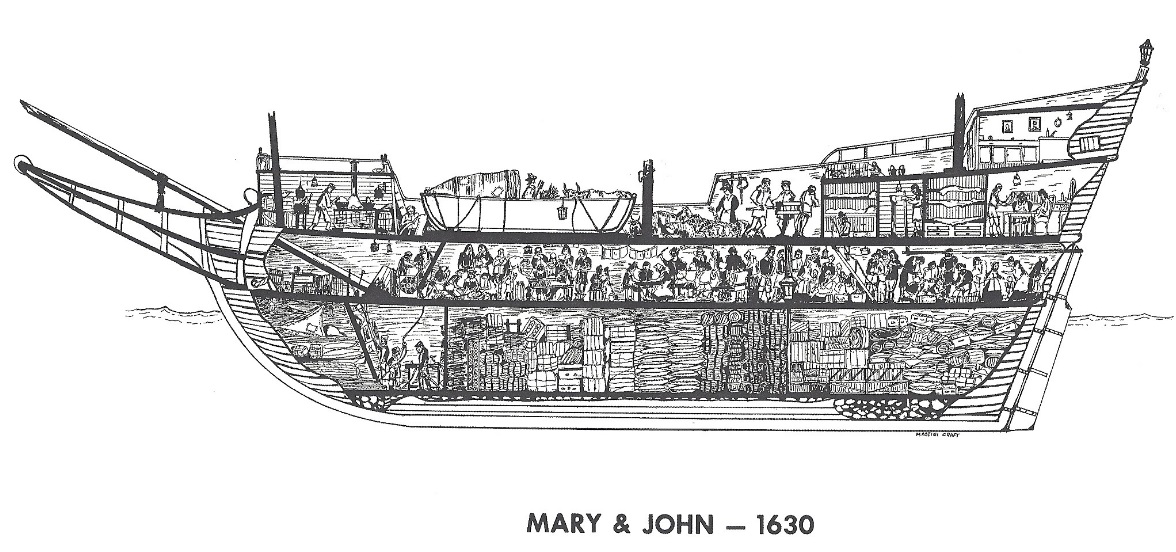
The Mary and John travelled back and forth from England to both Maine and Massachusetts in the 1620s and 1630s, carrying colonists and supplies. This illustration of the ship’s interior shows how cramped the conditions must have been on the vessel. It is amazing baby Mary survived. The Osgoods must have travelled with a wet nurse.


The family arrived in Massachusetts in spring of 1634, and settled in Ipswich. Several researchers have compiled all the colonial records for Christopher Osgood that can be located, showing that he took the Freeman’s Oath in 1635, received several grants of land in the Ipswich area, and worked as a bricklayer. Over the years, he also served several terms on the Ipswich Jury of Trials, so must have been a respected member of the community.

Map of Ipswich, Massachusetts 1640

Christopher Osgood died sometime between 1650 and 1651. He remembered Mary in his will, which read, “First, I do give unto my oldest daughter Mary Osgood, ten pounds, to be paid her or her assigns at her day of marriage.” He left five pounds each for her three half-sisters by his second wife, with his lands and property left to his wife and oldest son (which left the youngest son, born after his death, totally without property). Sadly, his wife Margery returned to the court a few months after his death to ask for an “abatement of the portions” (cutting of the bequests) to be paid to Mary and her siblings as the “property not proving sufficient.”

Close-up of map, with Osgood spelled "Ausgood"

Despite Mary’s lack of an inheritance, she was able to find a husband shortly after her father’s death. According to S. L. Bailey’s Historical Sketches of Andover, “third in the list of the first ten marriages in Andover is Jan. 1, 1651, John Lovejoy and Mary Osgood.” They were married in Ipswich by the Rev. Mr. Simons. The Lovejoys had travelled to Massachusetts on the same ship as the Osgoods, so the families were long acquainted. Mary was 18 years old, while John Lovejoy was 28.

The couple was quite prolific. Mary gave birth to twelve children over the space of 22 years. She died July 15, 1675 at the young age of 42—she probably died of exhaustion, having borne a baby every two years! Mary and John Lovejoy’s fifth child, Anne Lovejoy, was my eighth great-grandmother. She was born December 21, 1659, and married Johnathan Blanchard May 20, 1685. The familial line down to my great-grandmother Lucy Dane is shown below.


The second Mary Osgood is part of the newly-discovered branch of my family tree. She was born March 17, 1633 in Wherwell in the Test Valley of Hampshire, England. Her parents were John Osgood and Sarah Ann Booth.

John Osgood, my ninth-great-grandfather, was born in the Wherwell area in 1595. There is some debate about his parentage. Most researchers agree that his parents were Robert Osgood of Wherwell, and his wife Joan, who owned a farm called Cottonworth. John seems to have been the oldest son, and took over the farm when Robert died in 1630. I wrote about this farm’s house in my previous blog entry.

John Osgood married Sarah Ann Booth, sometime around 1627 in Wherwell. The couple likely had four children by the time they decided to emigrate to the colonies in 1638. The children included my eighth great-grandmother Mary Osgood, who was probably their third child, born March 17, 1633.

The Osgoods’ decision to emigrate was influenced by religious intolerance in their area, increasing tax burdens, and a crop failure in 1637. John seems to have been desperate to leave, as shown by a letter sent by the headmaster of the school at Winchester, a town ten miles from Wherwell, on John Osgood’s behalf. The letter was sent to Sir Edward Nicholas, Secretary of State to King Charles I, begging that he grant approval to Osgood’s planned move to the colonies.


John set sail with his wife and children, including 5-year-old Mary, on the ship Confidence in 1638. The passenger list includes “Sarah Osgood, spinster of Herrell, and four children”. Herrell is the phonetic spelling of Wherwell. Oddly, John Osgood is not listed on the passenger manifest. Instead Sarah—who was definitely not a spinster-- is accompanied by a William Osgood, age 11. There were several versions of the passenger list, compiled at separate times, and one of the others lists Sarah’s children as “Sarah Osgood 9, John Osgood 7, Mary Osgood 5, Elizabeth Osgood 3.” Her destination was listed as Newbury, Massachusetts.

There are varying explanations for the relationship between 11-year-old William Osgood and John Osgood. Most researchers suggest they were either brothers or that William was John’s nephew.

The Confidence probably set sail from Southampton on either April 11 or 24, 1638. The date of the ship’s arrival in Boston is unknown.

Christopher Osgood and family were living in Ipswich in 1638. Researchers have suggested that John and Christopher were related somehow—possibly cousins—and that Christopher provided shelter for John Osgood and his family for a few weeks after their arrival until John was able to acquire land of his own in nearby Newbury.

Colonial era Newbury Mass. map

From the colonial records, John seems to have been a decent, respected member of his community. He made his Freeman’s application on May 22, 1639. He spent some years living in Newbury before becoming one of the founders of Andover, Massachusetts. In 1645, he was one of ten founding members of the church in Andover. In 1650, he sold a house he still owned in Newbury to a man named George Little. In 1651, Andover residents appointed John to be their first representative to the General Court.

Sadly, John Osgood did not live to complete his term in office. He attended the May session, but by the fall session he was ill.  He died on October 24, 1651; he was 56 years old.

His will, reproduced in the Eben book listed below, provided 25 pounds each for daughters Mary, Elizabeth, and Hannah payable when they turned 18, and 25 pounds for son Stephen at age 21. John also left 20 shillings for Sarah Clements, his eldest and now-married daughter, with an additional 20 shillings for Sarah’s daughter Bekah. Presumably Sarah received less in the will because she had already received a dowry upon her marriage. His oldest son, also named John, inherited his lands and house, with a life interest to the widow Sarah.

Part of John Osgood's will

Mary Osgood had her 18th birthday a few months before her father’s death, so came into her inheritance quickly. She married Henry Ingalls two years later, on July 5, 1853. Mary was 20 years old, and Henry was 26.

As I alluded to at the beginning of the blog, I already had a man named Henry Ingalls in my family tree—he was the brother of my eighth-great-grandmother Elizabeth Ingalls, who married Rev. Francis Dane. This was the same man, so Henry Ingalls is both my eighth-great-granduncle, and my eighth-great-grandfather. Henry and Elizabeth’s parents, Edmund Ingalls and Ann Telbe, are my ninth-great-grandparents twice over.

Mary Osgood and Henry Ingalls had a huge family. Mary gave birth to ten children between 1654 and 1679—she was 45 years old when her last daughter, Sarah Ingalls, was born. Mary died seven years later on December 16, 1686 at age 53. I am descended from their daughter Mary Ingalls, born January 28, 1659, who went on to marry John Stevens. The relationship is spelled out below.


In order to understand how all these Osgood and Ingalls family members were related to one another and to me, I had to organize my records and do a lot of research into genealogies and family histories prepared by other researchers. I now have a clearer picture of these families. Best of all, I can finally tell the two Mary Osgoods apart. Perhaps someday I will be able to definitively determine whether the two Mary Osgoods and their Osgood fathers were related to one another, and if so, how. A project for a later date!


Sources:

Ancestry.com. The Fowler family : a genealogical memoir of the descendants of Philip and Mary Fowler, of Ipswich, Mass. [database on-line]. Provo, UT: Ancestry.com Operations Inc, 2005. Original data: Stickney, Matthew Adams,. The Fowler family : a genealogical memoir of the descendants of Philip and Mary Fowler, of Ipswich, Mass., ten generations, 1590-1882. Salem, Mass.: Printed for the author by Salem Press, 1883. https://www.ancestry.com/discoveryui-content/view/191:15733?tid=46986934&pid=322178585653&hid=1037386144396&_phsrc=Jng14245&_phstart=default

Great Migration 1634-1635, M-P. (Online database. AmericanAncestors.org. New England Historic Genealogical Society, 2010.) Originally published as: The Great Migration, Immigrants to New England, 1634-1635, Volume V, M-P, by Robert Charles Anderson. Boston: New England Historic Genealogical Society, 2007.

https://www.americanancestors.org/DB401/i/12155/318/235141190

https://www.laddfamily.com/Files/Mary%20&%20John/Mary%20and%20John.htm

Tepper, Michael, Passengers to America, Genealogical Publishing Co., Inc.: Baltimore, MD, 1977. Passenger list for the Mary and John’s 1633-34 voyage that Christopher Osgood and family were aboard.

"New Light on the English Background of the Osgoods of Essex County, Massachusetts", published in The American Genealogist, Jan/Apr 2008.

A Genealogy of the Descendants of John, Christopher and William Osgood, Who Came from England and Settled in New England Early in the Seventeenth Century, Osgood, Ira, 1799-1877; Putnam, Eben.         https://archive.org/details/genealogyofdesce00osgo/page/n23/mode/2up

Monday, August 29, 2022

400 Years Later: A House Still Standing 52 Ancestors 2022 Prompt “Preservation”

Cottonworth Farmhouse: Home of My Ninth Great Grandfather John Osgood and Family

John Osgood: 1595-1651 (9th Great-Grandfather, maternal side)
Mary Osgood Ingalls: 1633-1686 (8th Great-Grandmother, maternal side)
 

Serendipity led me to discover the 400-plus-year-old property where my ninth great-grandfather once lived. It all started when I received a notice from FamilySearch that someone had posted a story about one of my 8th Great-Grandfathers. To my surprise, this man, John Stevens, was someone I did not yet have in my Ancestry tree.  This sent me back to Ancestry to search records from 1630s Massachusetts. While filling out this new branch of my family tree, I discovered a new ninth-great-grandfather, John Osgood.

So how did I get from John Stevens to John Osgood? I had started building John Stevens’ family tree. He had several children, including a son named Joseph, who was my 7th great-grandfather. Joseph married a woman named Mary Ingalls, the daughter of Henry Ingalls and his wife Mary Osgood. That led me to Mary Osgood’s parents, John Osgood and Sarah Ann Booth Osgood.

John Osgood immigrated to Massachusetts in 1638. He helped to found the town of Andover, naming the town after the area in England where he was born, raised and was married. To my surprise, other researchers working on this family had traced John not just back to England, but to the actual house where he was living when he decided to emigrate. This house is called Cottonworth Farmhouse and still exists in Wherwell, Hampshire.

Of course, I had to Google the house. To my delight, I discovered that it had recently been listed for sale, and had a series of photos of the interior and exterior attached to the listing. What a find!

Street view of Cottonworth Farmhouse

The real estate listing describes Cottonworth Farmhouse as follows:

“A traditional Grade II Listed farmhouse situated in this small hamlet in the Test Valley. Having been owned by the same family for several generations the property offers much charm and character with exposed beams and open fireplaces. The accommodation is generous at just over 2500 sq ft and well suited to family life.”


The house’s address is SU 33 NE Wherwell Fullerton Road.  The sellers were asking a price of one million pounds, which equals $1,165,000 US currency.

Living room with beamed ceiling

Grade II Listing is similar to a listing on the National Historic Register here in America; the house has historic value or possible architectural significance, so any alterations or additions must meet with government approval. The Historic England website describes the house as follows:

“House. C17 timber-framed house, with C18 brick cladding, and a ½-hipped tile roof. T-shaped structure of 1 storey and attic, 3 windows to the south front. The walls are of English bond, with cambered openings, plinth. Casements, 1 gabled dormer with sill at eaves level. Boarded porch. A later outshot on the north-west side has a slate roof.”

Master Bedroom

While I still have a lot of records to locate to more fully flesh out the life of John Osgood, I am fairly confident that he is my ancestor. Other researchers have done a good job tracking down records that seem to match him and his family. Even sources in the Wherwell area of Hampshire have accepted the research. Here is a passage from the Wherwell & Chilbolton History Group’s website (Wherwellhistory.com), recounting a recent visit by a group of American Osgood descendants:

“Andover Massachusetts became twinned with Andover [Hampshire] in 2000 but the link between the towns is more than 350 years old. In the 1630s, the Osgoods farmed Cottonworth Farm near Wherwell. During the first years of that decade the family faced problems of religious intolerance, increasing taxes, crop failure and finally, in 1638, a disastrous flood across their land. A relative, Christopher Osgood from Marlborough, had crossed the Atlantic in 1633 to begin a new life in the American colonies. In 1638, John Osgood and his family followed, eventually making his home in a settlement called Cochichowicke (Great Water), which was later renamed Andover, Mass. John eventually owned over 600 acres of land and became one of its most respected and influential citizens.”

The website post also described the Cottonworth property.

“The original Cottonworth Farmhouse is still standing (and occupied) at the turning to Wherwell from the Stockbridge Road at Cottonworth. Several of the American guests are members of the North Andover Historical Society and were delighted to have the opportunity to see the English home of one of the founders of their town. It gave them a better understanding of the area he left to establish himself in Andover MA.”

The back section of the house shows the one-story addition with the slate roof. Presumably the rest of the house originally had a thatch roof.

I look forward to continuing my research into this interesting family, and perhaps someday I can travel to Wherwell to see Cottonworth Farmhouse for myself!

Sources:

https://www.osgoodancestry.org/emigrants.html

https://historicengland.org.uk/listing/the-list/list-entry/1093381?section=official-list-entry

https://www.rightmove.co.uk/properties/120824606#/?channel=RES_BUY

https://archive.org/details/genealogyofdesce00osgo/page/n23/mode/2up

https://www.wherwellhistory.com/topics/publications/osgood-family-descendants-american-andoverians-visit-andover-uk

Saturday, August 20, 2022

Lawn Chair for the Ages: 52 Ancestors 2022 Prompt “Preservation”

Metal Chair Preserved Over Four Generations of Petersons

Paul Peterson: 1867-1941
Regina Syverson Peterson: 1872-1952


My brother now owns the farm our grandfather, Paul Peterson, originally owned in Brown County, Minnesota. Kent also owns a metal lawn chair that our grandparents used. It’s been repainted a dozen times or so, but each generation has preserved it and used it. Now our children will have a chance to lounge in the grass in the same chair as their ancestors Paul and Regina did.

I don’t know where the chair was purchased, or when. It is constructed of heavy metal with a sort of curving shape—rounded hollow metal tubes form the arms and legs of the chair, and the back is shaped like a clam shell, while the seat has a couple holes for drainage. It is a heavy piece of outdoor furniture—no matter how strong the gale, the chair stood, usually in the shade of a tree, perfect for relaxing on a summer day.

The first photo I have found of the chair was taken in the summer of 1941. My grandfather Paul is seated in the chair, which was painted in a dark color. He looks frail; he died at age 74 about six months later on December 31, 1941. To the left is his granddaughter Elaine Peterson, and to the right is Elaine’s little brother Roger. They were the children of Paul’s son Oscar, so were my first cousins. They lived just down the road about a quarter mile or so, and so were probably frequent visitors to their grandparents’ and uncle’s house. Little Roger was born January 29, 1939, so was only two and a half years old in the photo. Elaine was eight.


I love the details in this photo. Grandpa Paul has his cane and is wearing a hat and a long-sleeved shirt and long pants, but he is barefoot—his one concession to what was probably a hot summer day. The farm dog, a collie mix, lies near him in the shade. Behind him is the house I grew up in. I can see that my grandma Regina has trained a vining plant to climb a trellis at the side of the porch, which would provide shade from the afternoon sun. There is another wooden chair on the porch at the far right of the photo.

My cousin Elaine is wearing a skirt—no shorts for young ladies in that era—and a buttoned blouse and open-work shoes. Little Roger is wearing a romper-length overall with no shirt, and some sort of summery shoes. I love his cheery smile and his cute little jug ears.

The next photo was taken a few years later, after Paul’s death. Regina is enjoying a summer afternoon in the yard. Given the shorter length of her dress and her snow white hair and apparent age, I think this photo was taken in the late 1940s, just a few years before her death at age 80 in 1952. The chair still seems to bear its original dark paint. Regina is sitting facing the road, so the house is out of the frame to the right. Behind her is a small sapling that was a large tree by the time I was a child, and the chicken coop.


Once again, the details are a delight. I love Regina’s glasses. Rather than wire frames, it looks like she had nearly black Bakelite or plastic frames with wire earpieces. She is wearing what folks called a “housedress”—not dressy enough for church or special occasions, but fine for regular housekeeping and gardening work. The floral dress’ collar is trimmed with white “rickrack” edging. Her shoes are interesting—not lace-ups like I’d expected, but some sort of slip-on with a pattern on the top. It appears she is wearing hose despite the warm day, which was pretty typical of the era. Her hands, folded in her lap, show the effects of a lifetime of hard work in a cold climate—her fingers and knuckles are thick and swollen-looking. She’s smiling, but not showing her teeth, and given the sort of crumpled look of her face, I’m guessing that’s because she was missing a lot of teeth.

Like Paul, she has the company of a dog. This time, it’s a tiny terrier. My dad had a similar dog when I was young, a rat terrier named Trixie, but I believe this is a different dog with a darker coat.

The third photo of the lawn chair shows me probably shortly after my first birthday, so the summer of 1960. The chair has now been repainted to the white that I remember from my childhood. The chair is sitting near where it was in Grandma Regina’s photo, but at more of an angle so anyone sitting in it could look back at the house and porch, while also getting a view of the road. The chicken coop is again visible, but the sapling is now a sizable tree.


In the photo, I am not a sturdy walker yet, so I am using the chair to stay on my feet. I am grinning over my shoulder at either my mother or my Grandpa Macbeth, who were the photographers in the family. I’m wearing a little pastel sunsuit, and I was probably barefoot. My hair was still thin and wispy, and was fluttering in a slight breeze. Such a happy summer shot!

I’m sure that a more thorough review of family photos will turn up more shots of family members in the long-lived lawn chair. I also need to get a photo of the next generation—either my children or my brother’s son—making use of the chair on a balmy Minnesota day. I’ll have to post an update to this post as I acquire more photos.

Preservation is important not just for family photos and records, but also for the everyday items that families used over many years and many generations. They often provide a deeper understanding of our ancestors’ lives than records.

So long live the chair, and a huge thanks to my brother for preserving it as it approaches its centennial!

Thursday, August 11, 2022

Exploring Family Search for Pioneer Ancestor: 52 Ancestors 2022 Prompt “Exploration”

Mormon Child Pioneer? Exploring Relationship to Possible Cousin Lorenzo Dow

Lorenzo Dow: 1845-1903 (Maternal Third Cousin 3x Removed)


I received a message from FamilySearch informing me that I had a “Pioneer Ancestor” who had “made the trek as a child”. I’d never gotten that type of message before. Since FamilySearch is affiliated with the LDS church, I realized that the “trek” referred to a Mormon wagon train, and the destination for this pioneer was Utah. Since I was unaware of having any Mormon ancestors, I decided to explore the site’s information on this young pioneer.


According to FamilySearch, my pioneer ancestor was a man named Lorenzo Dow, born in 1845 to parents Eli Lorenzo Dow and Lucy Perlina Ford. Young Lorenzo “departed on January 1, 1861” for Utah with “company unknown.” This information sounded a bit thin on facts and records. It likely meant that Lorenzo probably arrived in Utah at some point in 1861 when he was 15 years old, but that no further details were available. I doubted there were any primary sources to back up this assertion—that the information came from tales passed down by family members. I felt increasingly dubious about Lorenzo.

Also, the surname Dow was new to me. How exactly did FamilySearch believe we were related? The diagram below shows that according to FamilySearch’s wiki, our common ancestors are Samuel Daniels and Elizabeth Noble. My line comes down from their daughter Polly Daniels (my fourth great-grandmother), while Lorenzo supposedly descended from their daughter Abigail Daniels.


Abigail “Naby” Daniels, born in 1770, married Thomas Dow, born in 1769. They had several children; the oldest, David Dow, married Aphia Sambon or Sanborn, on March 11, 1813. While I was able to find their marriage record, I could not find any birth records for their two children, daughter Abigail and son Eli Lorenzo Dow. However, these children are named in at least two family histories that are available on the Ancestry site, so probably did exist.


According to one of these family histories, David Dow was a hard-drinking, abusive husband. He moved to Illinois where he worked as a smith, and finally persuaded Aphia, Eli and Abigail to join him. However, within two years, Aphia managed to acquire a divorce and returned with her children to an unspecified location in the East, possibly Vermont, New Hampshire or New York. That family history notes that the children disappear from genealogical records after that.

The FamilySearch tree records for Eli Lorenzo Dow were a bit mystifying. The only records attached to him were Mormon church records from the 1840s Mormon settlement in Nauvoo, Illinois. The first record, pictured below, was the Stake Ward Census taken in Nauvoo in 1842. Only Eli and wife Lucy appear; Lorenzo wasn’t born for another three years. Eli and Lucy had another child, a daughter born October 9, 1842 who died shortly after her first birthday on December 20, 1843, according to the Nauvoo Community Department Records.

Eli and Lucy on right, second entry from bottom

The remaining records attached to Eli are a mishmash. One is an 1850 census record for a Lorenzo Dow in Oneida, New York. He appears to be a single man lodging with another family, with no sign of wife Lucy or son Lorenzo. Why would he have left Nauvoo and returned to Oneida? Someone has also attached a census record from 1870 in St. Lawrence County New York, which from my Ancestry search obviously belonged to a totally different man named Lorenzo Dow who lived there his entire life.

Then there’s the death record from Santaquin, Utah, dated 1903. It is the same death date as his son, Lorenzo’s death. The same death record is attached erroneously to both men. I suspect they have no death record for Eli because he died back in Illinois shortly after Lorenzo’s birth. After all, Eli’s wife Lucy remarries. She appears on the 1850 census living in Pottawattamie County, Iowa as the wife of a John Miles or Mailes, another Mormon who was “endowed” at the Nauvoo Temple. How could she have remarried if her first husband was still alive, and still be a member in good standing of the Mormon Church? Divorce was discouraged.


So what records exist for my “pioneer”, Lorenzo Dow? He appears on the 1850 census under his stepfather’s name as Lorenzo Miles or Mailes. John Miles travelled to Utah with the “Fifth Ten of the First Fifty of the Fourth Hundred” handcart company around 1856, and apparently John died either enroute, or shortly after he arrived in Utah. By the time Lucy and her children arrive—including Lorenzo—in 1861, John Miles was already dead. I suspect Lorenzo accompanied his mother and half-siblings as a member of an unidentified handcart company.

Lorenzo appears to have married in 1875, choosing a much younger woman from Utah, Angeline Davis. Lorenzo would have been 30, and Angeline only 14! This is rather horrifying—in our era this was pedophilia.

By the 1880 census Lorenzo, then 34, and Angeline, supposedly 20, had three children and were farming in Provo. In an 1890 Provo City Directory he is listed as a farmer living in the 2nd Ward on E Street between Sixth and Seventh Streets. See the Sanborn Fire Map from 1900 to see the approximate location, near a foundry and a public square.


Sanborn Fire Map of Provo Utah 1900, E St between 7th and 6th

By the 1900 census, Lorenzo and Angeline had nine children, with eight surviving. Their final child was born the following year. Sadly, Lorenzo died October 12, 1903 at the age of 58. His wife, Angeline, was about 40 and remarried the following year.

I am willing to concede that Lorenzo Dow, son of Eli Dow, was a Mormon pioneer, trekking to Utah with a hand cart group around 1861. However, I am not thoroughly persuaded that he is the grandson of David Dow, son of my fourth-great-grandaunt Abigail Daniels. The paper trail is just too thin. I have found no documents that prove the Eli Dow who lived in Nauvoo, Illinois as a member of the fledgling Mormon Church was the same Eli Dow who supposedly left Illinois with his divorced mother Aphia Dow in early childhood. Where did Aphia go? Where was Eli living between his birth and 1861? How did he become involved with the Mormons? There are so many unanswered questions to explore.

Lorenzo Dow


Lorenzo Dow was certainly a pioneer, exploring new lands and new ideas in Utah. However, his father’s past requires more genealogical exploration to verify that Lorenzo was truly related to me.  


Sources:

Nauvoo Stake, Nauvoo Stake Ward Census, 1842. LR 3102 27_f0004_00033

http://nauvoo.byu.edu/ViewPerson.aspx?ID=49336

Illinois, Hancock County, Nauvoo Community Project, 1839-1846 (BYU Center for Family History and Genealogy)," database, FamilySearch (https://familysearch.org/ark:/61903/1:1:QL3Z-PT1P : 23 February 2018), Eli Lorenzo Dow in entry for Abigail Dow, from 1839 to 1846; citing Residence, Nauvoo, Hancock, Illinois, United States, from 1839 to 1846, Citing BYU Center for Family History and Genealogy, Provo, Utah.