Saturday, February 5, 2022

More Cousins than I Thought: 52 Ancestors 2022 Favorite Find

Discovery Adds Significance to Photo

George Wee: 1888-?
Ole Wee: 1878-1927
Willie Wee: 1898-1981
 

When I first ran across this charming photo on Facebook, I was delighted because it featured an ancestor of mine, cousin Sam Joramo, seated in the middle with the big smile. I had to re-evaluate the photo when I discovered that I am also related to three more of the young men. George Wee (far left), Ole Wee, and Willie Wee (the two gents at the right) are also my cousins. This photo has become one of my favorite finds as a result.


As I described in my previous post, I discovered that my great-grandmother Ragnhild Olsdatter Ve Syverson had two nephews who also immigrated to the same area of southern Minnesota in the 1870s and 1880s. One of these nephews was Anders Olesson Vee.

Anders and his wife Sigrid Olsdatter Hoseter Skaar took the surname “Wee” when they settled in the Hanska, Minnesota area, while Anders’ brother’s family spelled the name “Vee”. Anders and Sigrid had a large family—possibly as many as seven sons and three daughters. Sigrid states in both the 1900 and 1910 census that she has given birth to ten children and all ten are still living. Living or not, some of the sons just disappear: Ingvald, Nils and Henry just don’t appear on census or draft registrations after 1900 so I can’t determine what happened to them.

However, I have found records for the three sons that appear in this photo. Ole was the eldest son, born in 1878. George Wee, christened Karl Jorgen but called George, was the fifth child in the family, born in 1888. Willie Wee, christened Wilhelm, was the youngest in the family, born in 1898. Given that Willie appears to be in his late teens in the photo, I would guess it was taken around 1913 or so, when Willie was about 15, George 25 and Ole, quite the old man at 35 despite his youthful appearance.  The three are all my second cousins once removed.

From the records I’ve found so far, it doesn’t appear that any of the three men had any children. Ole and George don’t appear to have married, although Willie married. I will have to do more research to find out more information about this newly discovered branch of my tree.

In the meantime, I will enjoy this wonderful photo of five young farmers from southern Minnesota mugging for the camera in an auto they may not have been able to drive—it was probably just a photographer’s prop. I wish I knew the story behind the photo. What prompted them to dress up and get their photo taken? I also wonder if the fifth man in the photo, Ole Asleson, will turn out to also be a distant cousin. I’m so happy I stumbled on this photo—a true favorite find!

The Homestead Next Door: 52 Ancestors 2022 Prompt “Landed”

The Cousins Next Door: Ragnhild Olsdatter Vee Syverson’s Nephews Ole and Anders Olesson Vee

Ole Olesson Vee: 1850-1917
Anders Olesson Vee: 1853-1903

When I received an email from Ancestry notifying me of a DNA match to a cousin with the surname Vee, I wasn’t too surprised. I recognized the surname from my tiny hometown, Hanska, Minnesota. I was distantly related to a lot of people in the area. However, I was surprised to see how closely I was related to this cousin—we were possibly second or third cousins. Luckily, my cousin had a public tree, and Ancestry had identified a possible shared ancestor between the two of us: my great-grandmother Ragnhild Olsdatter Ve Syverson’s parents. The Vees were descended from one of Ragnhild’s siblings. This was a new connection for me—I hadn’t realized any of Ragnhild’s family members had left Norway, and had no idea they landed in the Hanska area.

My research revealed that Ragnhild Syverson, born in 1848, was the youngest daughter of Ragnhild Ve and Ole Gulbrandon Geithus. She had a much older sister, Gjoran Olsdatter Ve, born in 1826. Obviously, Gjoran was out of the house with a family of her own shortly after Ragnhild was born. Gjoran married Ole Torresson Havaardshaugen in October 1850, and they had their first son, Ole Olesson Vee, August 12, 1850. This meant that Ragnhild was only two years older than her nephew, Ole.

Ragnhild married Ove Syverson in Norway in the mid-1860s. Some trees claim they married as early as 1865, but I suspect it was a year or so later. Their first child, also named Ragnhild, was born January 9, 1868, and was baptized that April. The church records show that Ragnhild’s sister Gjoran and husband Ole Thoreson Ve were godparents to little Ragnhild, along with a couple with the surname Moen.

Ragnhild Olsdatter Ve's baptism record. Ole Thoreson Ve and wife Gjoran listed at far right

The young Syverson family set sail for America the next year, arriving in 1869—this arrival year appears on the 1900 census. Their second child, Syver, was born October 23, 1869 in Wisconsin. The family then moved to Linden Township in Brown County, where their third child, Ole, was born in 1871 or 1872.

Ragnhild and Ove must have described their life in America in positive terms when they wrote letters to family back in Norway, for her nephew Ole Olesson Vee and wife Sigri soon followed them to America. According to the information the Vees reported on the 1900 census, they arrived in 1872, and their first child, daughter, Julia Sirina, was born in Cottage Grove, Wisconsin on June 30, 1872. They relocated to Minnesota at some point around 1880, appearing on an 1885 state census living just a few farms away from Ragnhild, who had been widowed just three years earlier.

1885 Minnesota census with Vee brothers' families

Another of Ragnhild’s nephews also appears on that census. Ole Thoreson Vee’s brother Anders Olsson Vee followed his brother and aunt to America in 1882. Anders and his wife appear on the census on a farm between Ragnhild’s and Ole’s properties. Perhaps Ole and Anders settled near Ragnhild in order to help her hold on to her homestead after her husband Ove died; her sons were too young to be of much help with farmwork.

Whatever their motivation, both Vee families acquired land in the Hanska area. By the time the 1905 plat maps were generated for Brown County, Anders and Ole Vee have good sized acreages, and Ragnhild’s son Ole Syverson has taken over the Syverson farm. Ole Vee’s land abuts Ole Syverson’s, so they were next door neighbors. I’m sure the young cousins all grew up together.

1905 Linden plat map. Ole Syverson property in blue, Ole Vee property in orange

From landing in America to becoming landowners in Minnesota, the Vee brothers quickly became part of the Norwegian community in Brown County’s Linden and Lake Hanska Townships. The opportunity to own their own land drew them to America, and they achieved their dream: they “landed”.

1905 Lake Hanska plat map showing Anders Vee property

As for my relationship with my Vee DNA match, his grandfather was Ole Olesson Vee’s youngest son, Theodore Vee, born in 1888. His father was Theodore’s youngest son, Arvid Vee, born in 1926. My cousin was born a year after my birth, so we are close in age. I never knew him because we attended different elementary schools, and never shared high school classes. The DNA prediction of our relationship was fairly accurate: we are actually third cousins once removed.

Monday, January 31, 2022

Peterson/Syverson Land Over the Last Century: 52 Ancestors 2022 Prompt “Maps”

Plat Maps Showing Family Farmland Since 1886

Ove Syverson: 1840-1882
Ole Syverson: 1873-1933
Peder Peterson: 1815-1880
Paul Peterson: 1867-1941


When my mother died a few years ago, I, along with my brother, inherited farmland in Brown County, Minnesota. Recently, my brother sent me the latest plat maps of Linden and Lake Hanska Townships where my land lies, showing me as the owner. This made me curious about historic plat maps. I wanted to trace the ownership of those lands over the years, seeing where my ancestors first lived and homesteaded, and what farms they eventually settled on, and when those farms changed hands. I knew there were maps from the 1940s, but was pleased to discover maps from 1905 and 1914, with the most exciting discovery a plat map from 1886!

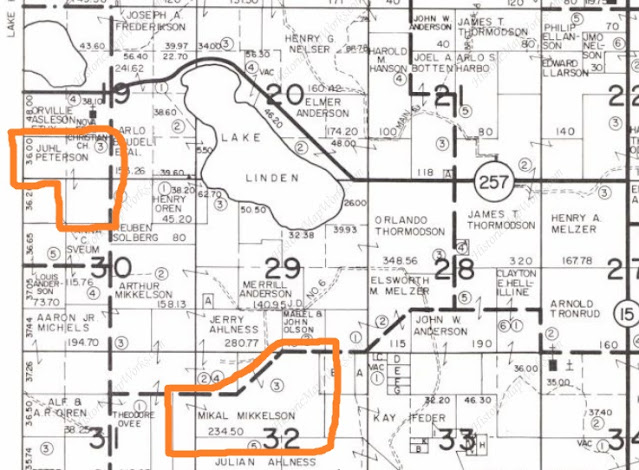
Here is the present-day plat map, showing my two parcels, one near Nora Unitarian Church just west of Linden Lake, and one southeast of our family’s home place, which my brother owns.


To go back to the very beginning, here are the 1886 plat maps for Lake Hanska and Linden Townships. To provide some background, my paternal great-grandparents, Peder and Anna Pederson Joramo, had immigrated from Norway in 1870. They moved around a bit before settling along the border of Lake Hanska and Linden Townships. They were residents by 1875, but probably arrived a couple of years earlier. Tragically, Peder was killed in a farm accident involving a horse in 1880, so by the time this plat map was made, Peder’s eldest son Jacob, who used the surname Joramo or Joramoe, was farming and homesteading with his mother and younger brother Paul. Jacob’s holding appears at the lower right hand corner. Land that became my dad’s farm is above, owned in 1886 by a man named Quale. The land I eventually would own is at the bottom right, owned in 1886 by a man named Johnson.


The Linden Township 1886 map is even more interesting. My grandmother Regina Syverson’s parents, Ove Syverson and Ragnhild Olsdatter Ve had immigrated in 1869, settling in Linden Township by 1872. Ove also died in a farm accident involving a horse (showing how hazardous farm work was in the 1800s) in 1882, leaving his wife Ragnhild and eldest son Ole, who was barely nine years old, to run their farm. Just four years after this tragedy, Ragnhild and Ole are listed as owner of a combined 120 acres (R. Siverson and O. Siverson) just down the road from P. Peterson, who was probably my grandfather Paul. My Linden Township land is just off the top of the map, owned in 1886 by a W. Bruce.


The 1905 plat map reflects the changes of a nearly twenty year time span. The Lake Hanska map shows Paul Peterson, my grandfather, on the 80 acre parcel of land that my father would farm. His brother, Jacob Joramo, now has two large parcels totaling 160 acres. My land, marked with a dot, is owned by a farmer named Andrew Oren.


The Linden 1905 map now shows Ole Syverson, my great-uncle, as the sole owner of the 160 acres of land. Ragnhild is still living with him, but has turned over the farm to him. What is now my land, marked with a dot, is owned by an Iver Johnson.


The 1914 plat has few changes—just a little more detail. Paul Peterson and Jacob Joramo still own the same parcels in Lake Hanska Township as in 1905. The Linden plat shows that Ole Syverson (now spelled Silverson) owns nearly 200 acres—the same parcels, but better measurements. Interestingly, this map confirms that the land labeled as “P. Peterson” on the previous plats did belong to my grandfather, Paul Peterson. His full name is now written on the forty acres. The land I will eventually own still belongs to Andrew Oren and Iver Johnson.


The 1949 plat maps move up a generation: now my father Juhl Peterson and his brother Oscar have taken over from their father Paul, and Sam Joramo, Jacob’s son, appears on the Lake Hanska map. My father has also purchased the forty acres I now own. 


The Linden map shows that either Paul or my father Juhl has sold the 40 acres they had owned at the far left corner; perhaps it was a trade for the forty acre parcel my father now owned across the township border. In addition, Ole Syverson had sold all his land around 1930; he and his mother had moved into Hanska due to his declining health. He died in 1933 at the age of sixty. His land was owned in 1949 by Mikel Mikelson. However, there is a sixty acre property just north of the old Syverson farm owned by a Siver O Syverson. This may have been Ole’s brother Siver, another of my granduncles. He lived until 1956, so could have owned land. Perhaps Ole had shared the proceeds from the farm with his brother, enabling him to buy property of his own. The map also shows that my Linden land was owned by Hans Knuth in 1949.


The final map shows Linden Township in 1969. The main item to note is that my father, Juhl Peterson, had bought the Knuth property following the death of the last Knuth family member. In the 1970s, my father tore down the house that remained on the property, and my brother and I grew cucumbers for the Gedney pickle company on about one-third acre of the property as a way to earn money.


It was very instructive to trace the ownership of my ancestor’s farmland over the years through these plat maps. I enjoyed discovering when my family acquired the two parcels I now own.

Wednesday, January 19, 2022

Dapper Young Gents: 52 Ancestors 2022 Prompt “Favorite Photo”

Siver Syverson and Friends Strike a Dashing Pose

Siver Syverson: 1882-1953 (Paternal Great-Uncle)
 

I don’t know much about my granduncle Siver Syverson. He was my paternal grandmother Regina Syverson Peterson’s youngest brother, ten years younger than Regina. He never married or had children, and seems to have been a bit of a rolling stone, moving from job to job, and from southern to northern Minnesota and back again. He was a bit of a mystery—I even had trouble finding his death record and place of burial. So I was delighted when my brother showed me this delightful photo of Siver and two friends. Until then, I didn’t know what Siver looked like. Now I can see a family resemblance to my father, and I can see that Siver had a sense of humor.

Siver was born January 21, 1882 to Ragnhild and Ove Syverson in Linden Township, a farming area in Brown County, Minnesota. He was the last of their eight children; two of their children had already died before Siver’s birth. Siver never had a chance to know his father; Ove died in a farming accident when Siver was just six months old.

Siver—also spelled at times as Sever and Syver, with the surname also showing variations on various records—worked as a farm hand on several different farms over the years. He even worked for his sister Regina following her husband’s death.

Siver's draft registration showing 3 different spellings of his name on a single document!

I’m not sure when this photograph was taken. Sever doesn’t look that old—probably out of his teens, but still in his early twenties. The man in the center of the photo looks like he was the oldest of the three men, but even he probably isn’t over thirty, and the man on the right looks very youthful.  I wish I knew who the other two men were—did they also live in Linden Township? Were they related or just friends?  


I love the photo’s details—all three men were obviously dressed in their best clothes: suits, white shirts and ties. Siver’s tie is so pale that it nearly blends in with his shirt—what color was it? A silvery grey or a pale blue? Yellow? His shoes are carefully shined; they aren’t as fancy as those of his seated friend—are those spats?—but are more polished and cared for than the third young man’s.

And look at those hats! I love the jaunty angle of Siver’s hat—it seems to suit the mood of the mens’ poses. They look proud, a little cocky and a little self-mocking. I get the feeling that the photo was a bit of a lark, and was meant to be amusing. Where did they get those amazing pipes? The bowl of the left-most gent’s pipe bowl appears to feature a carved rooster. Siver’s pipe reminds me of the mouthpiece of a set of bagpipes. Were the pipes props the photographer used? They were certainly functional, as we can see from the smoke wreathing from them.

Siver was born in 1882, so if the photo was taken when he was in his early twenties, that would be around 1902-1907. The clothing seems fairly appropriate for that era, based on wedding photos from that time period.

As I already mentioned, there is a definite family resemblance between Siver and his nephew, my father Juhl. The shape of the eyes and their light color, the shape of the jawline, and the nose are all similar. My father’s eyes were bright, light blue. According to Siver’s draft card, his were grey, and his hair brown, while my dad’s was darker, nearly black.


Siver at left, my dad in late teens in center, my dad in his thirties at right, with a heavier face and bad angle...


This photo was made into a postcard. The back reads, “From Oliver and Alfred” and the address portion  just includes Siver’s name—in this case spelled Siver Siverson. I am assuming Oliver and Alfred are the other two gents in the photo. The names suggest several possibilities for their identities that I will have to explore in the future.


I am so glad that my brother brought this marvelous, funny photo to my attention.

Thursday, January 13, 2022

First School: 52 Ancestors 2022 Prompt “Foundations”

Hanska Schools: Foundation of My Education


I belong to a Facebook group called “At Home in Hanska.”  Hanska is my hometown, and the Facebook page is a place for people connected to the community to post historic photos of their ancestors and of buildings around the area. I was so excited when someone posted some photos of the old Hanska High School. My first school experience was at the Hanska school. I see education as the foundation of my life, and that school laid the first stones of that foundation.

I am going to post a photo that was shared on the website, along with one I took about 15 years ago, and some vintage photos from Hanska High yearbooks from 1954 and 1956 I found on Ancestry. 

Campus from the air in 1956

Campus with Elementary wing partly visible through trees--circa 2006?

I attended kindergarten through sixth grade in Hanska. Most of my time was spent in the school’s elementary wing, which had been built more recently than the original high school building. However, I went to gym class and music class in the high school building, so I have fond memories of the place.


School photos from 1954 Yearbook

I appreciate all the teachers who patiently taught us and guided us: Mrs. Anderson in kindergarten; Mrs. Stadig in first grade; Mrs. Froland in second grade; Miss Eide in third grade; Mrs. Brudelie in fourth; Mr. Hammero in fifth; and Mrs. Yarger in sixth grade. I was a shy, quiet little thing, but all of those teachers made an effort to draw me out and help me to excel.

Old Hanska High School, now boarded up and standing empty....


Sunday, January 2, 2022

Onward to 2022: 52 Ancestors 2021 Prompt “Future”


I am so pleased with my progress in 2021. I only need to complete one more post, and I will have answered all 52 prompts! And I wrote extra blog posts as well—the final tally was 36 posts for my Aird family tree blog, “Another Tree to Climb”, and 25 posts for my Peterson/Macbeth family tree blog, “Twigs on the Family Tree”. That’s a total of 61 posts this year!

I discovered so many interesting stories—stories I would have failed to pursue or would have quickly forgotten if I hadn’t been motivated to research them further and write them up. Thank you to Amy Johnson Crow for organizing this wonderful challenge.


So what does the future hold? Yes, I am going to work on 52 Ancestors in 52 Weeks in 2022. This will be a challenging year to find time to write and research. There are a lot of family obligations and joyous but time-consuming events, so I have decided to be realistic—I will answer as many prompts as possible, but I know I won’t be doing all 52 this year and I will be content with that.

I plan to once again split my responses between the blog for my family, and the one for my husband’s family. In addition, I will post the prompts out of order, answering the prompts when I run across the perfect story rather than marching along in the order Ms. Crow has set them out. For example, my first post of 2022 will be a response to the prompt for Week 5, February 1-7. I like to do this challenge my way—it’s been working so far, so why rock the boat?

So Happy New Year, and Happy Researching!

Monday, December 27, 2021

Old Christmas Photos from My Grandma: 52 Ancestors 2021 Prompt “Holidays”

Christmas 1962 and 1964: My Brother and I
Photographs by Ivan Macbeth and Nora Macbeth


During my childhood, holidays were usually spent at my grandparents’ house on their farm near Eagle Lake, Minnesota, or at my family’s farm near Hanska. While looking through photos I inherited from my Grandma Nora Hoffman Macbeth, I found two cute holiday pictures of my brother and I from over fifty years ago.

The first photo was taken Christmas Day 1962 at the Macbeth house and features a three-year-old me and my baby brother Kent. This photo sparks so many memories. Kent is happily lying on his back in a little footed baby outfit, smiling at the camera, legs kicking in the air. He would have been nearly five months old on Christmas day.


I am sitting on the blanket next to him, wearing a light-colored long-sleeved tee and dark pants, probably accompanied by a pair of hard leather lace up shoes that came up over the ankle and had stiff, hard soles—popular footwear for toddlers then that would probably inspire horror among pediatricians today. I remember them as being reddish brown in color—I think they were Buster Brown shoes, but I’m not sure. My hair was cut in a pixie cut—a popular style in 1962 for girls—and my expression was equally pixie-like. My hair was mussed as usual—I rarely appear in photos with neatly combed hair. I must have always run my hands through it or rolled around while playing.

The blanket was resting on my grandparents’ patterned carpet. I remember the swirls of color and the stiff feel of the fibers although my memory of the shade has faded. Behind me is a comfortable chair that was a sort of silvery gray color as I recall. The arm of the chair is piled with Christmas wrap and tissue—the presents had been opened. It looks like someone got some new clothes, piled amid the wrap. I had obviously received a new doll, who has been abandoned to recline stiffly against the other chair arm. It looks like she has a thermometer sticking out of her mouth—was she a doll you could do doctor exams on? Or is that some other object that sticks out behind her? I don’t remember her very clearly—later in my childhood her shoes and clothes were no longer pretty, and she’d lost a lot of hair to my over-enthusiastic efforts to comb and style it. Poor dolly.

To my left in the gloom of the wall near the living room door is another chair I remember—an adjustable piano stool that could be spun around to go up and down in height. Unlike many piano stools, it had arms, which I would hold tightly as I spun slowly around. I think that chair eventually ended up back at our farm.

The next photo was taken two years later, Christmas 1964. The printing on the back says “Roxana age 5, Kent age 2.” That Christmas the family had gathered at the Peterson farm. I’m seated on the living room couch, with the window that faced the road at my back. Kent is standing next to me, a huge smile lighting his face, probably due to the new teddy bear his hand is resting on proudly.


We are dressed up for the occasion. Kent is in a cute little vest, dress shirt and pants combo with a tiny little bow tie at the collar. He looks adorable! I’m in a checkered dress—I believe it was red and white, paired with red tights. My hair is now in a bob with short, crooked bangs, slightly mussed as usual. My dollies are next to me on the couch—is the tilted, wide-legged one the same doll I received two years before? She looks like a war refugee, poor thing, with that same shell-shocked expression. The other, smaller doll I remember better. I think I called her Betty, and her hair shows the tragic effect of my vigorous brushing, sticking straight up and starting to recede. Before much longer, she developed a bald spot with tiny holes in her plastic head where hair used to sprout.

I remember the sectional couch and the combination pole lamp and occasional table in the corner. The couch was covered with a loose, washable fabric cover—smart with two small, frequently sticky children in the house.

I loved finding these photos and remembering those early years of my childhood. Christmas was always special and exciting, and you can see that in our faces.