Friday, January 19, 2024

First Branch of My Tree In New Hampshire: 52 Ancestors 2024 Prompt “Origins”

Seventy-Five Years in New Hampshire: Henry Langstaff’s Origins in America

Henry Langstaff: 1610-1705 (Maternal Tenth Great-Grandfather)


Nearly every year that I have worked on my family tree, I have discovered a new ancestor who arrived in the American colonies barely a decade after the Pilgrims landed at Plymouth Rock in 1620. Henry Langstaff, one of my many tenth great-grandfathers (everyone has over 1000 10th great-grandfathers by the way…) is this year’s discovery, arriving in 1630 or 1631. He appears to be the earliest of my ancestors to settle in New Hampshire, where he was among the early settlers of Dover, New Hampshire. He was also one of my longest-lived ancestors.

I discovered Henry by chance. I had been tidying up my ninth-great-grandfather Anthony Nutter’s records in my tree, and was finally able to verify the maiden name of Anthony’s wife: Langstaff. Further research led me to her father, Henry Langstaff. A quick search for Henry on American Ancestors led me to his profile in The Great Migration Begins (see citation below), which provided me with fascinating information and plenty of record citations.

Not much is known about Henry Langstaff’s origins in England. His parentage and birthplace cannot yet be confirmed. He seems to have arrived in New England around in either 1630 or 1631, appearing in a document entitled “The Names of Stewards and Servants sent by John Mason, Esq, into this Province of New Hampshire”.

John Mason was a professional soldier who, along with Ferdinando Gorges and other soldiers, formed an investment company determined to exploit whatever riches could be found in the New World. Mason and Gorges received a huge grant of land that seems to have comprised most of the northeastern United States. They divided the grant, with Mason receiving all the land between the Pascataqua and Merrimac Rivers in what is now New Hampshire. Mason formed the Laconia Company and sent out the barque Warwick to the Portsmouth area in 1630, loaded with his stewards—probably about a dozen military men—and about forty servants or contract workers, along with some of those colonists’ wives. Since Mason’s immigrants were adults, Langstaff is believed to have been around twenty years of age when he left England, which would mean he was likely born around 1610.

Henry Langstaff was not an educated man; all documents he executed bear his mark only—he couldn’t write his own name. We can assume he was one of the servants aboard the Warwick rather than a steward. His lack of education may be a reason for the variations in the spelling of his name in various over his lifetime, from Langstaff or Longstaff to Langster, Lankster and even Lancaster.

Mason’s great dreams of a profitable investment didn’t work out. He died in 1635, and his heirs chose to cut their losses and stop funding the Laconia Company. Some of Mason’s colonists returned to England, others relocated in New England, and some, like Henry Langstaff, remained in New Hampshire in the Portsmouth, Dover and Bloody Point areas.

17th Century map of the New Hampshire Colony

In May 1699, Henry was deposed in a lawsuit and testified as follows:

“Henry Langstaff of Bloody Point, of Dover in this province, aged ninety years or thereabouts, testifieth and saith, that about the year one thousand six hundred and thirty five, he arrived at the port of Piscataqua River, in the service of Captain Jno. Mason, that he lived two years in the service of said Mason , with Mr. Walter Neal, one of the agents of said Mason at Little Harbor, then called Randevous.” (NHPP 2:529)

While Henry misstated his arrival year, his testimony supports the premise that he sailed on the Warwick in 1631 as one of the servants Mason recruited. It also supports 1610 as his likely year of birth.

Henry married at some point, probably around 1639 or 1640, as his son John Langstaff is believed to have been born in 1640. Henry’s wife’s name and parentage is unknown. Some researchers surmise she was part of the Sheafe family as one record refers to a Samson Sheafe as Henry’s kinsman, but there is no way to verify the hypothesis.

In addition to son John, Henry had two daughters, Sarah Langstaff Nutter, my ninth great-grandmother, born in 1643, and Mary Langstaff Coleman, born around 1650, and one additional son, Henry Langstaff, born around 1647.

Despite Henry’s humble beginnings as a servant, he acquired several properties and became a valued member of his community. He seems to have been granted his first property in 1648, a six-acre plot in the Cocheco marsh. In 1652, Henry, along with three partners, were granted permission to build and operate a sawmill at Fresh Creek near Dover. In 1658, he was granted another 200 acres in Dover, along with a lot where another colonist’s home was located. In 1668, he purchased John Hale’s lands, livestock, and house with its contents in Bloody Point. In 1669 he, along with two partners, purchased land and buildings in the town of Greenland from a man named Chapernown. The Greenland property turned out to be a problem for Henry and his partners, leading to at least two lawsuits regarding their rights to timber and the use of the buildings.


The map above shows the areas where Henry Langstaff owned land. They are quite a distance apart. Given that he needed to travel by horse over rugged land, it is impressive that he managed to acquire and use all these properties.

Henry also held office in his community. He appears on a 1658 list of Dover freemen, and he served as a selectman and on the grand jury. He signed several colonial petitions to the British government asking for more favorable taxation rates. Apparently, the New Hampshire colonists were a litigious lot, as Henry’s remaining appearances in colonial records were as a party in various lawsuits over land boundaries and use.  

As Henry entered his nineties, he began planning for the distribution of his estate, which comprised extensive land holdings and livestock. His wife was apparently long dead, and his eldest son John appears to have moved out of state. In 1702, he transferred land:

“…to my daughter Mary Langster [for] natural love, goodwill, affection, etc., and her carefulness in taking pains to wait and attend upon me upon all occasions in this my great age.” (See NHPLR 7:143 below.)

We can gather from this bequest that Mary was his caregiver, and that she may have given up her own chances for marriage to care for her father. Henry provided for Mary further in 1704, deeding over more land in Dover and half his lands in Greenland.

He also provided for his son Henry, deeding him the “homestead at Bloody Point”, his remaining Dover property, and the other half of the Greenland property.

Mary and Henry Jr. also each received half of their father’s household goods “excepting three cows and ten sheep which I give to my daughter Sarah Nutter.” (See NHPLR 9:472 and 7:141) Sarah was already provided for as Anthony Nutter’s wife, so her bequest was significantly smaller.  

Henry’s preparations were prescient, for he died July 18, 1705. The journal of Rev. John Pike of Dover stated:

“Mr. Henry Langstar of Bloody-point deceased after ten days sickness, occasioned by a fall into his leanto, four stairs high, whereby being grievously bruised, it brought an inflammation upon him. He was about 100 years old, hale strong, hearty man, & might have lived many years longer, if &c.”

Transcription of Rev. Pike's journal on Henry's death

Rev. Pike may have slightly off in judging Henry a centenarian, but Henry likely was about ninety-five years old in 1705. It sounds as if he was in amazing shape for his age. He must have been quite a tough old gentleman. I have trouble imagining a lean-to building with a four-step staircase—I wonder what the structure looked like.

Henry lived in New Hampshire for nearly 75 years. From his humble origins as a servant, he transformed himself into a respected citizen and landowner, one of the original colonists to settle in the Dover, New Hampshire area. He is to be admired for his strength and determination. He was long-lived but his life seems to have been well-lived as well.


Sources:

The Great Migration Begins: Immigrants to New England, 1620-1633. Robert Charles Anderson. New England Historic Genealogical Society. Boston. 1995. Henry Langstaff entry: pgs 1156-1160. Accessed through NEHGS/American Ancestors.

NHPP: Provincial Papers, Documents and Records Relating to the Province of New Hampshire from 1686 to 1722, 40 vols., Nathaniel Boulton, ed. (Manchester, NH, 1867-1943)

NHPLR: Provincial Papers, Documents and Records Relating to the Province of New Hampshire from 1686 to 1722, 40 volumes, ed. Nathaniel Boulton (Manchester, N.H., 1867-1943).

NHGR: New Hampshire Genealogical Record, Volume 1 through present (1903-1920, 1900-present).

Pike, John, 1653-1710. [from old catalog], and Alonzo H. (Alonzo Hall) Quint. Journal of the Rev. John Pike, of Dover, N. H. Cambridge [Mass.]: Press of J. Wilson and son, 1876. Pg. 28. Accessed through the Library of Congress.

Wednesday, January 10, 2024

A Wedding in the 1880s: 52 Ancestors 2024 Prompt “Favorite Photo”

A Formal Photo for a Formal Occasion: A Typical 1880s Wedding Photo

Elizabeth “Minnie” Hoffman: 1869-1945 (Maternal Great-Grandaunt)
Frank L Graham: 1863-1939 (Maternal Great-Granduncle by Marriage)


My grandmother, Nora Hoffman Macbeth, passed down a number of family photos, including wedding photos for most of her numerous aunts and uncles. My brother has the originals; I scanned them for my records. One of these family treasures is this 1888 wedding photo, featuring my grandmother’s Aunt Elizabeth Hoffman and her new husband Frank Graham. I was charmed by the details and the facial expressions in the photo, and by what the image can tell us about weddings in the 1880s.


So who were Elizabeth Hoffman and Frank Graham? Elizabeth was born January 3, 1869 to parents Johannes Heinrich Wilhelm Hoffman and Sophia Maria Christiane Streu. Johannes and Sophia had immigrated from Germany in the 1850s and married around 1860 in the Milwaukee area. Elizabeth was the fifth of their eventual eleven children.

The family moved to Blue Earth County, Minnesota around 1870, so Elizabeth grew up on their farm near Mankato.

Frank Graham grew up on a farm in Martin County in Tenhassen Township, nearly 65 miles away, appearing on the 1880 federal census and the 1885 Minnesota State Census living with his parents.  I am not sure how the two young people met. Perhaps Frank moved to the Mankato area at some point after the 1885 census and they met there.


They married July 1, 1888 in Decoria Township, Blue Earth County, Minnesota. Frank was 24 years old, and Elizabeth was just 19 years old.

What can we gather and surmise from this photo?

First, the bride is not wearing white. It was quite common in the 1880s for brides to simply wear their best dresses for their weddings. White wedding dresses were becoming more popular thanks to Queen Victoria wearing one for her 1840s wedding, but many women could not afford a special dress, especially  in such an impractical color.

Elizabeth’s dress was fairly elaborate, featuring a jacket with dark velvet sleeves, collar and pockets. It is impossible to tell what color it was, but it was obviously quite dark, perhaps a dark green or blue, or even black. Even though Frank and Elizabeth were married in midsummer on July 1, Elizabeth’s skirt and jacket appear to be made of heavy fabrics—possibly a winter-weight wool. Elizabeth wore a blouse beneath her jacket—you can see the shirt sleeves peeping out from the velvet sleeves, and the dark shirt rises above the jacket’s velvet collar. The shirt collar rises high along her throat, edged with light colored piping. Elizabeth wore a bar-shaped broach to pin the shirt collar closed. Given how warm this outfit was, I suspect she may have worn the outfit only for the formal photo with her husband, and wore a lighter weight gown for the actual wedding ceremony.


Elizabeth was also wearing a corset, giving her that wasp-waisted shape that was so desirable in the Victorian era. The jacket hugs her corseted waist, with a double row of buttons holding the jacket closed. The skirt is rather plain in design compared to the jacket, but appears to be well tailored.

Elizabeth also took pains with her hair, which was elaborately curled and pinned.

As for Frank, he has also taken pains with his appearance. He is wearing a handsome suit and vest. Beneath the suit he wore a fancy shirt with a pattern of stripes or checks. The shirt also seems to have a sort of built-in tie or ascot that he has tacked down with a square tie pin. He has a watch chain and fob artfully draped across his chest. His boots look clean and cared for, and he appears to have visited the barber—his hair is neatly cut, and his chin and neck clean-shaven. I found his blond mustache—a contrast to his darker hair—charming.


Frank has a slight smile on his face, while Elizabeth looks very young and very solemn. Of course, due to the long photo exposures of the period, sitters were told not to smile so their image wouldn’t be blurred by movement.

The final thing to note about the photo is that neither the bride nor groom are wearing wedding rings. Was the photo taken before the ceremony, or did the couple not use wedding rings?

So what happened to Elizabeth and Frank after this photo was taken? The couple had only one child, Laura Jane, who was born seven years after their marriage. I suspect Elizabeth may have had some miscarriages or fertility problems.

After her birth, Frank volunteered to serve in the Minnesota Infantry in the Spanish American War. I have been unable to find details about his service, other than that he was a private in the 13th  Minnesota Infantry, Company D. The Minnesota 13th was sent to Manila in 1898 to put down an insurrection there. They returned to the United States in 1899. Did he volunteer to earn extra money? Out of patriotism? At 32, he was older than most of his fellow soldiers. It must have been hard on Elizabeth to be left at home to care for their young daughter alone.

By the time of the 1905 state census, Frank was back in Minnesota. He was working as a mason and the couple and their daughter were living in Fairmont, Minnesota. They continued to live in Fairmont at 1000 North Elm Street until their deaths. Frank died March 22, 1939 at age 75. Elizabeth died March 5, 1945 at age 76. Their daughter married and had two children.

1000 N. Elm, Fairmont, MN today, from Google Street View

I love Elizabeth and Frank’s wedding photo. It may not be the most elegant or beautiful photo, but it captures that moment in their lives so vividly, and gives us a window into the world of hard-working immigrant families in 1880s Minnesota. Let’s raise a toast to the bride and groom!

Friday, January 5, 2024

Lost Burial Plot: 52 Ancestors 2024 Prompt “Family Lore”


Where was Peder Buried?

Peder Peterson Joramo: 1815-Before 1880 (Paternal great-grandfather)


There has always been some family lore about the location of my great-grandfather Peder Peterson’s grave. A recent article in my hometown’s newspaper may offer a clue about the true location—and the location isn’t where family stories claimed it lay.

My great-grandfather was born in the Lesja, Oppland region of Norway around 1815. He decided to emigrate with his wife and five children in 1870. They settled in Lake Hanska Township in Brown County, Minnesota. Peder’s two daughters quickly married, and his eldest son, Peder, seems to have died. That left Peder, his wife Anna Gulbrandsdatter, and his two youngest sons, Jacob and Paul, to farm on their Brown County homestead.

At some point prior to 1880, tragedy struck (I can’t confirm the year, but by the time of the 1880 census, Anna was a widow). One of Peder’s work horses slammed him into an outbuilding or a fence. He was pinned between the horse and the solid object, and sustained crush injuries. According to the family lore, his desperate wife and sons took him to a neighbor’s dugout home. The neighbor’s wife had some nursing skills, and she did what she could, but he succumbed to internal injuries.

My father believed Peder was buried at that neighbor’s farm not far from their well. Peder had died before any official cemeteries had been established in the area, so it seems logical that he might have been buried where he died. My father believed the grave was located on land that was eventually farmed by my father’s cousin Sidney. My father was Peder’s grandson (Paul’s son) and Sidney was Peder’s great-grandson (Jacob’s grandson). Their two farms included some of the land Peder had originally homesteaded. The supposed location of the grave was a bit north and east of the property that eventually became Lake Hanska Church Cemetery. My brother eventually acquired Sidney’s land, and now he farms the possible grave location.

My newest piece of information came from an article written by Joel Botten, a genealogist and historian of the Hanska area, which was published in the November 2, 2023 edition of the Hanska Herald newspaper. Botten was recounting early pioneer Christian Ahlness’ immigration story. The article included a photo of an oil painting of Ahlness’dugout home in Lake Hanska Township. The photo caption reads:

“This is a painting by Christian’s daughter Marie Ahlness of the home they established on the present site of the Lake Hanska Cemetery. The first cemetery site, south of the present site, proved to be too wet, Christian offed his higher land which had contained his first dugout for a permanent cemetery. His dugout site became his family plot.”


This was the first time either my brother or I had heard of an earlier cemetery site. Was Peder buried there? If so, the family lore had the location off by a half mile or so. As you can see on the map below, the present cemetery is on the north side of the gravel road. If the original cemetery was to the south, it would have been on the south side of the present road. Our family lore thought Peder was buried north of the present cemetery.

Numbers refer to the following: 1 is location of present cemetery. 2 is the general area where family lore claimed Peder was buried, 3 is the general area where the first cemetery was located, and 4 is my family's farm.

We knew that once the cemetery had been established, some of the local families chose to move the graves of family members who had been buried earlier. Those graves were dug up and the bodies reinterred in the cemetery. However, our family did not believe that Peder’s body had been moved to the new cemetery.

I found a Lake Hanska church record that suggests either Peder or his son Peder’s body was reburied in the new cemetery. The record shows burials by year, and seems to show a mass reburial of eight people on August 28, 1878. All eight had varied death dates that were months and even years earlier than the burial date.


One entry is for a “Peder Joramo”. Joramo was Peder’s Norwegian “farm” surname, and his children used Peterson/Pederson and Joramo fairly interchangeably as surnames. The entry also indicates that this Peder Joramo was born in Lesja. Both Peder the father and Peder the son were born in Lesja. Each entry on the record also provides the age of individual at death. The age provided for the re-buried Peder appears to read “17”, which would suggest it was Peder’s son, but the age has been amended with a fountain pen to the point where it is difficult to read. The death date for this Peder Joramo was June 14, 1878. Peder the father would have been 63 in 1878 if the birth year 1815 is correct. Even if the number doesn’t actually read “17”, it does not appear to be a number in the fifties or sixties which would have been more likely to refer to Peder the father. 

So it seems that Peder’s burial spot and date of death remain a mystery. Did he die in 1878, or did his son die then? Was he buried on a neighbor’s farm north of the new cemetery? Was he buried at the first, slightly swampy cemetery south of the current burial ground? Was his body ever moved to the newer cemetery? I think we will never know for sure.

Sources:

Lake Hanska Lutheran Church records, U.S. Evangelical Lutheran Church Records 1781-1969. https://www.ancestry.com/imageviewer/collections/60722/images/41742_314248-00259?pId=776153

Hanska Herald. November 2, 2023 edition.

Saturday, December 30, 2023

Missing in Photos: 52 Ancestors 2023 Prompt “Me, Myself and…”


Always the Photographer, Never the Subject
 

I had a brilliant idea for this post—a photo of me as a child at Christmas, a photo of me with my own children at Christmas, and a photo of me with my newest grandchild this Christmas. Sounds great, right? Except I struggled to find a SINGLE photo of me with my children at Christmas when they were young. I searched several years of albums. There were tons of photos of the kids alone and with my husband, but I was missing in action. Why? I was always the family photographer, and in an era before the “selfie”, I couldn’t take a photo with me in it.

Yes, my husband should have taken photos of me. Years later, I started demanding that he take one of me on every holiday and on every trip—I joked I wanted proof that I was alive. Sadly, it seems I really needed that proof. Paging through our family photo albums, my children and their children might start to wonder if I was part of their lives at all!

So a word of warning to the family photographer: get someone to take photos of you! Lots of photos! Better yet, encourage everyone in the family to take photos. One person shouldn’t be solely responsible for recording the family. Luckily in the age of cell phones, that’s much easier than it used to be.

Me at age 3, my brother at 5 months. Christmas 1962

Here are the Christmas photos of me at three different stages of life. Yes, I finally found one of me and my daughter when she was one year old. It was a four-generation photo I made my husband take during a Christmas visit home to my parents’ house. Proof I was alive in 1989!

Christmas 1989: from left, Roxie, Amanda, my Grandma Nora Macbeth and my mom Ione Peterson.

Christmas Eve 2023 with grandbaby Kaia, 6 1/2 months


Friday, December 29, 2023

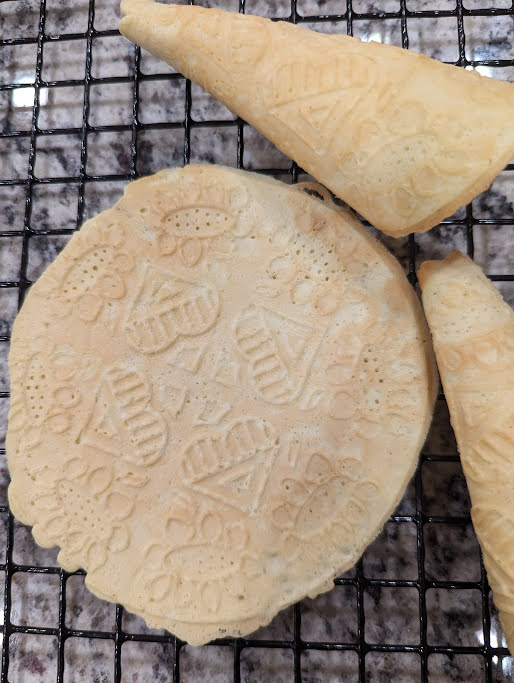
Krumkake or Skrullers? 52 Ancestors 2023 Prompt “Family Recipe”


My Favorite Norwegian Christmas Cookie


I grew up in an area of southern Minnesota that was settled by Norwegian immigrants. My ancestors were among those immigrants. Their descendants liked to celebrate their Norwegian heritage with food, especially at Christmas. They would dig out the old family recipes and would cook and bake wonderful Norwegian foods like sot suppe (sweet soup), rommegrot (cream porridge), rommebrod (cream bread), kringlar, lutefisk, rosettes, and of course lefse. My favorite among these treats was a thin, rolled cookie similar to Italian pizzelles. Most Norwegians call them krumkake (translates roughly as “curved cookie”), but many people in my small town called them skrulle or skrullers (translates to “scroll”).

So far I’ve been too lazy to learn how to make lefse, but twenty years ago, I bought a krumkake iron and learned how to make skrullers. I wanted my children to be exposed to at least one Norwegian treat—to celebrate that part of their heritage at Christmas. Skrullers or krumkake have become a staple in my annual Christmas cookie baking binge.

Krumkake tools: electrice Krumkake Iron, spatula and wooden dowel roller


So krumkake vs. skruller? It appears to be a regional difference—a certain area of Norway called them skrulle, probably because they resemble scrolls when they are rolled into a cone shape. I found a Norwegian webpage titled “Fant 16 synonym til krumkake”, which I believe means “16 synonyms for krumkake”. “Skrull” is number 3.

Batter on the krumkake iron

Here’s the recipe I use for my skrulle/skrullers/krumkake:

Ingredients:

4 eggs

1 ½ cups all-purpose flour

1 cup sugar

½ cup butter, melted

2 tblsp corn starch

1 tsp vanilla extract

½ tsp cardamom OR 1 tsp almond extract

Beat eggs and sugar—don’t overbeat. Add cooled, melted butter, vanilla, and cardamom and mix in. Sift flour and corn starch and add to egg mixture. Batter will have a dough-like consistency. Spoon batter onto the heated, greased krumkake iron. It is best to place batter a little toward the back of the iron as it will be squeezed forward when iron is closed. Press iron tightly closed and cook till krumkake are lightly browned.

Rolling the Krumkake

Use a spatula to lift off krumkake one at a time and wrap around wooden spindle and shape into a cone. Sprinkle finished krumkake with powdered sugar. Makes about 50 krumkake.

Ingredients and finished krumkake, ready to sprinkle with powdered sugar

The finished cookies are light and crispy with just the perfect amount of sweetness. Some people like to fill them with whipped cream, but I like them just as they are.


I think of my grandmother whenever I make these cookies—Regina Syverson Peterson died before I was born, but she taught her daughters to make lefse and krumkake, and I feel connected to that tradition when I make them. 

Grandma Regina, wedding photo

Happy holidays! Or as they say in Norway, God Jul!

Thursday, December 28, 2023

Back to Norway Through DNA Matches: 52 Ancestors 2023 Prompt “DNA”


Tracing a Connection to a Distant Cousin Leads to Norway Discoveries

Marit Johannesdatter Rolstad: 1731-1788 (Paternal Third Great-Grandmother)
Anne Ohlsdatter Bottom: 1700-? (Paternal Fourth Great-Grandmother)
Marit Arnesdatter: 1663-1718 (Paternal Fifth-Great-Grandmother)
JB: Paternal Sixth Cousin


Much of my research on the Norwegian side of my family tree ends one generation before the ancestor who immigrated to America. I feel confident that I can correctly identify the immigrants’ parents and siblings who remained in Norway. But I am nervous about moving back any additional generations. The old Norwegian surname system, where each generation had a different “surname” (which were a combination of patronymics and residence names), makes it hard for me to feel I am correctly identifying distant ancestors. I need to start learning about how to use the Bygdeboks, research records that trace the family ancestry of Norwegian farm families. They could help me add more generations with some confidence. But until then, I make the occasional discovery with the help of DNA matches. A recent match was especially serendipitous, extending my tree an additional three generations, back to a Norwegian ancestor born in 1663!

I originally was looking at a different potential fourth cousin when I ran across “JB”, the DNA match that helped me so much. I was trying to determine what part of the family line this other cousin came from, so pulled up our shared DNA matches on Ancestry DNA. JB was one of those shared matches. Ancestry had helpfully flagged JB as having a shared ancestor with me. I immediately pulled up the chart showing how we might be related. I was stunned to see the chart added three generations to my family tree: my great-grandmother Anne Gulbrandsdatter Peterson’s own grandmother, great-grandmother and great-great-grandmother (my 3rd, 4th and 5th great-grandmothers).


According to Ancestry’s DNA algorithm, JB and I shared my fifth-great-grandmother, Marit Arnesdatter, as a common ancestor. She was born in 1663! A tiny piece of her DNA travelled down through nearly four centuries of her descendants to me, to my son, and to our very distant cousin JB.

Lesja Bygdebok bind III pg 613

I am still in the process of verifying these new tree generations, but one of my distant relatives kindly posted on Ancestry copies of the Lesja, Norway Bygdebok that shows the family and descendants of Marit Arnesdatter’s daughter Anne Olsdatter Bottem, so it appears that I can verify at least two of these new generations on my tree. The research will continue!

Photo labelled in Norwegian as 'LagenLesjaBottem', and in English as 'Gudbrandsdalslågen river at Lesja, previously outflow of Lesja lake'. Note that both Gulbrands and Bottem were parts of my ancestors' surnames. Were they from this area of Lesja?

In one final note on the interesting little quirks of DNA: my son has a DNA link to JB, but my daughter does not. So the tiny DNA fragment I inherited from Marit Arnesdatter and passed down to my son didn’t get passed down to my daughter. Perhaps she has inherited a different fragment that will connect us to a new ancestor.

Sources:

Ancestry.com

Kjelland, Arnfinn. Bygdebok for Lesja Lesja kommune, 19872008.

https://commons.wikimedia.org/wiki/File:L%C3%A5genLesjaBottem.jpg

Wednesday, September 6, 2023

Mormon Pioneer Woman? 52 Ancestors 2023 Prompt “Random”


Down a Fascinating Rabbit Hole: Random Discovery of Mormon Pioneers in the Family Tree

Mary “Polly” Randall Pulsipher: 1789-1912 (First Cousin 5x Removed)
Harriet Pulsipher Pickett: 1811-1878 (Second Cousin 4x Removed)
Elizabeth “Betsey” Randall Pulsipher : 1787-1857 (First Cousin 5x Removed)

Sometimes I run across something that is very interesting but yet very random. It can set me off -- down the rabbit hole so to speak, hijacking my research plans for the day. That’s what happened when I started looking at the Randall-Pulsipher family. I got distracted by this distant offshoot of the family tree, but the entertainment value of my discoveries more than made up for the loss of my time.

My random journey began a few weeks ago with a message from FamilySearch informing me that I had a cousin who was a “pioneer”. I opened the message and discovered it referred to my first cousin 5x removed, Elizabeth “Betsey” Randall. She was the daughter of Deborah Rhoda Daniels, who was the sister of my 4th Great Grandmother Polly Daniels, and the granddaughter of my 5th Great-grandparents Samuel Daniels and Elizabeth Noble. I was excited, imagining Elizabeth in a wagon out on the prairie with Laura Ingalls Wilder or following the Oregon Trail. I quickly realized my mistake: when FamilySearch refers to “pioneers”, they mean Mormons who followed Brigham Young to Salt Lake City. I was surprised to find that I had a Mormon in the family tree, and as I researched further, I discovered that Elizabeth’s sister Mary “Polly” Randall was also a Mormon convert, and Polly’s daughter was as well.

Polly Randall Pulsipher

The Randall sisters grew up in Rockingham, Vermont with their five siblings. They married the Pulsipher brothers, also from Rockingham. Elizabeth married John Pulsipher March 2, 1809, and Polly married John’s younger brother Zerah Pulsipher on November 6, 1810.

The two couples were not Mormons when they married. Joseph Smith didn’t even found the Mormon faith until 1830. I was puzzled at how the Pulsiphers discovered Mormonism. A family history written by an LDS researcher offered one possible explanation, indicating that the Pulsiphers may have been distant cousins of Joseph Smith’s. Adah Mackleprang Wood wrote: “John Pulsipher, (the father of Zerah) was born July 8, Married in Rockingham, Elizabeth Dutton, who was born December 18, 1751, in Lunnenburg, Massachusetts. She was the daughter of Thomas Dutton and his first wife, Mary Hill. She was a descendant of the Thomas Dutton and his wife, Susanna, who settled in Reading, Massachusetts, and were the fourth great-grand parents of our “Beloved Prophet Joseph Smith”. (2)

However, I found Zerah Pulsipher’s memoir online, and it provides a better explanation. Apparently Zerah was an itinerant Baptist minister and farmer living in Onondaga, New York when he heard about Joseph Smith’s “golden tablet”. He wrote he heard of “an ancient record or Golden Bible in Manchester near Palmyra which remark struck me like a shock of electricity at the same time thought it might be something that would give light to my mind upon principles that I had been thinking of for years and many times I had remarked that if the pure church with its gifts and graces was not on the earth, if so I had not found it.”

 He went to hear a Mormon missionary, but was not completely convinced until he had a vision in his barn where a “light came over my head which caused me to look up. I thought I saw the angels with the Book of Mormon in their hands in the attitude of showing it to me and saying “this is the great revelation of the last days in which all things spoken of by the prophets must be fulfilled.” The vision was so open and plain that I began to rejoice exceedingly so that I walked the length of my barn crying “Glory Hal-la-lu-ya to the God and the Lamb forever.”

But when my mind became calm I called the church together, (Note: he was their minister) and informed them of what I had seen. I told them of my determination to join the Church of Latter Day Saints, which I did and a large body of my church went with me. I was ordained to the office of an elder and went to preaching with considerable success at home and abroad. I had the privilege of baptizing Wilford Woodruff on the 31st of December, 1833, at Richland, New York.” (4)

Zerah Pulsipher

By the time of his conversion, Zerah was a widower who had remarried. Polly had given birth to their only child, Harriet Pulsipher, on September 11, 1811. Polly died a little over a year later on November 26, 1812, possibly in childbirth with a second child.

Zerah mentioned inviting his brother John and sister-in-law Elizabeth to live with him and farm in his autobiography, noting first that “John also married, but had no children.” He later wrote: “In the year 1814 I hired a farm at Bellows falls on the Connecticut River and being alone gave my brother John the privilege to work it with me.” I suspect that Elizabeth provided care for young Harriet as part of this arrangement, which ended at some point before the 1820 census. Zerah next moved to Pennsylvania where he married Mary Brown, and then on to Onondaga.

Article in 1963 LDS paper about Zerah

John Pulsipher converted to Mormonism as well, probably brought into the faith by his brother. He and Elizabeth followed the Mormons to their new settlement in Kirtland, Ohio. They were still living in Rockingham at the time of the 1830 census, so moved later in that decade. Zerah had arrived in Kirtland in 1835, so John and Elizabeth either accompanied Zerah and his family or followed him a bit later.  John is mentioned in the 1838 Kirtland Elders Quorum Record as being proposed for ordination. (3)

John and Elizabeth never had children, and he died in September 3, 1840 at the age of 58. I have found no death record for him. I suspect he died in Kirtland, but John and Elizabeth may have chosen to follow Zerah Pulsipher and most of the Mormon faithful to their next settlement in Daviess County, Missouri around 1839, so he may have died there. The Mormons were living under harsh conditions, with little food and frequent illness, which makes John’s death all too understandable.

Zerah’s autobiography doesn’t mention his brother’s death, but may contain one final reference to Elizabeth. He reports that he sent his daughter Mariah and his “sister” to care for desperately ill Mormons in Nauvoo. Since his natural sisters had married in Vermont and were living with their husbands and families at that point, I suspect he was referring to his widowed sister-in-law, who he probably had taken into his household. He also had his mother living with him.

Zerah moved to Utah in the first big migration from Nauvoo. He was president of the First Seventy, a high position in the church, so was considered an early leader in the church. He entered into a plural marriage, having three wives and numerous children.

Elizabeth travelled west with a Mormon wagon train in 1853. She is listed among the pioneers in the Daniel A. Miller/John W. Cooley Company, who left Six Mile Grove in Iowa (a now non-existent place in Harrison County along the Iowa border with Nebraska) on June 8 and arrived in Salt Lake City on September 9, 1853. She was 66 years old—an amazing age to decide to travel over 950 miles in a jouncing wooden wagon for three months. She does not seem to have travelled with any Pulsipher family members, so I am not sure who took responsibility for her during the arduous journey. (5)

Record of Elizabeth's blessing by Pres. Wofford

She lived in Ward 15 in Salt Lake City until her death on June 3, 1857 at the age of 70. Janet Hassard reported on FamilySearch that “Elizabeth Randall Pulsipher was sealed as a sign of love and respect to President Wilford Woodruff before President Woodruff's teaching that children should be sealed to their own parents.” Zerah Pulsipher wrote that he had baptized President Woodruff, so there was probably a strong relationship between the two families.

As for young Harriet Pulsipher, Polly and Zerah’s daughter, she married Hiram Pickett of Onondaga, New York. They followed the Mormon faithful to Ohio, settling in Geauga County, and then moved to Nauvoo, Illinois. However, following the attack at Nauvoo that killed Joseph Smith, the couple did not follow the Mormons to Utah. Instead, they moved to Green County Wisconsin, settling in the town of Monroe where they raised their six or seven children.

Harriet Pulsipher Pickett

According to a county history, Hiram “was there at the time the trouble occurred with the Mormons at Nauvoo, previous to their removal to Salt Lake. In 1843 he removed from Illinois to Green Co., Wis. The following year he settle at Wiota, where he resided till the spring of 1867. He then moved to Monroe, where he died Dec. 12, 1872.”(1)

Hiram Pickett headstone

It does not appear that the Picketts continued with the Mormon faith—perhaps the Nauvoo violence led them to rethink. Harriet died October 2, 1878 at the age of 67. At least five of her children survived to adulthood and had families of their own. Sons Nelson and Daniel and their families appear on the 1860 census for Wiota Wisconsin, just before the entry for Harriet and Hiram.

I was fascinated by what I discovered in my research about the early days of Mormonism. Digging through the Kirtland Elders Quorum Records was a delight—people getting censured for flirting or expressing doubts about the latest revelation from Joseph Smith. Zerah Pulipher’s autobiography was even more enticing—his “visions” were quite amazing, and his life experiences were quite harrowing. While I fell down a very twisty rabbit hole, this random bit of research was very entertaining.


Sources:

1.      The History of Green County Wisconsin. Hiram Pickett 1809-1872. Springfield, Ill.; Union Publishing Company 1884. Page 755.

2.      THE EARLY PULSIPHER FAMILY HISTORY.  Research and Arranging by Adah Mackleprang Wood. https://www.ancestry.com/family-tree/person/tree/46986934/person/322508961954/hints

3.      Kirtland Elders Quorum Record, 1836-1841. July 15 and July 22, 1838 Records. https://josephsmithfoundation.org/kirtland-elders-quorum-record-1836-1841/

4.      AUTOBIOGRAPHY OF ZERAH PULSIPHER (C. 1803-1862), History of Zera Pulsipher as Written by Himself. https://doctrineandcovenantscentral.org/history/zerah-pulsipher/

5.      Miller/Cooley Wagon Train member list:  https://history.churchofjesuschrist.org/chd/list?filterOrganizationUri=%2Forganization%2Fpioneer-company%2Fdaniel-a-millerjohn-w-cooley-company-1853&subtype=pioneer-activity

6.      Photo of Zerah Pulsipher from FamilySearch, posted by mikellnelson1. https://www.familysearch.org/photos/artifacts/124681436?p=47699639&returnLabel=Zera%20Pulsipher%20(K2HH-5XK)&returnUrl=https%3A%2F%2Fwww.familysearch.org%2Ftree%2Fperson%2Fmemories%2FK2HH-5XK